Lyophilized Peptide Shipping Conditions: Stability and Handling
However, lyophilized peptide shipping conditions matter because dry, freeze-dried materials respond differently from peptide solutions. Therefore, researchers should evaluate temperature together with moisture, seal integrity, exposure time, packaging, and storage after delivery.
Research Use Only • Educational Resource1 Understanding Lyophilized Peptide Shipping Conditions
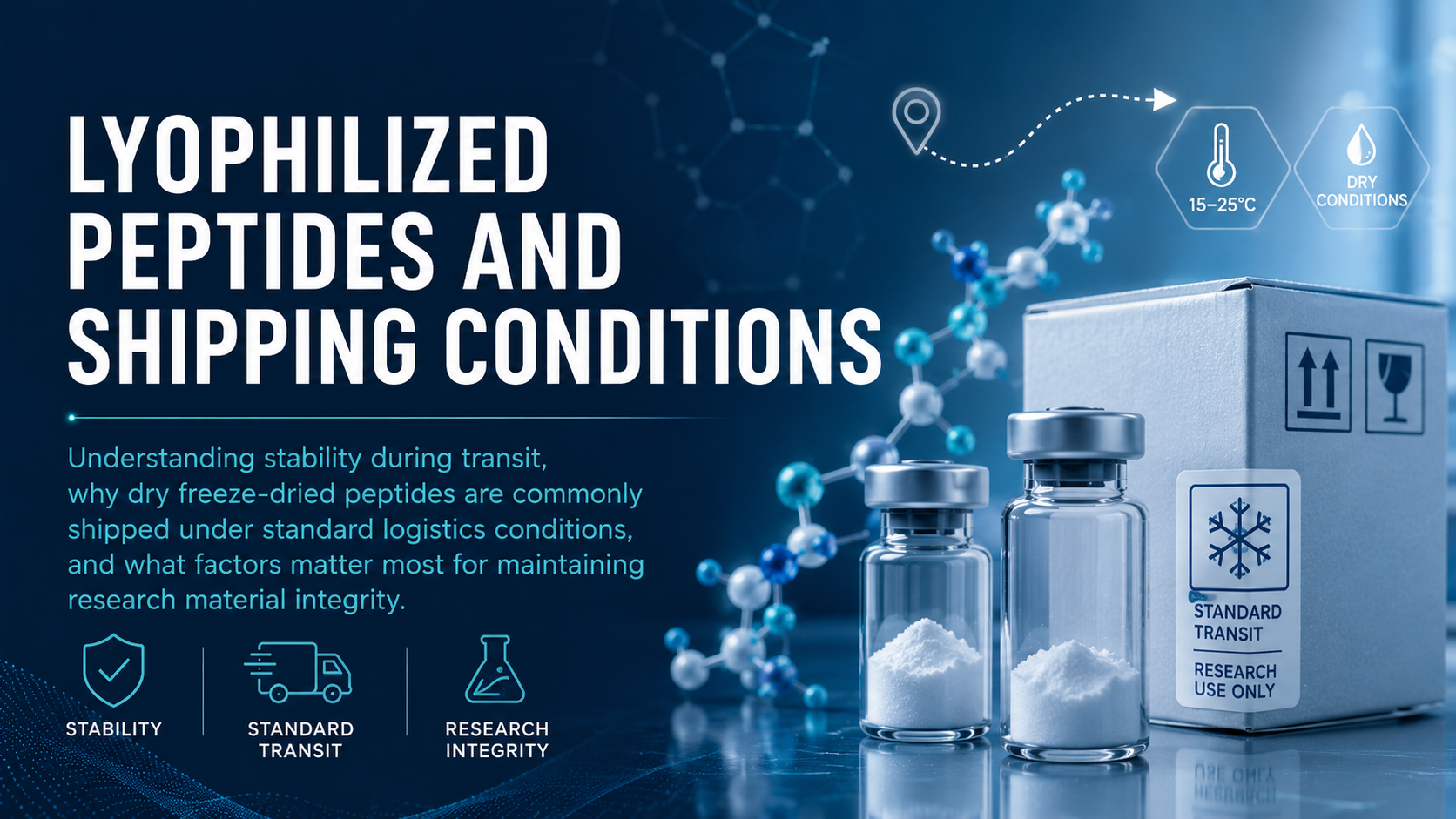
Therefore, lyophilized peptide shipping conditions often raise questions because temperature receives most of the attention. However, dry peptides usually tolerate short transit better than peptide solutions because freeze-drying removes most of the water that supports many degradation pathways.
In addition, online discussions often treat every peptide, package, and exposure event as identical. By contrast, actual stability depends on the specific compound, formulation, residual moisture, packaging, duration, and storage history.
2 What Lyophilization Means
In addition, lyophilization freezes a preparation and removes water through sublimation under reduced pressure. As a result, the process creates a dry cake or powder that can offer better storage and transport stability than the same peptide in solution.
3 Scientific and Industry Perspectives on Stability
Short-Term Stability in Dry Form
For example, published handling guidance commonly notes that many lyophilized peptides can tolerate limited ambient exposure when they remain dry and sealed. For example, research suppliers often use standard logistics for short transit, although each compound may have different limits.
Dry Peptide Versus Peptide Solution
As a result, peptides in solution generally face more hydrolysis, oxidation, aggregation, and contamination risk than dry powders. Therefore, reconstituted materials usually require tighter control of temperature, time, light, and handling.
Why Temperature Is Only One Variable
Meanwhile, temperature does not act alone. Moreover, the outcome also depends on the peptide sequence, formulation, moisture, oxygen, light, package integrity, exposure duration, and any temperature cycling.
4 Key Factors That Affect Lyophilized Peptide Stability
Moisture and Humidity
First, moisture can increase molecular mobility and speed hydrolysis, aggregation, or other reactions. Therefore, a dry environment and intact container closure remain central to stability.
Light and Oxygen
Next, some peptides or excipients can respond to light or oxygen over time. Meanwhile, opaque packaging, limited exposure, and suitable headspace conditions can reduce these risks.
Handling and Packaging
Finally, repeated opening, damaged seals, rough handling, or uncontrolled storage can undermine stability even when the shipping temperature seemed acceptable.
5 Professional Handling Practices
By contrast, researchers often receive lyophilized peptides through standard logistics networks. However, responsible handling still requires dry storage, intact labels, controlled exposure, and compound-specific documentation.
- Keep the vial sealed and dry before laboratory preparation.
- Avoid unnecessary humidity and condensation.
- Limit prolonged light exposure when the material is light-sensitive.
- Preserve the lot number, label, and supporting records.
- Follow a documented laboratory handling procedure.
- Review the supplier's compound-specific storage information.
- Move the material to suitable storage promptly after receipt.
- Use validated evidence rather than online speculation.
6 Shipping Conditions and Initial Receipt
Standard transit can last several days. Therefore, a stability review should consider the full shipment history, including time, temperature, packaging, moisture protection, and physical damage.
Minor warmth during ordinary shipping does not automatically prove degradation when a peptide remains dry, sealed, and properly manufactured. However, unusual heat, prolonged delays, condensation, or closure damage may justify closer evaluation.
7 Long-Term Storage Considerations
For extended storage, laboratories usually use controlled temperatures and follow compound-specific documentation. In addition, they should minimize moisture, light, repeated temperature cycling, and unnecessary handling.
8 Common Shipping and Stability Misconceptions
“A warm package means the peptide is ruined.”
“Every lyophilized peptide requires a cold pack.”
9 Important Research-Use Notice
This article covers general analytical and stability concepts for research materials. It does not provide medical advice, dosing instructions, reconstitution directions, or assurance that any material is safe for human or veterinary use.
10 Authoritative References and Further Reading
The following sources discuss peptide handling, freeze-drying, storage, and stability. However, researchers should still review original documents and compound-specific data before setting storage or shipping requirements.
Regulatory and manufacturing materials explain why freeze-drying can improve stability while emphasizing formulation, process control, and container integrity.
ICH stability guidance describes how temperature, humidity, light, and time support stability study design.
USP standards address storage terminology, packaging, and environmental protection for regulated materials.
Peer-reviewed studies explain freeze-drying, residual moisture, formulation effects, cake structure, and degradation pathways.
Supplier guidance distinguishes lyophilized peptides from more sensitive peptide solutions.
Handling guidance discusses dry storage, moisture control, and short-term transit considerations.
EMA materials connect stability evidence with shelf life, storage conditions, packaging, and product quality.
11 Frequently Asked Questions
Does a warm package prove a lyophilized peptide degraded?
No. Package warmth alone does not establish the internal vial temperature or chemical condition. However, prolonged heat, moisture, damaged seals, and compound-specific sensitivity can increase risk.
Why are peptide solutions usually less stable?
Water enables hydrolysis and greater molecular mobility. As a result, dissolved peptides may face faster degradation, aggregation, and contamination than dry materials.
Do all lyophilized peptides have the same shipping tolerance?
No. Sequence, formulation, excipients, moisture, container closure, and exposure duration all matter. Therefore, one compound's shipping data should not be applied automatically to another.
What should researchers inspect after delivery?
First, they should check the container, seal, label, lot number, visible damage, and evidence of moisture. Next, they should compare the shipment with the supplier's documented handling requirements.
Final Takeaway on Lyophilized Peptide Shipping Conditions
Lyophilized peptide shipping conditions should be judged through evidence, not package temperature alone. Because freeze-drying removes most water, many dry peptides tolerate short transit better than peptide solutions.
Therefore, the most important factors include compound-specific stability, exposure time, moisture, seal integrity, formulation, packaging, and storage after receipt.
Finally, researchers should rely on batch documentation, validated stability data, and qualified laboratory procedures rather than assuming that every warm package is damaged or every cold shipment is protected.