
*{box-sizing:border-box} body{margin:0;background:#f4f7fb;color:#172033;font-family:Arial,Helvetica,sans-serif;line-height:1.72} a
Neuropeptide Research Overview
Adalank and Adamax: What Researchers Actually Know
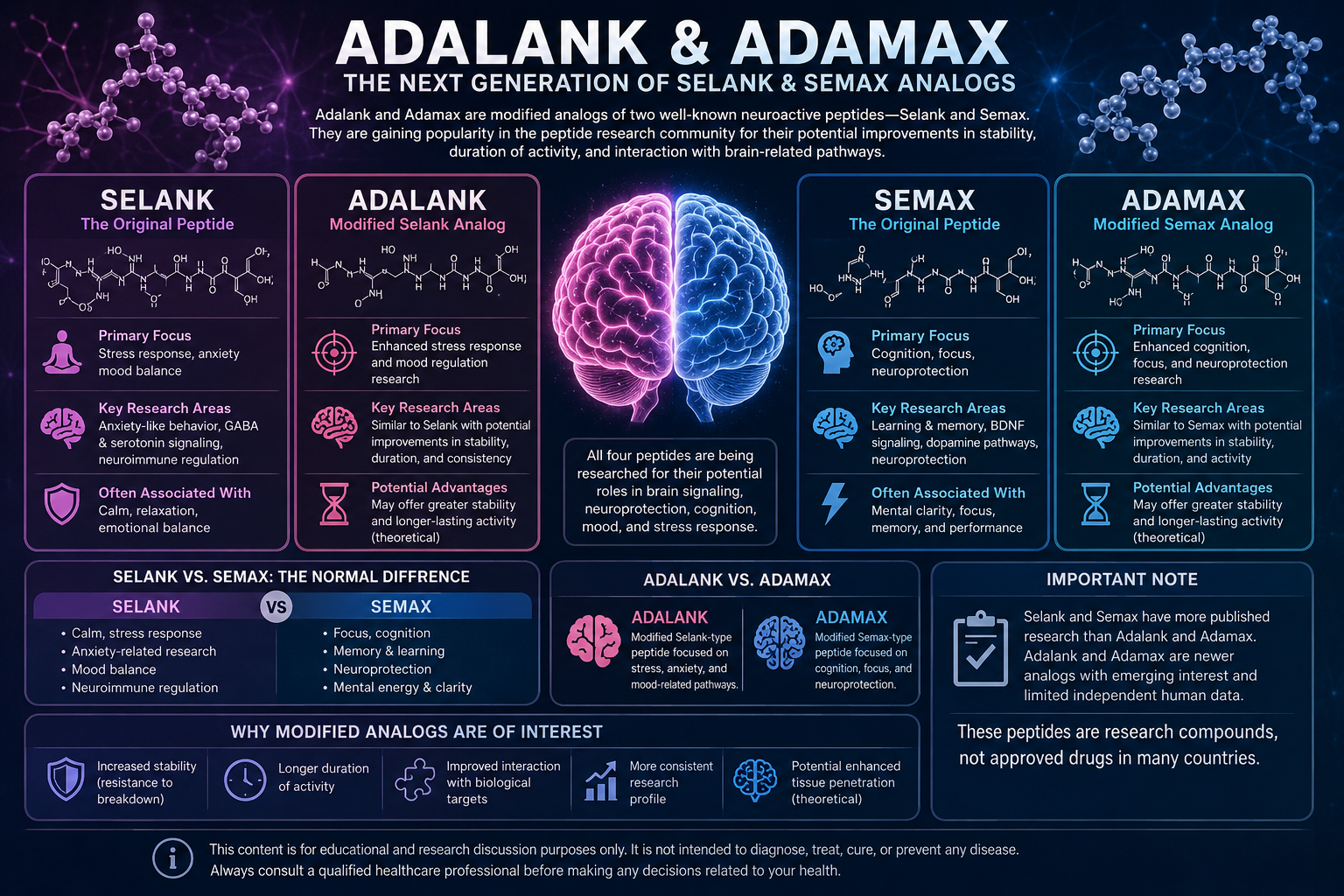
Adalank and Adamax are marketed as modified relatives of Selank and Semax. However, published evidence for the newer names remains extremely limited. Therefore, researchers should separate established findings on Selank and Semax from unverified claims about their commercial analogs.
Why Adalank and Adamax Are Gaining Attention
Interest in neuroactive peptides has expanded across academic, commercial, and private research settings. For example, researchers continue to study signaling pathways related to stress, learning, memory, neurotrophins, and neural resilience.
Meanwhile, Selank and Semax already have recognizable research histories. Therefore, products described as “next-generation” versions naturally attract attention. Commercial descriptions often suggest improved stability, longer activity, or stronger tissue interaction, but those claims usually rely on theory rather than direct comparative evidence.
Importantly, structural modification can change a peptide’s behavior. However, a modification may also alter receptor interaction, distribution, degradation, toxicity, or assay performance. Consequently, researchers cannot assume that a modified analog preserves the parent compound’s effects.
What Is Selank?
Selank is a synthetic heptapeptide with the sequence Thr-Lys-Pro-Arg-Pro-Gly-Pro. Researchers describe it as a tuftsin-derived analog and have studied it in relation to anxiety, stress-related behavior, enkephalin metabolism, immune signaling, and GABA-related mechanisms.
For example, published studies have examined Selank in patients with anxiety disorders and in animal models. In addition, mechanistic work has reported effects on enkephalin-degrading enzymes and GABA-receptor binding. Nevertheless, much of the literature comes from Russian research groups, and broad international replication remains limited.
Research Areas
Stress-related behavior, anxiety models, GABA signaling, enkephalin metabolism, and neuroimmune pathways.
Evidence Strength
More published evidence than Adalank, although the literature base remains narrower than that of widely approved medicines.
What Is Semax?
Semax is the synthetic heptapeptide Met-Glu-His-Phe-Pro-Gly-Pro and an analog of the ACTH(4-10) fragment. Researchers have studied it in relation to learning, memory, neuroprotection, dopamine signaling, and neurotrophin pathways.
For instance, animal studies have reported changes in BDNF, NGF, and TrkB-related signaling after Semax exposure. Some clinical reports have also examined Semax in neurological settings. However, those findings do not establish that a separately marketed Adamax product has the same structure, activity, or clinical profile.
Research Areas
Learning, memory, attention, neuroprotection, BDNF signaling, NGF signaling, and neurological recovery models.
Evidence Strength
More published mechanistic and clinical literature than Adamax, although evidence quality and international replication vary.
What Is Adalank?
Adalank is commonly marketed as a modified Selank analog. However, public scientific sources do not provide a stable, universally accepted definition of its sequence, formula, molecular mass, or terminal chemistry.
Therefore, researchers should not treat “Adalank” as a complete chemical identity. Instead, they should request an explicit sequence, structural drawing, molecular formula, theoretical mass, counterion information, and batch-specific analytical data.
Moreover, marketers often connect Adalank with Selank-related themes such as stress response, mood pathways, or peptide stability. Those associations remain hypotheses until direct studies test the exact Adalank structure under controlled conditions.
What Is Adamax?
Adamax is commonly marketed as a modified Semax analog. Yet public listings have used conflicting formulas, masses, and sequence descriptions for products carrying that name.
For example, some marketplace materials describe a lower-mass peptide extension, while others describe an adamantane-containing terminal modification. Therefore, the name alone cannot establish which molecule a vial contains.
In addition, Semax findings cannot automatically transfer to Adamax. A modified terminal group may change lipophilicity, protease resistance, distribution, or biological activity, but researchers need direct analytical and experimental evidence to confirm those effects.
Adalank and Adamax Compared With Their Parent Peptides
| Compound name | Common market description | Published evidence | Main caution |
|---|---|---|---|
| Selank | First, a tuftsin-derived regulatory heptapeptide | Therefore, the evidence includes animal, mechanistic, and limited clinical literature | Evidence remains concentrated in a relatively narrow research base. |
| Adalank | Next, a marketed modified Selank analog | However, no directly indexed peer-reviewed characterization was located | Therefore, the name does not define one verified structure. |
| Semax | Meanwhile, an ACTH(4-10)-derived synthetic heptapeptide | Likewise, the evidence includes animal, mechanistic, and some clinical literature | Importantly, findings do not automatically apply to modified analogs. |
| Adamax | Finally, a marketed modified Semax analog | However, no directly indexed peer-reviewed characterization was located | Consequently, conflicting marketplace formulas and structures create identity risk. |
Why Modified Analogs Can Behave Differently
Small structural changes can substantially alter peptide behavior. For example, a terminal modification may change enzyme susceptibility, solubility, aggregation, membrane interaction, or analytical ionization.
Likewise, a modification can affect receptor binding or off-target activity. Therefore, a longer half-life does not automatically mean better performance, and greater lipophilicity does not automatically mean better brain delivery.
- First, confirm the exact amino-acid sequence and terminal groups.
- Next, verify the molecular formula and theoretical masses.
- Also, examine intact high-resolution mass data.
- Moreover, review tandem mass-spectrometry evidence for sequence and modification location.
- In addition, compare chromatographic purity with a qualified reference when available.
- Finally, avoid transferring biological claims from the parent peptide without direct testing.
Adalank Versus Selank
Selank has a defined heptapeptide sequence and a published research record. By contrast, Adalank lacks a well-established public identity standard and direct peer-reviewed characterization.
Therefore, the most defensible distinction concerns evidence rather than promised performance. Selank has documented studies; Adalank mainly has commercial descriptions and theoretical comparisons.
Adamax Versus Semax
Semax has a defined sequence and multiple published studies involving neurotrophin-related pathways. Meanwhile, Adamax lacks one universally accepted public structure and direct comparative research.
Consequently, researchers should not describe Adamax as a proven stronger or longer-lasting Semax. Instead, they should identify the exact molecule and test its stability, activity, and distribution directly.
Adalank Versus Adamax
Adalank and Adamax are not interchangeable names. Commercially, Adalank relates to Selank, while Adamax relates to Semax.
However, that relationship does not prove chemical identity or biological equivalence. Therefore, every research plan should start with the exact structure rather than the trade name.
Key Evidence Limitations
First, No Canonical Public Standard
Neither name consistently points to one universally documented sequence, formula, and structure.
Next, No Direct Comparative Trials
No published trials located directly compare Adalank with Selank or Adamax with Semax.
Also, Parent-Peptide Extrapolation
Many claims infer effects from Selank or Semax rather than testing the exact modified analog.
Finally, Marketplace Inconsistency
Supplier pages may disagree about formulas, masses, terminal groups, and expected activity.
What a Defensible Research Record Should Include
- First, an unambiguous structural drawing and sequence notation.
- Next, a molecular formula, average mass, and monoisotopic mass that agree.
- Then, annotated LC-MS data with charge states, adducts, calculated ions, and mass error.
- Also, tandem mass-spectrometry evidence for sequence and modification placement.
- Moreover, a complete HPLC or UPLC method with chromatograms and integration rules.
- In addition, stability data under the exact storage and assay conditions.
- Finally, direct biological testing of the exact batch rather than assumptions based on the parent peptide.
Adalank and Adamax: Final Takeaway
Adalank and Adamax attract attention because sellers connect them with the better-known peptides Selank and Semax. However, the newer names have far less public scientific support and lack stable, universally accepted identity standards.
Finally, researchers should treat Selank and Semax as the compounds with the stronger published foundation. For Adalank and Adamax, the safest scientific approach begins with structure verification, batch-specific analytical data, and direct testing of every claimed property.
Authoritative References
- First, review molecular research on Selank activity
- Next, review a clinical study of Selank in anxiety disorders
- Also, examine Selank and enkephalin-degrading enzymes
- In addition, review Semax binding and BDNF findings
- Moreover, examine Semax regulation of BDNF and TrkB
- Finally, review Semax effects on BDNF and NGF expression