
*{box-sizing:border-box} body{margin:0;background:#f4f7fb;color:#172033;font-family:Arial,Helvetica,sans-serif;line-height:1.72} a
Peptide Quality-Control Education
7X and 8X Peptide Testing: What Real Quality Control Means
7X and 8X peptide testing describe supplier-defined testing programs that combine several analytical and contamination checks. However, the labels are not official FDA, USP, or ICH standards. Researchers must therefore examine the actual methods, sample counts, acceptance criteria, laboratory credentials, and batch records behind each claim.
Why “Lab Tested” Does Not Explain Enough
Peptide sellers often use phrases such as “lab tested,” “third-party verified,” “COA included,” or “pharmaceutical grade.” However, those phrases do not reveal which tests the laboratory performed, how many vials it examined, or whether the report matches the current batch.
For example, a laboratory may confirm molecular identity without evaluating sterility. Likewise, a chromatographic purity result may look strong even when the vial contains less material than the label claims. Therefore, researchers should review each quality question separately.
- First, identify every analytical method listed on the report.
- Next, confirm that the lot number matches the product vial.
- Also, check the test date and laboratory identity.
- Moreover, review the sample size and sampling plan.
- Finally, examine the numerical results and acceptance limits.
What Is 7X and 8X Peptide Testing?
How the Supplier-Defined Framework Works
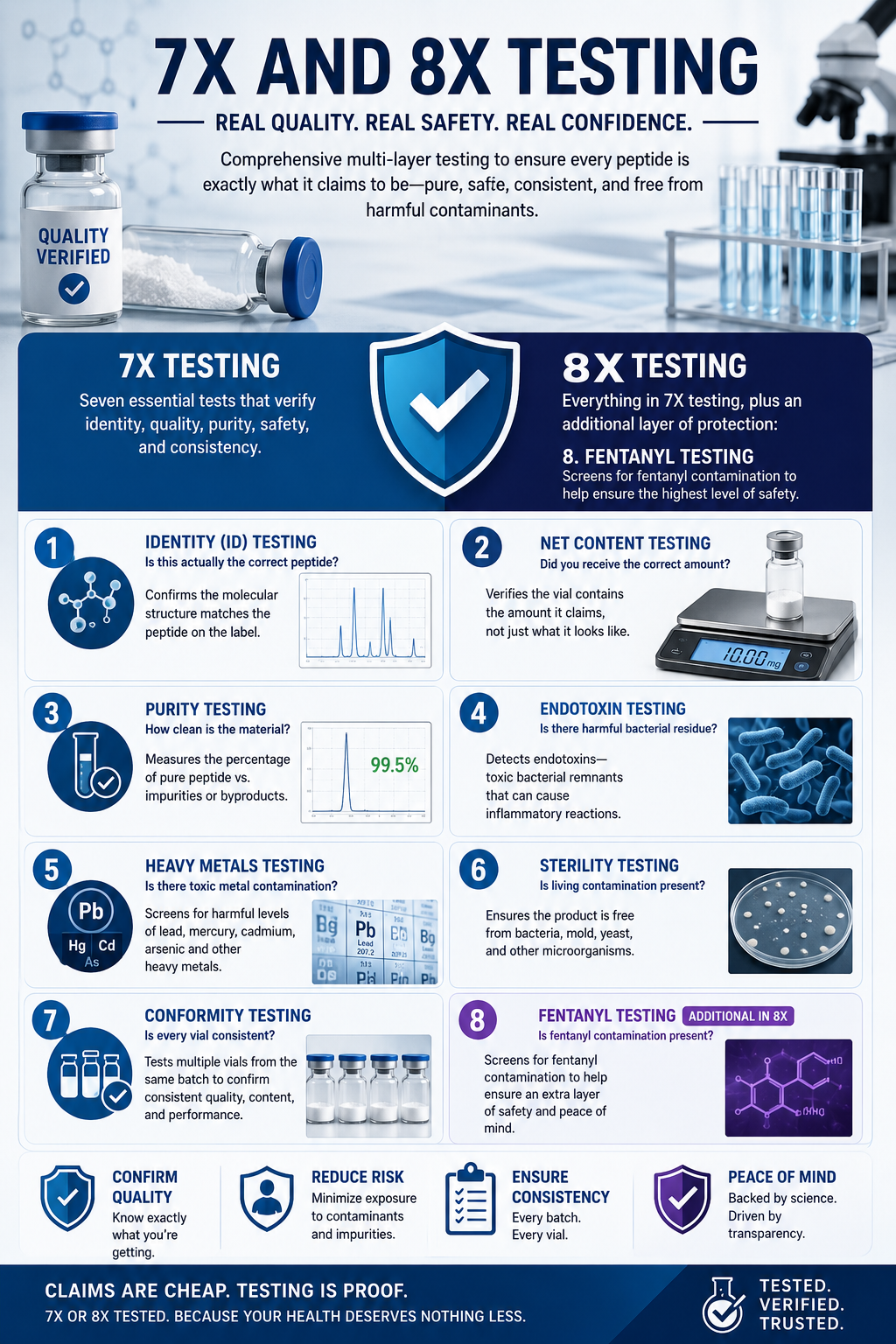
In this article, 7X testing refers to seven categories: identity, net content, purity, bacterial endotoxins, elemental impurities, sterility, and vial-to-vial conformity. Meanwhile, 8X testing includes those seven categories plus fentanyl screening.
Importantly, the number does not show the depth or quality of each method. A complete report should explain the instrument, preparation, controls, detection limit, acceptance criteria, sample count, and result. Therefore, a supplier should not treat a simple “pass” statement as a substitute for supporting data.
Eight Testing Categories Compared
| Category | Main question | Typical evidence | Important limitation |
|---|---|---|---|
| Identity | First, ask whether the target compound is present. | For example, mass spectrometry, LC–MS, or another structure-supporting method | However, intact mass alone may not prove sequence, linkage, or stereochemistry. |
| Net content | Next, ask how much target material the vial contains. | Next, use a validated quantitative assay with a reference standard or calibrated response | Likewise, gross vial weight does not equal peptide content. |
| Purity | Then, ask how dominant the target-related peak is. | Meanwhile, review an HPLC or UPLC chromatogram with integration details | Moreover, area percentage does not prove identity or net content. |
| Endotoxins | Also, ask whether bacterial endotoxin exceeds a stated limit. | In addition, use a USP-compatible bacterial endotoxins test | Importantly, sterility and endotoxin status answer different questions. |
| Elemental impurities | Moreover, ask whether relevant toxic elements remain below stated limits. | Likewise, use ICP–MS or another validated elemental analysis | However, a limited panel does not cover every possible contaminant. |
| Sterility | In addition, ask whether the tested sample shows microbial growth. | Moreover, use a compendial or validated sterility test | Therefore, a sample result does not replace manufacturing controls. |
| Conformity | Likewise, ask how consistently multiple vials perform across the batch. | Therefore, review individual-vial content results and a defined sampling plan | Consequently, one vial cannot characterize vial-to-vial variability. |
| Fentanyl screen | Finally, ask whether the method detected fentanyl above its reporting threshold. | For instance, use targeted LC–MS/MS or another validated toxicology method | However, a screen covers only the analytes and limits listed. |
The Seven Core Testing Categories
Identity Testing
First, identity testing asks whether the sample contains the expected compound. Mass spectrometry can support a molecular-mass assignment, while tandem mass spectrometry may provide stronger sequence or modification evidence.
However, identity requires a coherent match among the proposed structure, formula, theoretical mass, observed ions, and analytical interpretation. A product name or chromatographic retention time alone offers weak evidence.
Net Content Testing
Next, net content testing estimates the amount of target material in each vial. This measurement matters because lyophilized cakes can look similar even when their actual content differs.
Therefore, researchers should look for a quantitative assay rather than a visual estimate or gross powder weight. Water, counterions, excipients, and residual solvents can contribute to total mass without increasing target-peptide content.
Purity Testing
Purity testing commonly uses HPLC or UPLC to separate the main component from detectable related substances. For example, the report may show the main peak’s relative area under a defined method.
By contrast, purity percentage does not show how many milligrams the vial contains. It also does not automatically identify the main peak or detect every impurity.
Bacterial Endotoxins Testing
Endotoxins come from the outer membrane of certain Gram-negative bacteria. Importantly, these materials can remain after bacterial cells die, so sterility testing and endotoxin testing address separate hazards.
Therefore, a useful report should state the method, sample preparation, interference controls, reporting units, detection limit, and acceptance limit. USP chapters <85> and <86> describe recognized bacterial endotoxins test approaches.
Elemental Impurity Testing
Elemental analysis can screen for substances such as lead, cadmium, arsenic, and mercury. These elements may enter a process through raw materials, equipment, reagents, or environmental exposure.
However, laboratories should choose analytes and limits through a documented risk assessment. FDA guidance implements ICH Q3D principles for controlling elemental impurities in drug products.
Sterility Testing
Sterility testing looks for viable microbial contamination under specified incubation and culture conditions. Meanwhile, USP <71> provides a recognized compendial sterility-test framework.
Nevertheless, final-product testing examines only the units selected for testing. As a result, strong manufacturing controls, environmental monitoring, aseptic processing, and container-closure integrity remain essential.
Vial-to-Vial Conformity Testing
Conformity testing compares multiple vials from the same lot. For instance, a plan may sample units from the beginning, middle, and end of a filling run to look for content variability.
Moreover, individual-vial results reveal variation that a pooled or composite sample can hide. Researchers should therefore request the number of vials, sampling locations, individual results, average, range, and variability statistics.
What 8X Testing Adds
Targeted Fentanyl Screening
8X programs typically add a targeted fentanyl screen to the seven categories above. The screen aims to identify fentanyl at or above the method’s reporting threshold.
However, the result should not imply that fentanyl contamination commonly occurs in legitimate peptide manufacturing. Instead, the test represents a supplier-selected precaution for a specific analyte.
In addition, a credible report should identify the analytical method, target analyte, detection limit, reporting threshold, controls, and result. A generic test-strip photograph provides much less information than a validated laboratory method.
Why One Vial Cannot Represent an Entire Batch
A single vial can show what the laboratory found in that unit. However, it cannot establish that every vial in the lot contains the same amount or shares the same condition.
Therefore, broader sampling increases the opportunity to detect fill variation or isolated problems. Ten individually tested vials can provide a wider view than one vial, although the ideal sample size still depends on batch size, process controls, risk, and the statistical question.
For example, individual-vial testing can report the mean, minimum, maximum, standard deviation, and coefficient of variation. By contrast, combining several vials into one composite result may obscure an underfilled or overfilled unit.
Common Misunderstandings About Multi-Layer Testing
“A 99% Purity Result Proves Quality”
No. Instead, purity addresses one part of the quality picture. Researchers still need identity, content, contamination, and batch-consistency information.
“A COA Means Every Test Passed”
No. A certificate only documents the tests and results that appear on it. Therefore, review the methods and numerical data rather than the document title.
“Sterile Means Endotoxin-Free”
No. Sterility testing looks for viable microorganisms, while bacterial endotoxins testing detects specific bacterial components. Consequently, one result does not replace the other.
“One Tested Vial Represents the Lot”
No. One vial supplies one data point. Moreover, it cannot quantify vial-to-vial variability across the full production batch.
How to Evaluate a 7X or 8X Testing Claim
- First, request the complete batch-specific reports rather than a marketing badge.
- Next, verify laboratory name, accreditation scope, report date, and sample identifiers.
- Then, confirm that identity, content, and purity use methods suitable for the claimed compound.
- Also, review sterility and endotoxin reports as separate tests.
- Moreover, check which elemental impurities the laboratory measured and which limits it applied.
- In addition, examine how many vials supported the conformity claim.
- Finally, compare every report’s lot number with the vial and product page.
7X Versus 8X Testing at a Glance
| Program label | Included categories in this framework | Best interpretation |
|---|---|---|
| 7X testing | Identity, net content, purity, endotoxins, elemental impurities, sterility, and vial-to-vial conformity | Therefore, treat it as a supplier-defined seven-category package that requires review of each underlying report |
| 8X testing | Everything in the 7X package, plus targeted fentanyl screening | Likewise, treat it as a supplier-defined eight-category package with one additional targeted contaminant screen |
7X and 8X Peptide Testing: Final Takeaway
7X and 8X peptide testing can organize a broad quality-control program, but the numbers alone do not prove quality. Instead, researchers should verify the exact methods, limits, laboratory credentials, sample counts, batch match, and numerical findings.
Finally, strong quality review considers identity, quantity, purity, microbial risks, elemental impurities, vial-to-vial consistency, and any targeted contaminant screens together. Claims are easy to print; complete, batch-specific evidence provides the meaningful proof.
Authoritative References
- FDA: Chemistry, Manufacturing, and Control Information for Investigational Drugs
- FDA/ICH Q6A: Specifications, Test Procedures, and Acceptance Criteria
- USP: Microbiological Quality-Control Testing
- USP <85>: Bacterial Endotoxins Test
- FDA: Elemental Impurities in Drug Products
- FDA: Current Good Manufacturing Practice and Pharmaceutical Quality