
article{max-width:1180px;margin:0 auto;padding:42px 24px 80px} :root{ --bg:#0a0a0a; --panel:#121212; --panel-2:#18
How to Evaluate Peptide Suppliers Before You Buy
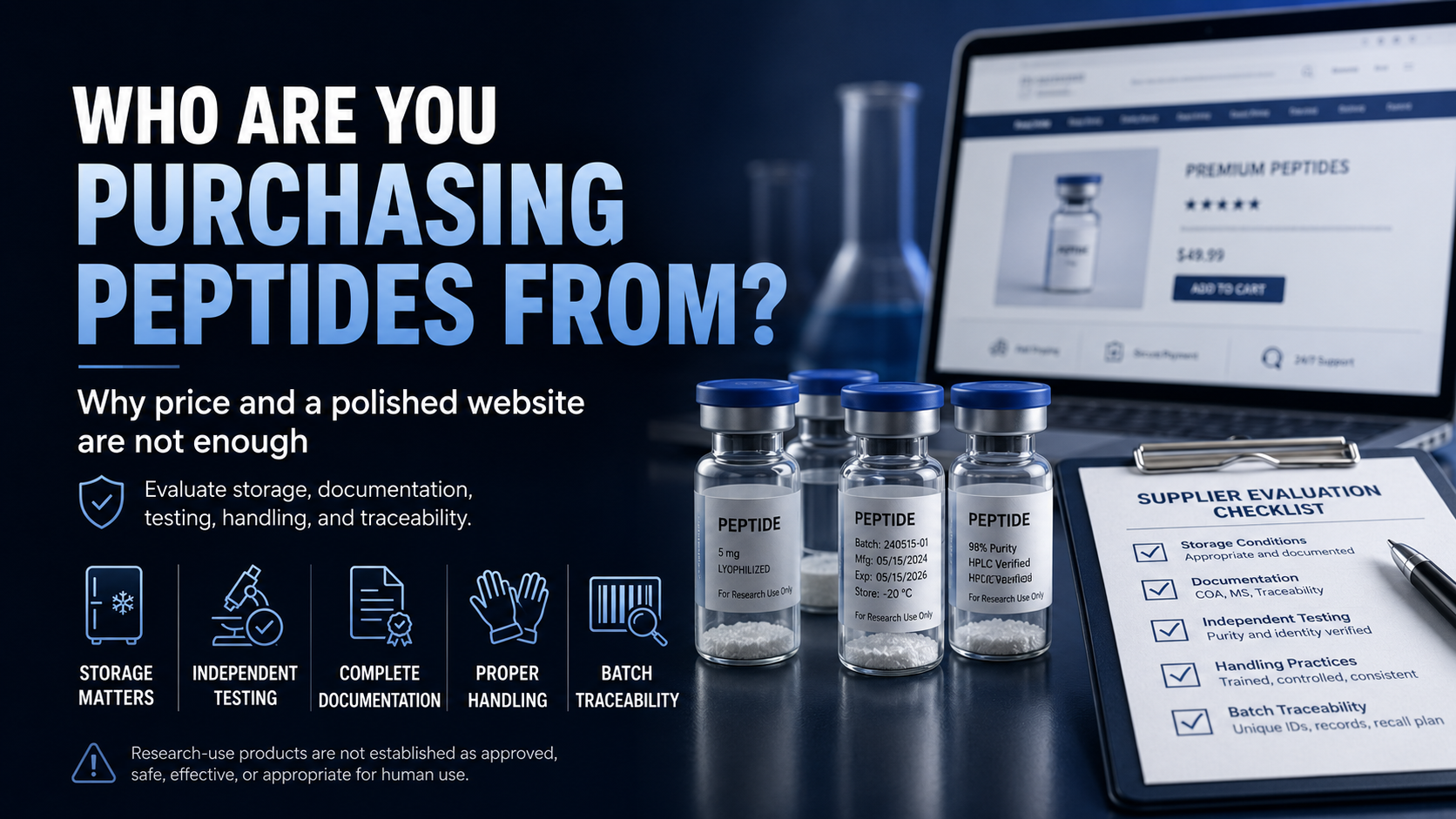
However, learning how to evaluate peptide suppliers means looking beyond website design, social-media popularity, and low prices. Therefore, a stronger review examines testing, storage, batch traceability, documentation, policies, and the business practices behind the product. The source matters.
A Website Is Not Proof of Quality
In addition, launching an online storefront is easier than building a reliable quality system. For example, a domain, product photos, and checkout page can appear polished even when a company lacks controlled storage, traceable batches, documented procedures, or independent testing.
Therefore, buyers should not judge a supplier only by price, branding, follower count, or claims such as “high purity.” Those details may support a professional presentation, but they do not replace verifiable evidence.
Warning Signs Buyers Should Take Seriously
! Unprofessional Business Practices
For example, poor communication, evasive answers, inconsistent policies, anonymous ownership, and careless complaint handling may point to deeper operational problems. As a result, buyers should treat repeated patterns as meaningful warning signs.
! Questionable Storage Conditions
As a result, products kept in garages, vehicles, hot rooms, unsecured cabinets, or poorly controlled spaces may face heat, moisture, contamination, or mishandling. In addition, a supplier should be able to explain its storage controls in clear terms.
! Reused or Unverifiable COAs
Moreover, a certificate of analysis should connect to a specific product and batch. Meanwhile, generic reports, altered documents, recycled certificates, or reports that the laboratory cannot verify should lower confidence.
! Prices That Do Not Make Sense
Low prices are not automatically suspicious. However, extremely cheap products may leave little room for legitimate testing, controlled handling, secure packaging, support, and quality oversight.
What a More Trustworthy Supplier Should Provide
✓ Appropriate Storage and Handling
By contrast, the company should explain how it receives, stores, monitors, packages, and ships inventory. For instance, buyers can ask about temperature control, documentation, security, and backup plans during power outages.
✓ Independent Testing
Likewise, testing should come from a qualified third-party laboratory and should match the batch being sold. Moreover, reports should show methods, dates, identifiers, and clear results.
✓ Product Traceability
Finally, batch or lot numbers should connect the product label to the correct analytical records. Likewise, the website, vial label, and COA should use consistent names and strengths.
✓ Transparent Policies
However, shipping, returns, claims, storage, testing, and support policies should be available before purchase. Therefore, buyers can compare how different companies handle common problems.
✓ Professional Standards
Therefore, a legitimate supplier should use consistent business information, clear contact methods, secure checkout, and documented procedures. In addition, in many cases, strong day-to-day operations reflect a broader commitment to quality.
✓ Honest Product Claims
For example, responsible sellers avoid presenting unapproved research compounds as guaranteed treatments or substitutes for licensed medical care. Instead, they use accurate research-use language and avoid overstating what a test result proves.
How to Review a Certificate of Analysis
As a result, a certificate of analysis, or COA, can provide useful evidence when it is authentic, batch-specific, and relevant to the product in hand. Therefore, buyers should review more than the headline purity percentage and examine how the laboratory produced the data.
- Confirm the laboratory. Look for the lab name, contact information, report number, and test date. Also, consider whether the laboratory appears independent of the seller.
- Match the batch. The lot on the report should match the product being sold, including strength and salt form when applicable.
- Review the method. The report should identify methods such as HPLC, UPLC, or mass spectrometry so buyers can understand what each result addresses.
- Check what was tested. Purity, identity, net content, sterility, endotoxin, residual solvents, and elemental impurities require different analyses.
- Verify directly when possible. A reputable laboratory may confirm whether a report number is genuine. For broader analytical background, readers can review PubMed.
- Watch for editing. Inconsistent fonts, blurred fields, covered identifiers, altered dates, missing pages, or mismatched names may indicate manipulation.
Purity Is Not the Same as Total Vial Content
One common mistake is assuming that a 99% purity result proves the vial contains the labeled milligrams. However, chromatographic purity and total content answer different questions.
| Test or Claim | What It May Show | What It Does Not Automatically Prove |
|---|---|---|
| Identity | Whether the tested sample is consistent with the expected compound under the stated method. | It does not establish the labeled quantity, sterility, or absence of every contaminant. |
| Purity | This result shows the relative amount of the main detected component compared with detected related material. | Exact milligram content still requires a suitable quantitative method. |
| Net Peptide Content | An estimate of target material in the tested sample after defined corrections. | That every vial in the batch contains exactly the same amount. |
| Sterility | Whether the test detected microbial growth under the stated conditions and sampling plan. | Identity, purity, potency, endotoxin status, or suitability for human use. |
| Endotoxin | The measured bacterial endotoxin level under the stated method and reporting units. | Overall sterility, chromatographic purity, or clinical safety. |
Questions to Ask Before Buying
How to Evaluate Peptide Suppliers Step by Step
- Who operates the company, and can you verify a consistent business identity?
- Can the supplier explain how and where it stores products?
- Do COAs match specific batches or lot numbers printed on the labels?
- Can you verify the testing laboratory and report number independently?
- Does the supplier distinguish purity, identity, and total content?
- Are shipping, return, replacement, and claim policies clear?
- Does the company provide professional support through reliable channels?
- Do the label and website agree on product name, strength, and quantity?
- Does the seller avoid unsupported medical claims and use clear research-use language?
- Does the price make sense when testing, storage, packaging, and support are considered?
Low Price Versus Real Value
Buyers naturally compare prices, but price alone is a weak measure of value. For example, the cheapest listing may exclude meaningful third-party testing, controlled storage, traceable records, secure payment processing, or dependable support.
A higher price does not guarantee quality either. Instead, buyers should compare how well each supplier supports its claims with documentation, traceability, and consistent operating standards.
Transparency Should Be Easy to Find
Trustworthy companies should not force customers to search private messages for basic information. For instance, testing records, research-use labeling, business policies, storage guidance, and contact options should remain easy to find.
Transparency also means acknowledging limits. No laboratory report answers every question, and no supplier tests every unit. Moreover, a COA does not convert an investigational compound into an approved medical product. Readers can review FDA drug information for broader regulatory context.
For related guidance, see AminosInfo’s article on how to read a peptide COA.
Frequently Asked Questions About Evaluating Peptide Suppliers
Does a high purity number prove a supplier is trustworthy?
No. A purity result addresses only the tested sample and method. Therefore, buyers should also review identity, content, traceability, sampling, and report authenticity.
Should every batch have its own COA?
Batch-specific documentation offers stronger evidence than a generic certificate. However, one tested vial still cannot prove every unit in the batch is identical.
Is the lowest price always a warning sign?
No. Low pricing can have legitimate explanations. Nevertheless, buyers should ask whether the price supports testing, storage, packaging, and customer service.
How to Evaluate Peptide Suppliers With Confidence
Finally, ask direct questions, review the testing, compare batch information, read the policies, and evaluate the business behind the product. Knowing how to evaluate peptide suppliers helps buyers focus on evidence instead of marketing.
In addition, be informed, be careful, and expect professional standards.