Mazdutide (IBI362 / LY3305677): What It Is, How It Works, Benefits, and Research Overview
A comprehensive, evidence-graded review of mazdutide, a once-weekly oxyntomodulin-derived dual glucagon and GLP-1 receptor agonist approved in China for chronic weight management and type 2 diabetes but not approved in the United States.
What Is Mazdutide?
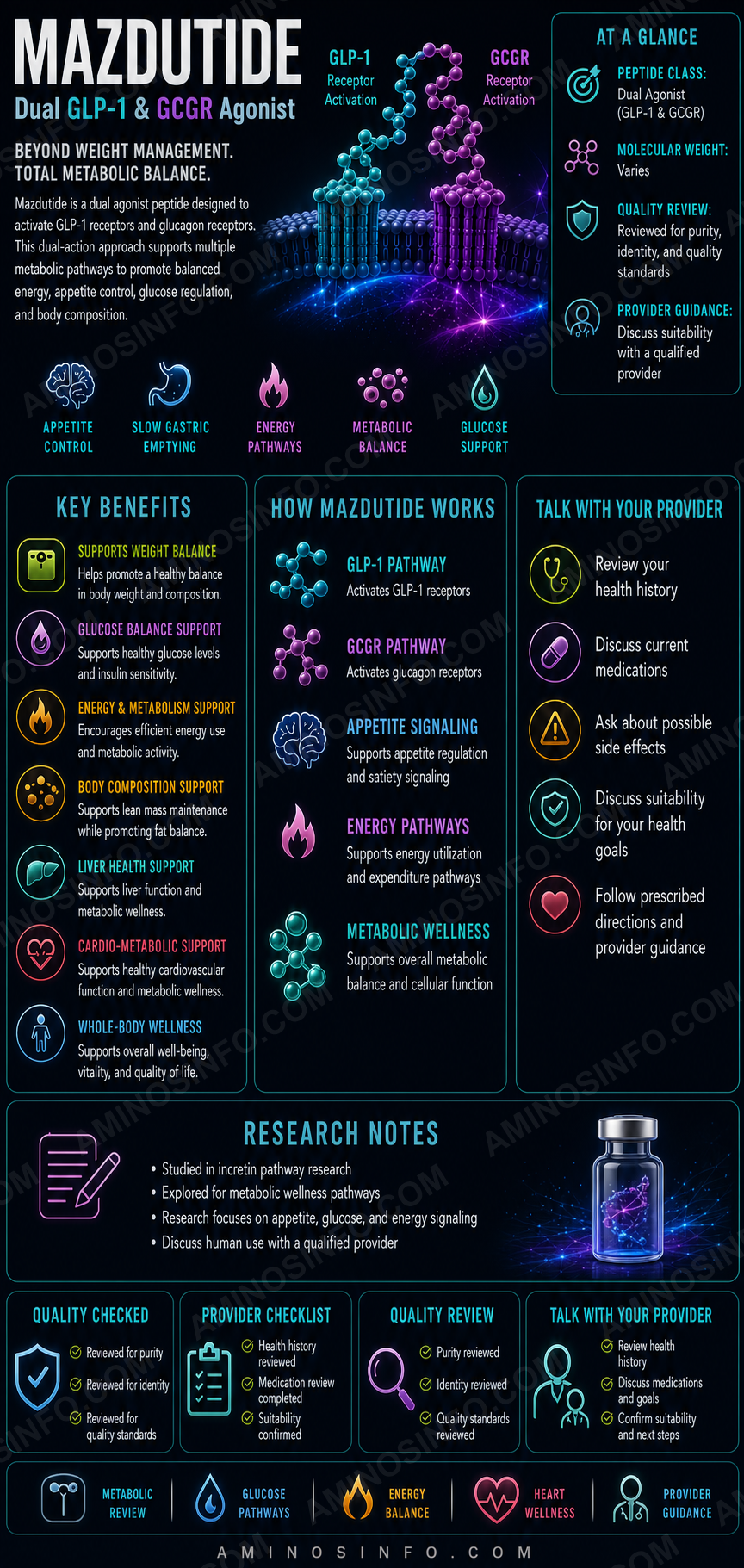
Mazdutide, also known as IBI362, LY3305677, and historically OXM3, is a long-acting synthetic analogue of the intestinal peptide oxyntomodulin.
It activates two receptors:
- GLP-1 receptor: appetite suppression, glucose-dependent insulin secretion, reduced inappropriate glucagon signaling, and delayed gastric emptying.
- Glucagon receptor: increased energy expenditure, lipid mobilization, hepatic metabolic effects, and possible reductions in liver and visceral fat.
IBI362 / LY3305677
Long-acting acylated peptide
GLP-1R + GCGR
Once-weekly subcutaneous injection
Obesity and type 2 diabetes
No
🧬 Structure, Sequence, and Molecular Properties
Oxyntomodulin-derived peptide
Mazdutide is an acylated, long-acting, single-chain peptide analogue of oxyntomodulin. Oxyntomodulin naturally contains the glucagon sequence plus an eight-amino-acid C-terminal extension.
Public sequence representation
Public supplier and patent-derived representations describe a glucagon-like 29-residue pharmacophore containing a noncanonical amino acid at position 2 and a long hydrophilic linker plus fatty-acid modification attached to a lysine side chain.
H-{Aib}-QGTFTSDYSKYLDEKKAK-{AEEA-AEEA-γGlu-fatty-acid}-EFIAWLLKGRG
Key structural features
- Oxyntomodulin-derived single-chain peptide
- Noncanonical amino acid that improves protease resistance
- Long hydrophilic linker
- Fatty-acid acylation for albumin association
- No required disulfide bridge in the published reference structure
- Designed for once-weekly exposure
⚛️ Molecular-property records
| Source representation | Formula | Molecular weight |
|---|---|---|
| KEGG / INN-oriented record | C210H322N46O67 | Approximately 4563.07 g/mol |
| FDA GSRS estimated record | C210H328N46O69 in one displayed estimate | Reference record should be reviewed directly |
| PubChem CID 167312357 | C207H317N45O65 | Approximately 4476 g/mol |
Why databases can differ
Peptide databases may represent different counterions, hydration states, terminal groups, linker definitions, neutral forms, or patent compounds. These differences reinforce the need for batch testing against the exact approved or sponsor-controlled reference structure.
📅 Discovery and Approval Timeline
Eli Lilly discovery program
LY3305677 was developed as a long-acting oxyntomodulin analogue with balanced GLP-1 and glucagon receptor activity.
2018: Innovent licensing agreement
Innovent Biologics licensed development and commercialization rights in China from Eli Lilly.
2021: Phase 1b obesity data
Multiple-ascending-dose research showed clinically meaningful short-term weight loss in Chinese adults with overweight or obesity.
2022: High-dose and diabetes phase 1b studies
Studies evaluated doses up to 9 mg and 10 mg and assessed glycemic and weight effects in type 2 diabetes.
2023: Phase 2 obesity publication
A 24-week randomized trial confirmed dose-dependent weight loss and broad cardiometabolic improvements.
2024–2025: GLORY and DREAMS phase 3 programs
Large phase 3 trials evaluated chronic weight management and glycemic control.
May 2025: GLORY-1 published
The phase 3 obesity trial was published in the New England Journal of Medicine.
June 27, 2025: Chinese obesity approval
China’s NMPA approved mazdutide for chronic weight management in eligible adults with overweight or obesity.
September 19, 2025: Chinese diabetes approval
The NMPA approved mazdutide for glycemic control in adults with type 2 diabetes.
2025–2026: Higher-dose development
Innovent submitted a 9 mg obesity application and reported one-year weight-loss results exceeding 20% in a phase 3 program.
Current status
Mazdutide is approved in China but remains unapproved by the FDA and other major Western regulators.
🧠 How Does Mazdutide Work?
1. Appetite and satiety
GLP-1 receptor signaling reduces hunger, increases fullness, and lowers total calorie intake.
2. Glucose-dependent insulin secretion
GLP-1 receptor activation increases insulin secretion when blood glucose is elevated.
3. Glucagon receptor activity
GCGR activation promotes hepatic substrate turnover, lipid oxidation, and energy expenditure.
4. Dual-receptor balance
The molecule is engineered so GLP-1 activity counters the glucose-raising potential of glucagon while preserving energy and liver-metabolic effects.
5. Gastric emptying
GLP-1-related slowing of gastric emptying contributes to early satiety and lower postprandial glucose exposure.
🎯 Receptor Profile and Signaling Balance
| Target | Action | Clinical relevance |
|---|---|---|
| GLP-1 receptor | Direct agonist | Appetite, insulin secretion, glucose regulation |
| Glucagon receptor | Direct agonist | Energy expenditure, lipid oxidation, hepatic metabolism |
| GIP receptor | No intended direct agonism | Distinguishes mazdutide from tirzepatide and retatrutide |
| cAMP pathway | Primary downstream GPCR pathway | Functional potency at both receptors |
| Albumin | Reversible binding through acylation | Supports once-weekly pharmacokinetics |
Potency-ratio importance
A correct mazdutide product must reproduce activity at both receptors. Sequence identity without the correct GLP-1R-to-GCGR potency balance does not establish pharmaceutical equivalence.
Obesity and Weight-Management Evidence
Phase 2 trial
A 24-week randomized study in Chinese adults with overweight or obesity found clinically meaningful, dose-dependent weight loss with 3 mg, 4.5 mg, and 6 mg once-weekly mazdutide.
Broader metabolic effects
Weight reduction was accompanied by improvements in:
- Waist circumference
- Blood pressure
- Triglycerides and cholesterol measures
- Serum uric acid
- Liver enzymes
- Liver-fat markers
High-dose phase 1b and phase 2 data
Doses of 9 mg and 10 mg produced larger average weight reductions and supported higher-dose phase 3 development.
GLORY-1 Phase 3 Results
Trial design
GLORY-1 enrolled 610 Chinese adults with obesity or overweight plus at least one weight-related condition. Participants received 4 mg, 6 mg, or placebo once weekly for 48 weeks, with the primary efficacy analysis at week 32.
Reported weight effects
Both 4 mg and 6 mg produced significantly greater weight reduction than placebo. Clinically meaningful proportions achieved at least 5%, 10%, and 15% weight loss.
Additional benefits
Reductions were reported in waist circumference, blood pressure, cardiometabolic risk markers, liver fat, and serum uric acid.
Regulatory role
GLORY-1 formed a central part of the evidence supporting China’s 2025 chronic weight-management approval.
High-Dose 9 mg Development
Rationale
The 9 mg program targets adults with moderate-to-severe obesity who may need efficacy approaching metabolic-surgery ranges.
2025 application
Innovent submitted a Chinese marketing application for the 9 mg dose in November 2025.
2026 one-year data
Innovent reported that the high-dose phase 3 program achieved more than 20% average weight loss after one year, with weight still declining and no clear plateau.
Regulatory caution
High-dose approval status should be checked separately from the currently approved lower-dose indication and presentation.
Type 2 Diabetes Evidence
Monotherapy
In a phase 3 trial of 320 adults inadequately controlled with diet and exercise, mazdutide 4 mg and 6 mg reduced A1C by 1.57 and 2.15 percentage points at week 24, compared with 0.14 percentage points for placebo.
Weight effects in diabetes
At week 24, mean weight changes were approximately −5.61% with 4 mg, −7.81% with 6 mg, and −1.26% with placebo.
Combination with oral diabetes drugs
In DREAMS-2, mazdutide produced greater A1C and weight reductions than dulaglutide 1.5 mg in adults receiving background oral therapy.
Composite outcomes
More participants achieved simultaneous glycemic targets and clinically meaningful weight reduction with mazdutide.
DREAMS Phase 3 Program
DREAMS-1
Evaluated mazdutide monotherapy against placebo in adults with type 2 diabetes controlled inadequately by diet and exercise.
DREAMS-2
Compared 4 mg and 6 mg mazdutide with dulaglutide 1.5 mg in adults taking oral diabetes medicines. Mazdutide was superior for A1C and body-weight reduction.
DREAMS-3
Compared mazdutide directly with semaglutide. Innovent reported superior achievement of a composite endpoint combining A1C below 7% with at least 10% body-weight reduction.
Chinese diabetes approval
The DREAMS program supported NMPA approval for glycemic control in September 2025.
Liver Fat and Cardiometabolic Effects
Liver-fat reduction
Dual glucagon/GLP-1 agonism may reduce liver fat through weight loss, improved insulin sensitivity, and glucagon-mediated lipid oxidation.
Liver enzymes
Clinical trials reported improvements in alanine aminotransferase and related hepatic markers.
Visceral fat
Waist and imaging analyses support reductions in central and visceral adiposity.
MASH potential
Mazdutide is biologically relevant to MASLD and MASH research, but approval for obesity or diabetes does not automatically establish an approved MASH indication.
Uric Acid and Kidney-Related Research
Serum uric acid
Mazdutide repeatedly reduced serum uric acid in obesity and diabetes trials.
Potential mechanisms
- Weight reduction
- Improved insulin sensitivity
- Altered renal urate handling
- Glucagon-related kidney signaling
Kidney markers
Exploratory studies reported changes in albuminuria and renal metabolic markers, but dedicated kidney-outcome trials are needed.
No gout indication
Mazdutide should not be described as an approved treatment for gout or hyperuricemia unless supported by jurisdiction-specific labeling.
Side Effects and Safety Considerations
Most common adverse effects
- Diarrhea
- Nausea
- Vomiting
- Reduced appetite
- Constipation
- Abdominal discomfort
- Injection-site reactions
Heart rate
Dual glucagon and GLP-1 agonism can increase pulse, requiring continued cardiovascular monitoring.
Potential class risks
- Pancreatitis
- Gallbladder disease
- Dehydration and kidney injury
- Severe gastrointestinal intolerance
- Delayed gastric emptying
- Hypoglycemia with insulin or insulin secretagogues
- Loss of lean tissue during rapid weight reduction
Glucagon-specific concerns
Potential risks include increased hepatic glucose output, altered amino-acid metabolism, increased heart rate, and changes in liver or lipid metabolism.
Population limitation
Most pivotal evidence has been generated in Chinese participants. Broader international efficacy, pharmacokinetics, and safety require continued evaluation.
Pharmacokinetics and Weekly Dosing
Albumin association
The fatty-acid side chain supports reversible albumin binding and slows clearance.
Protease resistance
The noncanonical residue near the N terminus reduces DPP-4-related degradation.
Once-weekly administration
Structural stabilization and acylation support weekly subcutaneous dosing.
Titration
Approved Chinese dosing uses staged escalation to improve gastrointestinal tolerability. Exact dosing should follow the current Chinese prescribing information.
Regulatory Status
China: weight management
Approved by the NMPA on June 27, 2025 for chronic weight management in eligible adults with overweight or obesity.
China: type 2 diabetes
Approved on September 19, 2025 for glycemic control in adults with type 2 diabetes.
Higher-dose 9 mg
A separate application was submitted for adults with moderate-to-severe obesity.
United States
Mazdutide is not FDA approved.
Other countries
Approval in China does not establish approval or legal human use elsewhere.
🧪 Laboratory Testing Methods
| Method | Purpose | Important limitation |
|---|---|---|
| RP-HPLC / UPLC | Separates intact mazdutide from deletion peptides, deacylated material, oxidation products, and aggregates. | Area purity does not prove sequence or receptor balance. |
| LC-HRMS | Confirms intact molecular mass against the stated reference form. | Database formula discrepancies must be resolved. |
| MS/MS peptide mapping | Confirms sequence, noncanonical residues, linker, and acylation site. | Requires a qualified reference standard. |
| Amino-acid analysis | Confirms composition and supports net peptide content. | Does not prove residue order or modification location. |
| Chiral amino-acid analysis | Detects epimerization and incorrect stereochemistry. | Hydrolysis can introduce artifacts. |
| Linker and fatty-acid analysis | Confirms AEEA units, γ-Glu, fatty-acid identity, and attachment. | Shorthand vendor sequences may omit important details. |
| Deacylated-peptide assay | Measures loss or absence of the long-acting side chain. | Deacylated peptide may retain partial receptor activity. |
| Oxidation and deamidation assays | Measure chemically modified degradants. | Some variants require high-resolution separation. |
| SEC-HPLC | Measures aggregates and high-molecular-weight species. | Small reversible oligomers may require orthogonal analysis. |
| Net peptide-content assay | Measures actual active peptide mass. | Must correct for water, TFA, acetate, and excipients. |
| GLP-1R cAMP assay | Measures GLP-1 receptor agonist potency. | Does not establish glucagon-receptor potency. |
| GCGR cAMP assay | Measures glucagon receptor agonist potency. | Must use comparable cell systems. |
| Dual-receptor potency ratio | Confirms intended pharmacological balance. | No universal interlaboratory ratio exists. |
| Albumin-binding assay | Confirms the long-acting acylated design. | Does not fully predict human pharmacokinetics. |
| Plasma stability | Measures proteolysis and deacylation. | Species differences are important. |
| Residual-solvent and counterion testing | Measures synthesis solvents and salts. | Does not establish biological potency. |
| Sterility and endotoxin | Required for finished injection products. | Raw-peptide purity cannot establish injectable safety. |
| Particulate matter | Measures visible and subvisible particles. | Requires finished-product testing. |
| Stability-indicating assay | Tracks oxidation, deamidation, hydrolysis, aggregation, deacylation, and potency loss. | Requires validated forced-degradation studies. |
📄 How to Interpret a Mazdutide COA
- Identify the exact structural reference: State whether the standard follows the INN/KEGG, FDA GSRS, sponsor, or patent representation.
- Do not rely on one database formula: Public records differ.
- Verify the full peptide sequence and every noncanonical residue.
- Confirm the linker, fatty-acid chain, and exact attachment site.
- Use LC-HRMS plus MS/MS peptide mapping.
- Confirm stereochemistry: Epimers may have the same nominal mass.
- Measure deletion peptides, deacylated material, oxidation, deamidation, hydrolysis, and aggregates.
- Report net peptide content: “99% HPLC purity” is not the labeled milligram amount.
- Test GLP-1R and GCGR potency separately.
- Confirm the receptor-potency ratio.
- For injectable products, require sterility, endotoxin, particles, fill accuracy, container closure, and stability.
- Do not infer regulatory equivalence: A vendor COA cannot establish equivalence to the approved Chinese drug product.
📊 Mazdutide vs Semaglutide vs Tirzepatide vs Retatrutide
| Feature | Mazdutide | Semaglutide | Tirzepatide | Retatrutide |
|---|---|---|---|---|
| Receptors | GLP-1R + GCGR | GLP-1R | GIPR + GLP-1R | GIPR + GLP-1R + GCGR |
| Type | Acylated peptide | Acylated peptide | Acylated peptide | Acylated peptide |
| Route | Weekly injection | Weekly injection | Weekly injection | Weekly injection in trials |
| China approval | Yes | Yes, selected products | Yes, selected products | No |
| FDA approval | No | Yes | Yes | No |
Mazdutide vs Survodutide vs Pemvidutide
| Compound | Receptors | Development emphasis |
|---|---|---|
| Mazdutide | GLP-1R + GCGR | Obesity and diabetes |
| Survodutide | GCGR + GLP-1R | Obesity and MASH |
| Pemvidutide | GCGR + GLP-1R | Obesity and MASH |
Mazdutide vs Dulaglutide vs Semaglutide in Diabetes
| Feature | Mazdutide | Dulaglutide | Semaglutide |
|---|---|---|---|
| Mechanism | GLP-1R + GCGR | GLP-1R | GLP-1R |
| Weight effect | Greater than dulaglutide in DREAMS-2 | Moderate | High for a mono-agonist |
| Head-to-head evidence | Compared with both agents in Chinese trials | Active comparator | Active comparator in DREAMS-3 |
| Global approval | China only | Multiple markets | Multiple markets |
Raw Mazdutide vs Approved Chinese Drug Product
| Quality attribute | Raw peptide | Approved finished product |
|---|---|---|
| Identity | Sequence, modification, mass | Full sponsor-controlled reference |
| Potency | Dual receptor assays | Validated release specifications |
| Microbiology | Bioburden as applicable | Sterility, endotoxin, particles |
| Delivery | Not established | Validated concentration, container, and dose |
| Clinical equivalence | Not established by COA | Supported by NMPA-reviewed manufacturing and trials |
🖼️ Original Diagram Specifications
Diagram 1: Mazdutide peptide architecture
Show the oxyntomodulin-derived sequence, Aib residue, lysine modification site, AEEA linker, γ-Glu, and fatty-acid side chain.
Diagram 2: Dual-receptor mechanism
Show GLP-1R effects on appetite and glucose and GCGR effects on energy expenditure and liver metabolism.
Diagram 3: China approval timeline
Show June 27, 2025 obesity approval, September 19, 2025 diabetes approval, and the later 9 mg application.
Diagram 4: GLORY-1 pathway
Show weight loss, waist reduction, lower uric acid, liver markers, and blood-pressure improvements.
Diagram 5: DREAMS diabetes results
Show A1C and weight changes versus placebo, dulaglutide, and semaglutide.
Diagram 6: Benefit–risk balance
Show appetite, glycemic, liver, and weight benefits opposite GI effects, heart-rate changes, gallbladder risk, and dehydration.
Diagram 7: COA workflow
Show structural reference, sequence, HRMS, peptide mapping, linker and lipid verification, dual receptor assays, sterility, and stability.
❓ Frequently Asked Questions
Is mazdutide a peptide?
Yes. It is a long-acting acylated oxyntomodulin-derived peptide.
What are its other names?
IBI362, LY3305677, and OXM3.
What receptors does it activate?
The GLP-1 receptor and glucagon receptor.
Does it activate GIP receptors?
No intended direct GIP receptor agonism is part of its mechanism.
Is mazdutide approved?
Yes in China for chronic weight management and type 2 diabetes; no in the United States.
When was it approved in China?
June 27, 2025 for chronic weight management and September 19, 2025 for type 2 diabetes.
What is its molecular formula?
Public databases differ. KEGG lists C210H322N46O67, while one PubChem record lists C207H317N45O65.
What is its molecular weight?
Depending on the database representation, approximately 4476 to 4563 g/mol.
Why do the chemistry records differ?
They may represent different structural forms, terminal groups, counterions, hydration states, or patent versus INN definitions.
How is it administered?
Once-weekly subcutaneous injection.
How much weight loss has been reported?
Approved-dose phase 3 studies showed clinically meaningful double-digit reductions, while a higher-dose 9 mg program reported more than 20% after one year.
Does it lower A1C?
Yes. Phase 3 diabetes trials showed substantial A1C reductions.
What are the most common side effects?
Diarrhea, nausea, vomiting, reduced appetite, constipation, and abdominal symptoms.
How is it different from tirzepatide?
Tirzepatide activates GIP and GLP-1 receptors; mazdutide activates GLP-1 and glucagon receptors.
How is it different from survodutide?
Both target GLP-1R and GCGR, but they have different sequences, receptor balance, clinical programs, and regulatory status.
Does 99% HPLC purity prove authentic mazdutide?
No. Exact structure, sequence, modification, stereochemistry, net content, aggregates, and dual-receptor potency must be verified.
Final Thoughts
Mazdutide is the first glucagon/GLP-1 dual-receptor agonist approved for chronic weight management and type 2 diabetes. Its Chinese approvals are supported by phase 3 evidence showing meaningful reductions in weight and A1C, along with improvements in waist circumference, liver markers, serum uric acid, and other cardiometabolic measures.
The glucagon component distinguishes mazdutide from conventional GLP-1 mono-agonists and may contribute to energy expenditure, liver-fat reduction, and visceral-fat effects. Higher-dose research has reported average one-year weight loss above 20%, although the exact approved status and labeling of the 9 mg presentation must be checked separately.
Analytical authentication is complicated by inconsistent public chemistry records. A legitimate product should be tested against an exact sponsor or regulatory reference for sequence, noncanonical residues, linker and fatty-acid architecture, molecular mass, stereochemistry, impurities, net peptide content, GLP-1R potency, GCGR potency, albumin binding, sterility, particles, and stability. A generic vendor COA cannot establish equivalence to the NMPA-approved Chinese drug product.
📚 References
- Ji L, et al. Once-Weekly Mazdutide in Chinese Adults with Obesity or Overweight. New England Journal of Medicine. 2025.
- Zhu D, et al. Mazdutide versus placebo in Chinese adults with type 2 diabetes. Nature. 2025.
- Guo L, et al. Mazdutide versus dulaglutide in Chinese adults with type 2 diabetes. Nature. 2026.
- Ji L, et al. A phase 2 randomized controlled trial of mazdutide in Chinese adults with overweight or obesity. Nature Communications. 2023.
- Zhang B, et al. Efficacy and safety of mazdutide in Chinese patients with type 2 diabetes. Diabetes Care. 2024.
- Jiang H, et al. IBI362 in Chinese patients with type 2 diabetes: phase 1b trial. Nature Communications. 2022.
- Ji L, et al. IBI362 in Chinese adults with overweight or obesity: phase 1b trial. eClinicalMedicine. 2021.
- Ji L, et al. High-dose 9 mg and 10 mg mazdutide in Chinese adults with overweight or obesity. eClinicalMedicine. 2022.
- Innovent Biologics. NMPA approval of mazdutide for chronic weight management. June 27, 2025.
- Innovent Biologics. NMPA approval of mazdutide for glycemic control in adults with type 2 diabetes. September 19, 2025.
- Innovent Biologics. Mazdutide 9 mg marketing application for moderate-to-severe obesity. November 2025.
- Innovent Biologics. GLORY-2 high-dose phase 3 results. June 2026.
- Innovent Biologics. DREAMS-3 head-to-head results versus semaglutide. 2025–2026.
- ClinicalTrials.gov. GLORY-1, NCT05607680.
- ClinicalTrials.gov. DREAMS-1, NCT05628311.
- ClinicalTrials.gov. DREAMS-2, NCT05606913.
- PubChem. Mazdutide compound record, CID 167312357.
- KEGG Drug. Mazdutide, D12225.
- FDA Global Substance Registration System. Mazdutide, UNII MB76Z4IBZ5.
- IUPHAR/BPS Guide to Pharmacology. Mazdutide ligand record 13924.
- US Patent 9,938,335. Glucagon and GLP-1 co-agonist compounds.
- Dong W, et al. Mazdutide, a dual agonist targeting GLP-1R and GCGR. Review. 2025.
- Holst JJ. Enteroglucagon. Annual Review of Physiology.
- Wynne K, et al. Oxyntomodulin increases energy expenditure and reduces food intake. International Journal of Obesity.
- Wynne K, et al. Subcutaneous oxyntomodulin reduces body weight in overweight and obese subjects. Diabetes.
- Day JW, et al. A new glucagon and GLP-1 co-agonist eliminates obesity in rodents. Nature Chemical Biology.
- Pocai A, et al. GLP-1/glucagon receptor dual agonism reverses obesity in mice. Diabetes.
- Finan B, et al. Unimolecular dual and triple incretin receptor agonists. Science Translational Medicine.
- Habegger KM, et al. The metabolic actions of glucagon revisited. Nature Reviews Endocrinology.
- Campbell JE, Drucker DJ. Islet alpha cells and glucagon. Cell Metabolism.
- Longuet C, et al. The glucagon receptor is required for control of energy expenditure. Cell Metabolism.
- Drucker DJ. Mechanisms of action and therapeutic application of GLP-1. Cell Metabolism.
- Müller TD, et al. GLP-1 molecular physiology and therapeutic applications. Nature Reviews Drug Discovery.
- Holst JJ. The physiology of GLP-1. Physiological Reviews.
- Wilding JPH, et al. Once-weekly semaglutide in adults with overweight or obesity. New England Journal of Medicine.
- Jastreboff AM, et al. Tirzepatide once weekly for obesity. New England Journal of Medicine.
- Jastreboff AM, et al. Retatrutide for obesity. New England Journal of Medicine.
- le Roux CW, et al. Survodutide for obesity. Lancet Diabetes & Endocrinology.
- Nahra R, et al. Cotadutide in adults with overweight or obesity and type 2 diabetes. Diabetes Care.
- Lincoff AM, et al. Semaglutide and cardiovascular outcomes in obesity. New England Journal of Medicine.
- Perkovic V, et al. Semaglutide and chronic kidney disease in type 2 diabetes. New England Journal of Medicine.
- Sattar N, et al. Cardiovascular, mortality, and kidney outcomes with GLP-1 receptor agonists. Lancet Diabetes & Endocrinology.
- Bankir L, et al. Glucagon actions on the kidney revisited. American Journal of Physiology Renal Physiology.
- Rinella ME, et al. AASLD practice guidance for MASLD and MASH. Hepatology.
- Younossi ZM, et al. Global burden of MASLD and MASH. Hepatology.
- Heymsfield SB, Wadden TA. Mechanisms and management of obesity. New England Journal of Medicine.
- Morton GJ, et al. Neurobiology of food intake. Nature Reviews Neuroscience.
- International Council for Harmonisation. ICH Q1A(R2): Stability Testing.
- International Council for Harmonisation. ICH Q2(R2): Validation of Analytical Procedures.
- International Council for Harmonisation. ICH Q3A and Q3B: Impurities.
- International Council for Harmonisation. ICH Q3C: Residual Solvents.
- International Council for Harmonisation. ICH Q6B: Specifications for Biotechnological Products.
- International Council for Harmonisation. ICH M10: Bioanalytical Method Validation.
- United States Pharmacopeia General Chapter <621>: Chromatography.
- United States Pharmacopeia General Chapter <71>: Sterility Tests.
- United States Pharmacopeia General Chapter <85>: Bacterial Endotoxins Test.
- United States Pharmacopeia General Chapter <788>: Particulate Matter in Injections.
Chemistry, Chinese approvals, phase 2 and phase 3 obesity and diabetes evidence, high-dose development, safety, and analytical recommendations were reviewed in July 2026.