
*{box-sizing:border-box} body{margin:0;background:#f4f6fb;color:#182235;font-family:Arial,Helvetica,sans-serif;line-height:1.72} article{max-w
Melanocortin Research Education
Melanotan II Scientific Overview: Structure, Mechanism, Research, and Testing
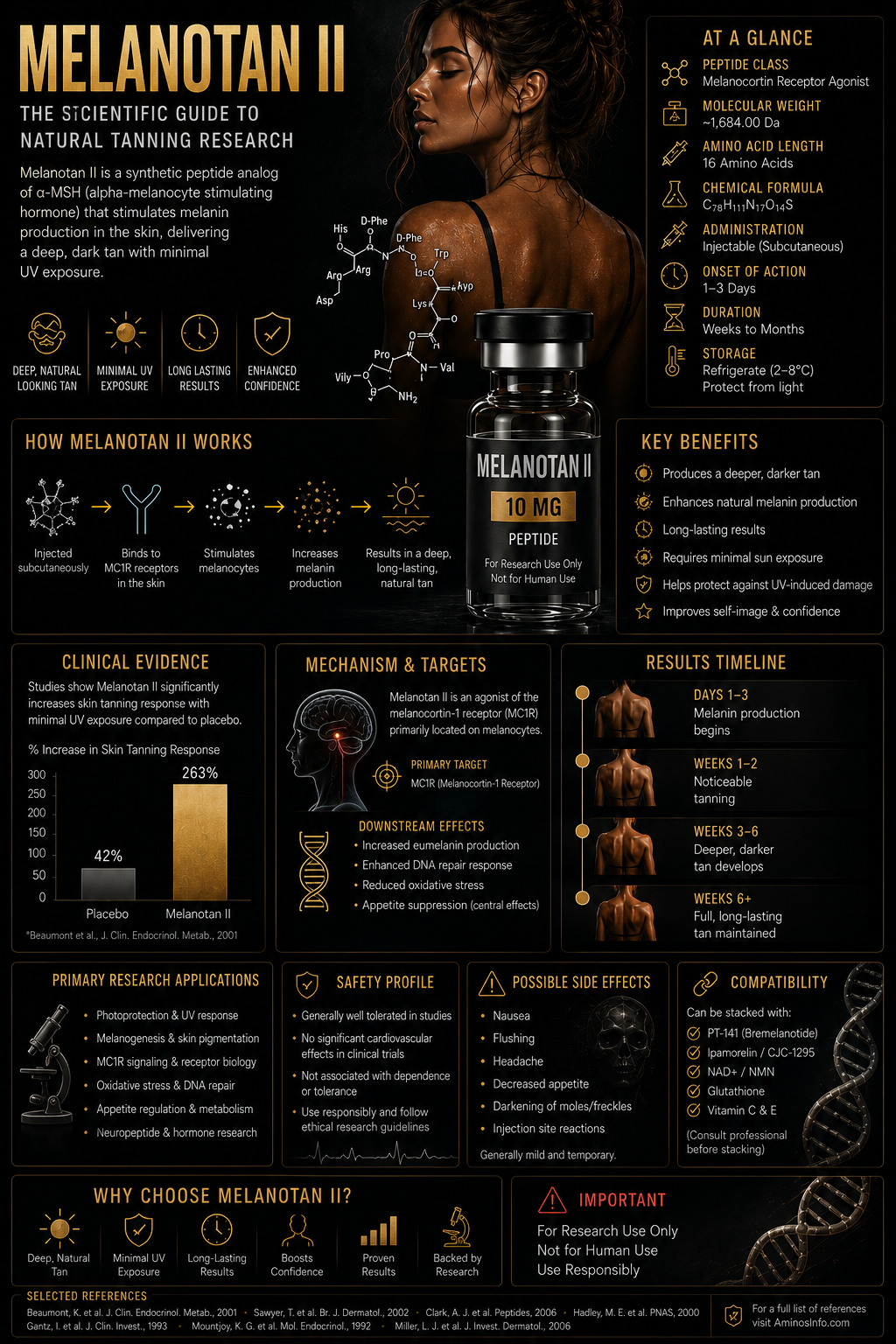
For example, Melanotan II scientific overview content requires careful separation between established melanocortin research and unsupported online claims. This synthetic cyclic α-MSH analog that activates several melanocortin receptors, but it remains unapproved and investigational.
What Is Melanotan II?
Moreover, Melanotan II, often abbreviated MT-II or MT2, is a synthetic cyclic heptapeptide derived from α-melanocyte-stimulating hormone. Researchers designed it to resist enzymatic breakdown and activate melanocortin receptors more strongly than the native hormone.
For example, a 1996 pilot Phase I study documented increased pigmentation together with nausea, fatigue, yawning, and spontaneous erections in a small group of male volunteers. Later controlled studies explored erectile responses and sexual desire. However, those early experiments did not establish long-term safety or general therapeutic use.
| Property | Information |
|---|---|
| Compound | Melanotan II |
| Class | In addition, Synthetic cyclic melanocortin peptide |
| Sequence | Ac-Nle-c[Asp-His-D-Phe-Arg-Trp-Lys]-NH₂ |
| Average molecular weight | Approximately 1,024.2 g/mol |
| Molecular formula | C50H69N15O9 |
| CAS number | 121062-08-6 |
| Primary receptors | However, MC1R, MC3R, MC4R, and MC5R |
| Development status | Therefore, Investigational; not FDA approved |
Molecular Structure and Sequence
Likewise, The sequence contains norleucine, D-phenylalanine, N-terminal acetylation, C-terminal amidation, and a lactam bridge between aspartic acid and lysine. Together, these features constrain the peptide’s shape and improve resistance to proteolytic enzymes.
Cyclic lactam bridge
First, the Asp-to-Lys side-chain bridge stabilizes a receptor-active conformation and distinguishes the compound from linear α-MSH.
D-phenylalanine
Next, the D-amino acid reduces susceptibility to common peptide-degrading enzymes.
Norleucine substitution
In addition, norleucine replaces oxidation-prone methionine and improves chemical stability.
Terminal modifications
Finally, acetylation and amidation alter terminal charge and contribute to the designed pharmacological profile.
A formula or intact mass cannot independently prove cyclization, stereochemistry, sequence order, or the correct isomer. Therefore, strong identity testing combines high-resolution mass spectrometry with sequence-supporting fragmentation and, when needed, NMR.
Discovery and Research Timeline
Meanwhile, Researchers characterized melanocyte-stimulating hormones and connected α-MSH with pigmentation biology.
By contrast, Medicinal chemists developed more stable and potent α-MSH analogs, including cyclic melanocortin ligands.
Finally, A pilot Phase I study reported tanning activity and systemic effects in three healthy male volunteers.
Consequently, Small placebo-controlled crossover studies examined erectile responses and sexual desire in men with erectile dysfunction.
For example, FDA approved afamelanotide for a specific erythropoietic protoporphyria indication and bremelanotide for a specific sexual-desire disorder indication.
Moreover, Melanotan II remains a research tool rather than an approved tanning or therapeutic product.
Mechanism of Action
In addition, Melanotan II activates multiple melanocortin G-protein-coupled receptors. Following receptor activation, Gs signaling can stimulate adenylyl cyclase, increase cyclic AMP, and activate protein kinase A.
Pigmentation pathway
At MC1R on melanocytes, cAMP signaling promotes CREB and MITF-related transcription. Consequently, cells increase tyrosinase and other melanogenic proteins that support eumelanin production and pigment transfer to keratinocytes.
However, darker pigmentation does not equal complete photoprotection. Ultraviolet radiation can still damage DNA, accelerate photoaging, and increase skin-cancer risk. Therefore, pigmentation should never replace sunscreen, protective clothing, or other established UV precautions.
Central nervous system effects
MC3R and MC4R participate in appetite, autonomic function, energy balance, and sexual behavior. By contrast, MC2R primarily responds to ACTH and drives adrenal steroid production; Melanotan II does not meaningfully reproduce ACTH’s MC2R activity.
Melanocortin Receptor Profile
| Receptor | Main locations | Major research roles | MT-II activity |
|---|---|---|---|
| MC1R | Melanocytes and skin | However, Pigmentation, melanocyte survival, and UV-response signaling | High |
| MC2R | Adrenal cortex | ACTH-dependent cortisol production | Minimal |
| MC3R | Therefore, Brain and peripheral tissues | Likewise, Energy balance and nutrient partitioning | Moderate |
| MC4R | Meanwhile, Hypothalamus and other brain regions | By contrast, Satiety, autonomic signaling, sexual behavior, and body-weight regulation | High |
| MC5R | Finally, Peripheral tissues and exocrine glands | Consequently, Sebaceous, sweat-gland, immune, and other peripheral functions | Moderate |
Human Research Findings
Pigmentation
First, the pilot human study reported measurable skin darkening after repeated subcutaneous administration.
Erectile responses
Next, small crossover studies found more frequent and longer erectile responses after Melanotan II than after placebo.
Sexual desire
Moreover, some participants reported increased sexual desire, which helped guide development of later melanocortin agonists.
Adverse effects
However, nausea, yawning, stretching, reduced appetite, fatigue, and spontaneous erections occurred in clinical research.
Relationship to Afamelanotide and Bremelanotide
For example, Afamelanotide, sometimes called Melanotan I, is a distinct linear analog with greater emphasis on MC1R-related pigmentation and photoprotection. FDA approved it in 2019 to increase pain-free light exposure in adults with erythropoietic protoporphyria.
Bremelanotide, or PT-141, is another distinct melanocortin agonist developed from this research area. FDA approved it for acquired, generalized hypoactive sexual desire disorder in certain premenopausal women. Nevertheless, neither approval transfers to Melanotan II.
| Feature | Melanotan II | Afamelanotide | Bremelanotide |
|---|---|---|---|
| Structure | Cyclic peptide | Linear peptide | Cyclic melanocortin agonist |
| Main research emphasis | Moreover, Pigmentation, appetite, and sexual physiology | Photoprotection and pigmentation | Sexual desire |
| FDA approval | In addition, No; Melanotan II remains investigational. | However, Yes, specific EPP indication | Therefore, Yes, specific HSDD indication |
| Interchangeable? | Likewise, No; afamelanotide is a distinct medicine. | Meanwhile, No; bremelanotide is a distinct medicine. | By contrast, No; the compounds are not interchangeable. |
Safety Considerations and Regulatory Warnings
Melanotan II remains unapproved, and products sold through unregulated channels may have uncertain identity, content, purity, sterility, and storage history. In addition, online products do not undergo the same premarket review and manufacturing controls as approved medicines.
Reported and plausible concerns
- Finally, Nausea, flushing, headache, fatigue, yawning, and appetite changes
- Consequently, Spontaneous erections and possible priapism
- For example, Generalized darkening and changes in freckles or existing moles
- Moreover, Uncertain long-term melanocyte and melanoma-related risk
- In addition, Unknown cardiovascular, endocrine, reproductive, and drug-interaction effects
- However, Contamination or dosing variability in unregulated products
Current evidence does not prove that Melanotan II directly causes melanoma. However, it stimulates melanocyte signaling, can darken pigmented lesions, and may encourage additional UV exposure. Consequently, claims of no skin-cancer concern are not scientifically justified.
Recommended Laboratory Testing
LC-MS or LC-HRMS identity
For example, confirm theoretical ions, isotope pattern, charge states, and fragmentation that support the correct cyclic sequence.
HPLC or UPLC purity
Meanwhile, report the full chromatographic method, chromatogram, integration table, main peak, and related impurities.
Quantitative content
In addition, determine the actual milligrams with a validated assay and qualified reference material.
Sequence and stereochemistry
Moreover, use MS/MS and suitable orthogonal methods to support D-Phe, cyclization, terminal groups, and sequence order.
Endotoxins and sterility
Importantly, treat bacterial endotoxins and viable microbial contamination as separate quality questions.
Residual solvents and elements
Finally, use process-specific solvent testing and elemental analysis for relevant contaminants.
A high HPLC area percentage does not prove identity, labeled milligrams, sterility, or freedom from endotoxins. Therefore, no single test can establish complete quality.
How to Interpret a Melanotan II COA
Confirm batch identity
First, match the lot number, product name, sequence, formula, molecular weight, test date, sample description, laboratory, and report number to the exact vial.
Separate identity, purity, and content
Next, review LC-MS or LC-HRMS identity independently from chromatographic purity. Also, require a quantitative content result because a 99% area-purity result does not prove the stated milligrams.
Review contamination testing
Moreover, examine endotoxin, sterility, residual-solvent, elemental-impurity, moisture, and other process-specific results. The report should state methods, limits, units, and numerical findings.
Watch for red flags
- Therefore, Missing or mismatched lot number
- Likewise, No chromatogram or mass-spectrum attachment
- Meanwhile, Purity presented as proof of milligram content
- By contrast, No sequence or cyclic-structure confirmation
- Finally, Generic “pass” statements without methods or limits
- Consequently, Claims of sterility without validated sterility documentation
- For example, Edited, cropped, unreadable, or internally inconsistent pages
Frequently Asked Questions
Is Melanotan II a peptide?
Moreover, Yes. It is a synthetic cyclic α-MSH analog.
Does it increase skin pigmentation?
In addition, Yes. Human research documented increased pigmentation through melanocortin-receptor signaling.
Is it FDA approved?
However, No. Melanotan II has no FDA-approved indication.
Is it the same as afamelanotide?
Therefore, No. Afamelanotide is a distinct linear analog with a specific approved indication.
Is it the same as bremelanotide?
Likewise, No. Bremelanotide is a distinct approved melanocortin agonist developed for a specific sexual-desire disorder.
Does pigmentation replace sunscreen?
Meanwhile, No. Increased melanin does not eliminate ultraviolet DNA damage or replace established sun protection.
Why can nausea occur?
By contrast, Central melanocortin signaling affects autonomic and appetite-related pathways, which may contribute to nausea and yawning.
Does a purity result prove the labeled amount?
Finally, No. Chromatographic area purity and quantitative content are separate measurements.
Melanotan II Scientific Overview: Conclusion
Consequently, Melanotan II scientific overview evidence identifies the compound as a potent cyclic melanocortin agonist that affects pigmentation, appetite-related signaling, autonomic pathways, and sexual physiology.
However, Melanotan II remains unapproved and lacks a defined long-term human safety profile. Finally, researchers should rely on precise structural identification, batch-specific analytical testing, regulatory context, and cautious interpretation rather than online tanning or therapeutic claims.
Authoritative References
- For example, Dorr RT, et al. Evaluation of Melanotan-II in a pilot Phase I clinical study.
- Moreover, Wessells H, et al. Melanotan II in psychogenic erectile dysfunction.
- In addition, Wessells H, et al. Melanotan II in organic erectile dysfunction.
- However, Human studies of melanocortin agonists, erection, and sexual motivation.
- Therefore, Discovery and development of Melanotan I and Melanotan II.
- Likewise, FDA orphan-drug record for afamelanotide approval.
- Meanwhile, FDA information on bremelanotide approval.
- By contrast, ICH Q2(R2): Validation of Analytical Procedures.