
:root{--ink:#16202a;--muted:#5c6975;--line:#dce3e8;--panel:#f6f8fa;--accent:#174f69;--accent2:#7a4266;--warning-bg:#fff8e8} *{box-sizing:border
Oxytocin Scientific Overview: Structure, Mechanism, Clinical Use, and Testing
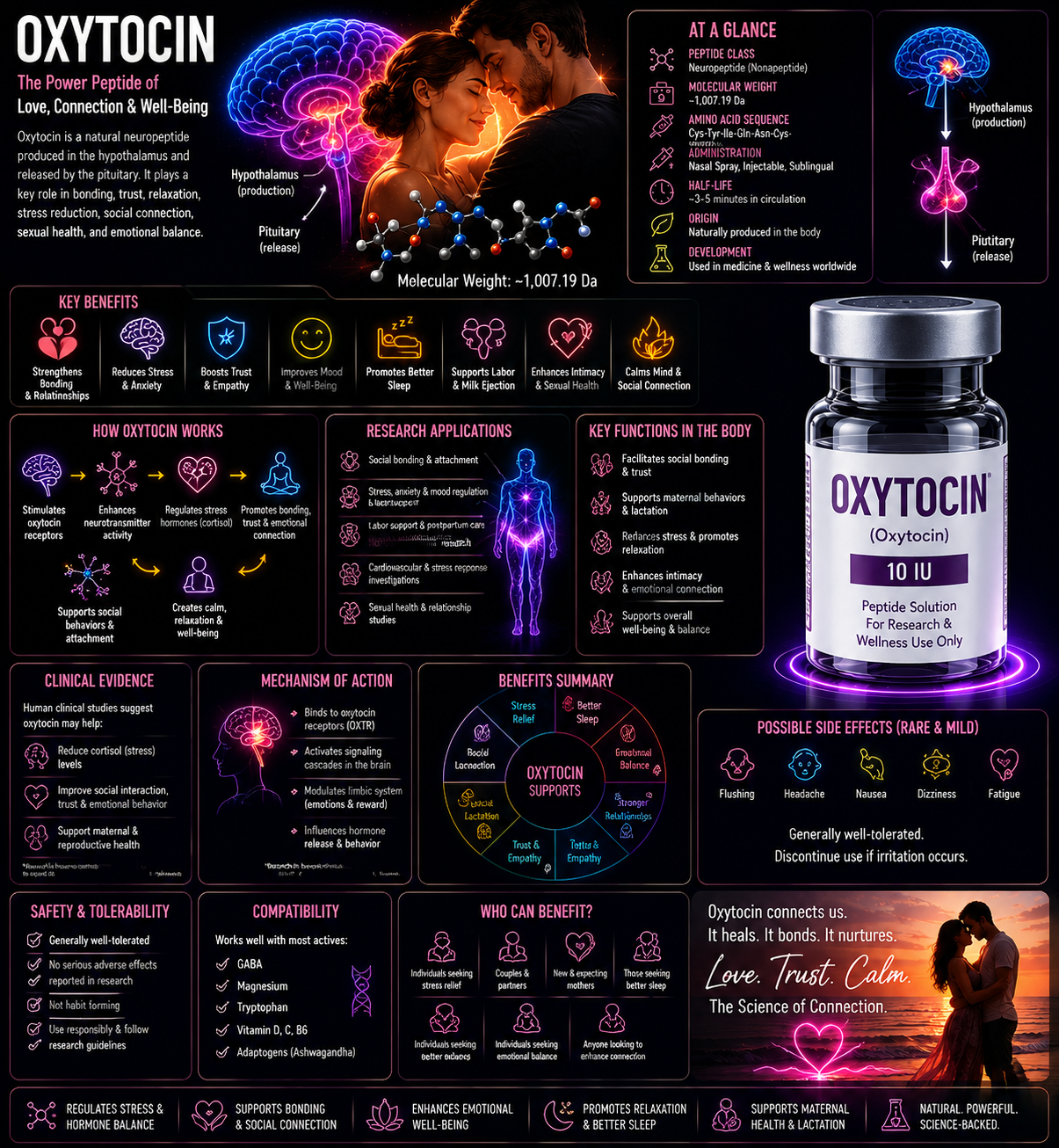
For example, Oxytocin scientific overview content should separate established obstetric uses from investigational intranasal and behavioral claims. This cyclic nonapeptide hormone that activates OXTR and plays defined roles in uterine contraction and milk ejection.
What Is Oxytocin?
First, oxytocin is a naturally occurring peptide hormone and neuropeptide synthesized mainly in magnocellular neurons of the hypothalamic paraventricular and supraoptic nuclei. It is transported down axons and released into the bloodstream from the posterior pituitary. Oxytocin is also released within the brain, where it acts as a neuromodulator.
Next, its best-established physiological roles are stimulating uterine smooth-muscle contractions during labor, triggering milk ejection during breastfeeding, supporting maternal behavior and reproductive physiology, and modulating social recognition, salience, attachment, fear, stress, and reward in context-dependent ways.
Importantly, synthetic oxytocin is marketed in injectable pharmaceutical formulations, including products historically associated with the brand name Pitocin. Approved uses relate primarily to induction or augmentation of labor and control of postpartum uterine bleeding. Claims involving trust, empathy, bonding, anxiety, autism, depression, PTSD, sexual function, or relationship enhancement remain investigational.
Cyclic nonapeptide hormone
Oxytocin receptor (OXTR)
Hypothalamus
Posterior pituitary
Labor and postpartum uterine control
Intranasal social and neuropsychiatric research
🧬 Molecular Structure
First, oxytocin is a nine-amino-acid cyclic peptide. Six residues form a ring closed by a disulfide bond between cysteine residues at positions 1 and 6. A three-residue tail extends from the ring.
Moreover, the disulfide bridge is essential to the native three-dimensional structure and receptor activity. The C-terminus is amidated, which also contributes to biological potency and stability.
🧪 Amino-Acid Sequence
Cys-Tyr-Ile-Gln-Asn-Cys-Pro-Leu-Gly-NH₂
One-letter notation: CYIQNCPLG-NH₂
⚛️ Molecular Weight and 🧫 Formula
| Molecular formula | Meanwhile, C43H66N12O12S2 |
|---|---|
| Average molecular weight | Approximately 1,007.2 g/mol |
| Exact mass | Approximately 1,006.44 Da |
| Peptide length | 9 amino acids |
| CAS number | 50-56-6 |
| PubChem CID | 439302 |
Therefore, oxytocin acetate and other salt forms have different formulas and total molecular weights. The acetate salt is listed with molecular formula C45H70N12O14S2 and molecular weight of approximately 1,067.2 g/mol. A COA should state the exact material form.
📅 Discovery Timeline
1906: Uterotonic activity described
First, Sir Henry Dale reported that posterior pituitary extracts caused uterine contractions, helping establish the physiological basis for later oxytocin research.
1910s–1930s: Milk-ejection and posterior-pituitary functions clarified
Next, researchers distinguished uterotonic and antidiuretic actions of posterior pituitary extracts and linked oxytocin-like activity to milk let-down.
1953: Structure determined and oxytocin synthesized
Then, Vincent du Vigneaud and colleagues determined oxytocin’s sequence and achieved the first synthesis of a biologically active peptide hormone. For example, du Vigneaud received the 1955 Nobel Prize in Chemistry for work on sulfur-containing compounds and peptide hormones.
1950s–1970s: Obstetric use expands
Afterward, synthetic oxytocin became widely used to induce or augment labor and manage uterine atony and postpartum bleeding.
1980s–1990s: Receptor and central-neuroscience research grows
Meanwhile, researchers characterized OXTR expression and signaling in uterine, mammary, cardiovascular, and brain tissues. Moreover, animal studies linked oxytocin to maternal behavior, pair bonding, social memory, and stress regulation.
2000s–2020s: Intranasal research expands and becomes more nuanced
Finally, human studies examined trust, emotion recognition, amygdala reactivity, empathy, attachment, and psychiatric symptoms. In addition, later work increasingly emphasized context dependence, replication, dose-response, sex differences, and uncertainty about nose-to-brain delivery.
📖 Research History
Importantly, oxytocin is historically important because it was among the first peptide hormones to be chemically synthesized with retained biological activity. However, its early medical role centered on childbirth and lactation, where effects are direct, measurable, and well established.
However, behavioral research later expanded the molecule’s public reputation. Therefore, animal studies provided strong evidence that oxytocin can regulate maternal behavior, social recognition, pair bonding, and stress responses. Human findings are more variable and do not support describing oxytocin as a universal trust, empathy, or bonding enhancer.
🧠 Mechanism of Action
First, oxytocin binds to the oxytocin receptor (OXTR), a seven-transmembrane G-protein-coupled receptor. OXTR primarily couples to Gq/11 proteins, although signaling can vary by tissue and receptor context.
1. OXTR activation
Next, oxytocin binds extracellular regions of OXTR and stabilizes an active receptor conformation.
2. Calcium signaling
Then, Gq/11 activation stimulates phospholipase C, producing IP₃ and DAG. Likewise, iP₃ releases intracellular calcium, while DAG activates protein kinase C.
3. Uterine and mammary contraction
Afterward, in myometrial and mammary myoepithelial cells, increased calcium activates contractile proteins.
4. Prostaglandin amplification
Moreover, in the uterus, oxytocin can increase local prostaglandin production, further supporting contractions and labor physiology.
5. Central neuromodulation
In addition, OXTR signaling changes neuronal excitability and transmitter release and interacts with dopamine, serotonin, GABA, glutamate, endogenous opioids, corticotropin-releasing hormone, and vasopressin systems.
6. Positive feedback
Finally, during labor, cervical stretch promotes more oxytocin release through the Ferguson reflex. Meanwhile, during breastfeeding, nipple stimulation triggers pulsatile release and milk ejection.
🎯 Receptor Profile
| Target | Primary signaling | Relevance |
|---|---|---|
| OXTR | Likewise, Predominantly Gq/11 → PLC → IP₃/DAG → Ca²⁺ | In addition, Primary receptor mediating uterine, mammary, cardiovascular, and central effects. |
| V1a vasopressin receptor | Gq/11 signaling | Moreover, Oxytocin can interact at higher concentrations because the two peptides are structurally related. |
| V1b vasopressin receptor | Gq/11 signaling | By contrast, Potential cross-reactivity may contribute to central and endocrine effects. |
| V2 vasopressin receptor | Gs/cAMP signaling | Also, Weak cross-reactivity may contribute to antidiuretic and water-retention effects at high exposure. |
Physiological Roles
Labor and childbirth
Importantly, uterine OXTR expression rises near term. By contrast, oxytocin produces rhythmic myometrial contractions, increases contraction frequency, and raises uterine tone. Excessive stimulation can impair fetal oxygenation or injure uterine tissue, which is why clinical administration requires close monitoring.
Postpartum uterine contraction
Next, after delivery, oxytocin promotes uterine contraction and compression of placental blood vessels, supporting prevention or treatment of postpartum bleeding due to uterine atony.
Lactation and milk ejection
Moreover, suckling activates sensory pathways that stimulate hypothalamic oxytocin neurons. Finally, oxytocin contracts myoepithelial cells around mammary alveoli and pushes milk into ducts. Prolactin is more directly responsible for milk production.
Social recognition and salience
In addition, oxytocin can alter attention to social cues, facial emotion processing, memory, and reward. Consequently, effects may be positive, neutral, or adverse depending on context.
Stress and fear processing
Likewise, oxytocin can modify amygdala reactivity and hypothalamic-pituitary-adrenal-axis responses but does not uniformly reduce anxiety.
Cardiovascular effects
Meanwhile, OXTR appears in cardiovascular tissues. For example, oxytocin can influence vascular tone, heart rate, autonomic balance, natriuresis, and nitric-oxide signaling.
Sexual and reproductive behavior
Finally, oxytocin is released during sexual stimulation and orgasm and has been studied in arousal and bonding. Moreover, these findings do not establish intranasal oxytocin as an approved sexual-enhancement treatment.
Established Clinical Uses and Investigational Research
1. Induction and augmentation of labor
First, injectable oxytocin is indicated for initiation or improvement of uterine contractions when medically appropriate. In addition, product labeling requires hospital supervision for induction or augmentation.
2. Postpartum uterine bleeding
Next, oxytocin promotes uterine contraction after delivery, and clinicians use it to manage uterine atony or postpartum bleeding.
3. Selected obstetric indications
In addition, some labels include adjunctive use in selected situations involving incomplete or inevitable abortion.
4. Autism-spectrum research
However, researchers have studied intranasal oxytocin for social functioning in autistic children and adults. However, results are inconsistent and have not established a broadly effective approved treatment.
5. Anxiety, depression, PTSD, and schizophrenia
Moreover, studies have explored fear extinction, social anxiety, mood, trauma-related processing, negative symptoms, and social cognition. Therefore, evidence remains mixed.
6. Relationship and bonding research
Likewise, oxytocin may influence social attention and affiliation, but it does not reliably create trust, love, empathy, fidelity, or attachment.
7. Pain, inflammation, and metabolism
Finally, preclinical and early clinical research has examined analgesia, inflammation, appetite, bone metabolism, and metabolic disease. Likewise, these remain investigational.
Safety and Regulatory Considerations
Uterine hyperstimulation
First, excessive oxytocin can cause overly frequent, prolonged, or intense contractions, potentially leading to fetal distress, reduced uteroplacental blood flow, placental abruption, uterine rupture, or cervical injury.
Water intoxication and hyponatremia
Importantly, oxytocin has vasopressin-like antidiuretic activity. Meanwhile, prolonged high-dose infusion with excessive electrolyte-free fluid can cause water retention, hyponatremia, seizures, coma, and death.
Cardiovascular effects
Moreover, rapid intravenous exposure can cause hypotension, tachycardia, arrhythmia, chest pain, or other cardiovascular effects.
Fetal and neonatal effects
In addition, excess uterine activity can impair fetal oxygenation. By contrast, labeling describes fetal bradycardia, arrhythmias, low Apgar scores, jaundice, and other possible complications.
Intranasal research safety
Meanwhile, short-term studies often report mild nasal irritation, headache, dizziness, nausea, or fatigue. Finally, long-term safety and repeated-use effects remain incompletely defined.
Regulatory status
However, injectable oxytocin is FDA approved for specific obstetric uses. Consequently, intranasal products marketed for bonding, autism, libido, anxiety, mood, or cognitive enhancement are not FDA-approved treatments for those purposes.
🧪 Laboratory Testing Methods
| Method | Purpose | Important limitation |
|---|---|---|
| RP-HPLC or UPLC | Consequently, Separates oxytocin from related peptides and degradation products. | However, Does not prove identity, potency, sterility, or fill amount alone. |
| LC-MS / HRMS | Therefore, Confirms intact molecular mass and supports identity. | For example, May not fully prove correct disulfide pairing or biological activity. |
| MS/MS peptide mapping | Meanwhile, Confirms sequence fragments and helps identify truncations or substitutions. | Likewise, Requires complementary analysis for full structural confirmation. |
| Disulfide-bond mapping | In addition, Verifies the Cys1–Cys6 bridge. | Moreover, Not always included in basic COAs. |
| Biological potency assay | By contrast, Measures receptor or uterotonic activity relative to a reference standard. | Also, Chemical purity alone cannot substitute for potency. |
| Consequently, Assay / net peptide content | However, Measures actual oxytocin quantity. | Therefore, do not infer net content from chromatographic area purity. |
| Related-substances analysis | For example, Detects deamidation, oxidation, disulfide scrambling, dimers, and hydrolysis products. | Meanwhile, Requires validated stability-indicating methods. |
| Likewise, pH, osmolality, and particulates | In addition, Evaluates finished injectable formulation quality. | Moreover, Does not establish peptide identity. |
| Endotoxin and sterility | By contrast, Evaluates pyrogenic endotoxin and viable microbes. | Also, Each test answers a different question; one does not replace the other. |
| Consequently, Residual solvents and elemental impurities | Evaluates process contaminants. | However, Does not establish biological activity. |
📄 How to Interpret an Oxytocin COA
1. Confirm the exact batch and dosage form
First, the report should identify the lot, concentration, and whether it covers bulk peptide, lyophilized material, or finished sterile injection.
2. Verify the chemical form
Next, the COA should state whether the material is oxytocin free peptide, acetate salt, or another form.
3. Confirm sequence and disulfide structure
Moreover, correct molecular mass is not enough to prove correct disulfide pairing.
4. Separate purity, assay, and potency
- Purity First, estimates chromatographic composition.
- Assay Next, measures how much oxytocin is present.
- Potency Also, evaluates biological activity relative to a reference standard.
5. Review degradation products
In addition, oxytocin can undergo oxidation, deamidation, hydrolysis, disulfide exchange, dimerization, and adsorption to surfaces.
6. Evaluate sterile-product tests
Likewise, a finished injectable should have appropriate sterility, endotoxin, particulate, pH, appearance, and concentration testing.
7. Interpret units correctly
Finally, oxytocin products may be labeled in units rather than milligrams. For example, unit claims are based on biological potency standards and should not be converted using an assumed mass.
📊 Oxytocin vs Vasopressin vs Argireline vs Semax
Mechanisms and Established Roles
| Feature | Oxytocin | Vasopressin | Argireline | Semax |
|---|---|---|---|---|
| Compound type | Therefore, Natural cyclic nonapeptide hormone | For example, Natural cyclic nonapeptide hormone | Synthetic cosmetic hexapeptide | Synthetic ACTH-derived peptide |
| Primary pathway | OXTR | Meanwhile, V1a, V1b, V2 receptors | Likewise, Proposed topical SNAP-25 interaction | Investigational neuroactive pathways |
| Main established role | In addition, Uterine contraction and milk ejection | Moreover, Water retention and vascular tone | Topical cosmetic appearance | Investigational neuroactive use |
| FDA-approved drug? | By contrast, Yes, injectable for specific obstetric uses | Also, Yes, for specific indications | No drug approval | No U.S. approval |
Oxytocin vs Vasopressin
Receptor and Systemic Differences
| Property | Oxytocin | Arginine Vasopressin |
|---|---|---|
| Length | 9 amino acids | 9 amino acids |
| Primary receptor | OXTR | V1a, V1b, V2 |
| Dominant systemic roles | Consequently, Labor and milk ejection | Antidiuresis and vasoconstriction |
| Cross-reactivity | However, Can activate vasopressin receptors at high exposure | Therefore, Can interact with OXTR in some conditions |
Oxytocin vs Prolactin
| Function | Oxytocin | Prolactin |
|---|---|---|
| Lactation role | For example, Milk ejection or let-down | Meanwhile, Milk synthesis and maintenance |
| Source | Hypothalamus; posterior-pituitary release | Anterior pituitary |
| Target | Mammary myoepithelial cells | Mammary epithelial cells |
🔗 Related Peptides and Compounds
- Arginine vasopressin: First, Closely related cyclic nonapeptide controlling water balance and vascular tone.
- Carbetocin: Next, A longer-acting oxytocin analog used in some countries for postpartum hemorrhage prevention.
- Atosiban: Also, An oxytocin/vasopressin receptor antagonist used as a tocolytic in some regions.
- Prolactin: Moreover, The principal pituitary hormone supporting milk production.
- Argireline: In addition, A topical cosmetic peptide that is not physiologically equivalent to oxytocin.
🖼️ Original Diagram Specifications
Diagram 1: Oxytocin molecular structure
Likewise, Create a nine-residue peptide diagram showing the Cys1–Cys6 disulfide bridge, six-residue ring, Pro-Leu-Gly tail, and C-terminal amide.
Diagram 2: Hypothalamus-to-posterior-pituitary pathway
In addition, Illustrate oxytocin synthesis in the paraventricular and supraoptic nuclei, axonal transport, posterior-pituitary storage, and systemic release.
Diagram 3: Labor positive-feedback loop
Moreover, Show cervical stretch, sensory signaling, hypothalamic activation, oxytocin release, stronger uterine contractions, and continued feedback until delivery.
Diagram 4: Milk-ejection reflex
By contrast, Show nipple stimulation, sensory-neuron signaling, posterior-pituitary oxytocin release, mammary myoepithelial contraction, and milk flow.
Diagram 5: Context-dependent social effects
Also, Place oxytocin at the center of a social-salience network connecting the amygdala, nucleus accumbens, prefrontal cortex, hippocampus, and hypothalamus. Moreover, include affiliation, reward, vigilance, fear, memory, and stress branches.
❓ Frequently Asked Questions
Is oxytocin a peptide?
Consequently, Yes. In addition, oxytocin is a cyclic peptide hormone composed of nine amino acids.
Where is oxytocin made?
However, hypothalamic neurons synthesize oxytocin, and the posterior pituitary releases it into circulation.
What is injectable oxytocin used for?
Therefore, Approved uses primarily involve induction or augmentation of labor and control of postpartum uterine bleeding.
Is oxytocin the same as Pitocin?
For example, Oxytocin is the active hormone. However, pitocin is a historical brand name for a specific synthetic oxytocin injection product.
Does oxytocin produce breast milk?
Meanwhile, Oxytocin causes milk ejection. Therefore, prolactin is more directly responsible for milk production.
Is intranasal oxytocin FDA approved for anxiety, autism, bonding, or libido?
Likewise, No. Those uses remain investigational in the United States.
Does oxytocin make people trust each other?
In addition, Not reliably. Effects are context dependent and can include affiliation, vigilance, defensiveness, or no meaningful change.
Can oxytocin be dangerous during pregnancy?
Moreover, Yes. It directly stimulates uterine contractions and can create an obstetric emergency when used improperly.
Can oxytocin cause low sodium?
By contrast, Yes. Prolonged or high-dose exposure with excess electrolyte-free fluid can cause water retention and hyponatremia.
What is the difference between oxytocin purity and potency?
Also, Purity measures chemical composition. Potency measures biological activity. A chemically pure sample can still have reduced activity if its structure is incorrect.
Does 99% HPLC purity prove an injectable product is safe?
Consequently, No. It does not establish sterility, endotoxin, potency, correct concentration, particulate quality, pH, or container integrity.
Oxytocin Scientific Overview: Final Thoughts
In conclusion, oxytocin is a foundational peptide hormone with clearly established roles in uterine contraction and milk ejection and a complex neuromodulatory role in social, emotional, autonomic, and reproductive physiology.
Importantly, its obstetric value is well established, but medical oxytocin is also a high-risk drug when administered incorrectly. Behavioral and intranasal research remains important, but oxytocin should not be reduced to a simple “love hormone.” Human responses are variable, context dependent, and not supported by sufficient evidence for broad psychiatric, relationship, cognitive, or wellness claims.
📚 References
- For example, DailyMed. Oxytocin injection prescribing information.
- Moreover, U.S. Food and Drug Administration. Oxytocin Injection, USP prescribing information. 2022.
- In addition, DailyMed. Pitocin (oxytocin injection) label.
- However, National Center for Biotechnology Information. PubChem Compound Summary: Oxytocin.
- Therefore, National Center for Biotechnology Information. PubChem Compound Summary: Oxytocin acetate.
- Likewise, du Vigneaud V, et al. The synthesis of oxytocin. Journal of the American Chemical Society. 1953.
- Meanwhile, Dale HH. On some physiological actions of ergot. Journal of Physiology. 1906.
- By contrast, Gimpl G, Fahrenholz F. The oxytocin receptor system: structure, function, and regulation. Physiological Reviews. 2001.
- Finally, Jurek B, Neumann ID. The oxytocin receptor: from intracellular signaling to behavior. Physiological Reviews. 2018.
- Consequently, Grinevich V, Neumann ID. Brain oxytocin: how puzzle stones from animal studies translate into psychiatry. Molecular Psychiatry. 2021.
- For example, Froemke RC, Young LJ. Oxytocin, neural plasticity, and social behavior. Annual Review of Neuroscience. 2021.
- Moreover, Marlin BJ, et al. Oxytocin enables maternal behaviour by balancing cortical inhibition. Nature. 2015.
- In addition, Donaldson ZR, Young LJ. Oxytocin, vasopressin, and the neurogenetics of sociality. Science. 2008.
- However, Ross HE, Young LJ. Oxytocin and the neural mechanisms regulating social cognition and affiliative behavior. Frontiers in Neuroendocrinology. 2009.
- Therefore, Meyer-Lindenberg A, Domes G, Kirsch P, Heinrichs M. Oxytocin and vasopressin in the human brain. Nature Reviews Neuroscience. 2011.
- Likewise, Bartz JA, et al. Social effects of oxytocin in humans: context and person matter. Trends in Cognitive Sciences. 2011.
- Meanwhile, Shamay-Tsoory SG, Abu-Akel A. The social salience hypothesis of oxytocin. Biological Psychiatry. 2016.
- By contrast, Evans SL, et al. Intranasal oxytocin effects on social cognition: a critique. Brain Research. 2014.
- Finally, Guastella AJ, MacLeod C. A critical review of intranasal oxytocin and social cognition. Hormones and Behavior. 2012.
- Consequently, Quintana DS, Guastella AJ. An allostatic theory of oxytocin. Trends in Cognitive Sciences. 2020.
- For example, Leng G, Ludwig M. Intranasal oxytocin: myths and delusions. Biological Psychiatry. 2016.
- Moreover, Marsh N, et al. Oxytocin and the neurobiology of prosocial behavior. Frontiers in Behavioral Neuroscience. 2021.
- In addition, De Cagna F, et al. The role of intranasal oxytocin in anxiety and depressive disorders. Therapeutic Advances in Psychopharmacology. 2019.
- However, Cochran DM, et al. The role of oxytocin in psychiatric disorders. Harvard Review of Psychiatry. 2013.
- Therefore, Yatawara CJ, et al. Oxytocin nasal spray and social interaction deficits in autism. Molecular Psychiatry. 2016.
- Likewise, Rung JM, et al. Safety and tolerability of chronic intranasal oxytocin in older men. Psychopharmacology. 2021.
- Meanwhile, Magon N, Kalra S. The orgasmic history of oxytocin: love, lust, and labor. Indian Journal of Endocrinology and Metabolism. 2011.
- By contrast, International Council for Harmonisation. ICH Q2(R2): Validation of Analytical Procedures.
- Finally, United States Pharmacopeia. General Chapter <621>, Chromatography.
- Consequently, United States Pharmacopeia. General Chapter <71>, Sterility Tests.
- For example, United States Pharmacopeia. General Chapter <85>, Bacterial Endotoxins Test.
- Moreover, United States Pharmacopeia. General Chapters <788> and <790>, Particulate Matter and Visible Particulates in Injections.
- In addition, United States Pharmacopeia. General Chapters <232> and <233>, Elemental Impurities.
- However, International Council for Harmonisation. ICH Q3C: Impurities—Guideline for Residual Solvents.
- Therefore, International Council for Harmonisation. ICH Q5C: Stability Testing of Biotechnological/Biological Products.
- Likewise, International Council for Harmonisation. ICH Q6B: Specifications—Test Procedures and Acceptance Criteria for Biotechnological/Biological Products.
Regulatory and Foundational Sources
Behavioral, Clinical, and Analytical Sources
However, Regulatory status, current U.S. labeling, molecular properties, and research context were reviewed for this article in July 2026. Consult the latest official prescribing information and primary literature before relying on time-sensitive medical or regulatory details.