
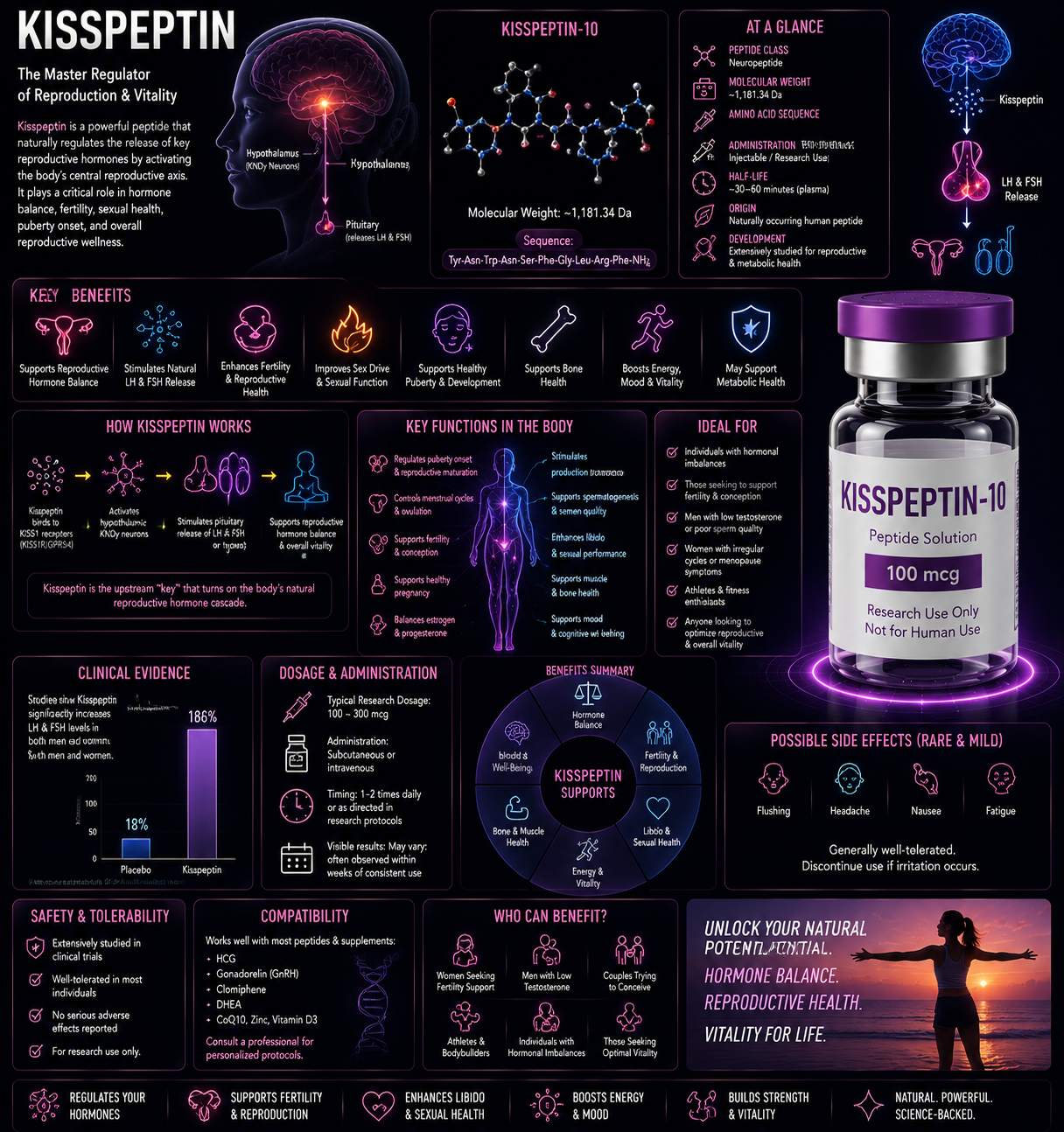
Kisspeptin: What It Is, How It Works, Benefits, and Research Overview What Is Kisspeptin? Kisspeptin is a naturally occurring neuropeptide hormone t
Kisspeptin: What It Is, How It Works, Benefits, and Research Overview
What Is Kisspeptin?
Kisspeptin is a naturally occurring neuropeptide hormone that plays a central role in regulating the hypothalamic-pituitary-gonadal (HPG) axis, reproductive hormones, puberty, fertility, and sex hormone signaling. It is encoded by the KISS1 gene and works by activating the GPR54 receptor (also called KISS1R). Hypothalamic–pituitary–gonadal axis
Kisspeptin is primarily produced in the:
- Hypothalamus
- Placenta
- Gonads (testes and ovaries)
- Liver and pancreas (lower levels)
Researchers and clinicians study kisspeptin for:
- Reproductive hormone regulation
- Testosterone and estrogen signaling
- Fertility and ovulation biology
- Puberty initiation
- Libido and sexual behavior signaling
- Metabolic and endocrine interactions
Unlike many investigational peptides, kisspeptin has been studied in human clinical research, particularly in reproductive endocrinology.
What Is Kisspeptin Made Of?
Kisspeptin exists in several forms:
- Kisspeptin-54 (metastin)
- Kisspeptin-14
- Kisspeptin-13
- Kisspeptin-10
These are shorter fragments derived from the same precursor peptide.
The most commonly studied forms in research are:
Kisspeptin-10 and Kisspeptin-54
All forms work through:
KISS1 receptor (GPR54) activation.
How Does Kisspeptin Work?
Kisspeptin functions as one of the body’s master regulators of reproductive hormone signaling.
1. Stimulates GnRH Release
Kisspeptin activates neurons in the hypothalamus to release:
GnRH (Gonadotropin-Releasing Hormone)
GnRH then stimulates the pituitary gland to release:
- LH (Luteinizing Hormone)
- FSH (Follicle-Stimulating Hormone)
These hormones regulate:
- Testosterone production
- Estrogen and progesterone signaling
- Sperm production
- Ovulation and menstrual cycles
In simple terms:
Kisspeptin says:
“Turn on reproductive hormone signaling.”
2. Testosterone and Estrogen Signaling
Because kisspeptin stimulates the HPG axis, researchers investigate whether it may influence:
In males
- Endogenous testosterone production
- Leydig cell stimulation (indirectly through LH)
- Fertility and spermatogenesis signaling
In females
- Ovulation signaling
- Menstrual cycle regulation
- Estrogen and progesterone rhythms
Importantly:
Kisspeptin is not testosterone or estrogen.
It influences upstream hormone signaling.
3. Fertility and Reproductive Research
Kisspeptin is heavily studied in:
- Female infertility
- IVF protocols
- Hypogonadotropic hypogonadism
- Delayed puberty
- Reproductive endocrine dysfunction
Researchers investigate kisspeptin because it may stimulate reproductive hormones in a more physiologic way than direct hormone administration.
4. Puberty and Development
Kisspeptin is considered one of the major signals involved in:
Puberty onset
Defects in KISS1/KISS1R signaling can cause:
- Delayed puberty
- Reproductive dysfunction
Excess signaling may contribute to:
- Precocious puberty
5. Libido, Mood, and Brain Signaling
Emerging research investigates kisspeptin for:
- Sexual desire and libido
- Emotional processing
- Reward and attraction signaling
- Mood and relationship bonding
Brain imaging studies suggest kisspeptin may influence:
- Limbic pathways
- Sexual attraction signaling
- Emotional and reward processing
These findings remain early-stage.
Why Is Kisspeptin Getting Attention?
Kisspeptin attracts attention because it combines several major themes:
- Natural testosterone and estrogen signaling
- Fertility biology
- Libido and sexual behavior research
- Puberty and reproductive development
- Endocrine optimization research
Researchers are especially interested in:
Stimulating reproductive hormones upstream rather than replacing them.
Potential Research Areas of Interest
1. Testosterone and HPG Axis Research
Researchers investigate whether kisspeptin may support:
- Endogenous testosterone signaling
- LH and FSH production
- HPG axis activation
- Reproductive hormone balance
2. Fertility Research
Experimental and clinical work explores kisspeptin in relation to:
- IVF support
- Ovulation induction
- Sperm production signaling
- Hypogonadism models
3. Libido and Sexual Health Research
Researchers study kisspeptin for:
- Sexual motivation signaling
- Libido and attraction pathways
- Relationship and reward neurobiology
4. Puberty and Endocrine Development
Researchers investigate kisspeptin for:
- Pubertal timing
- Reproductive maturation
- Developmental endocrine signaling
Kisspeptin vs HCG vs Testagen vs CJC-1295/Ipamorelin
| Feature | Kisspeptin | HCG | Testagen | CJC-1295/Ipamorelin |
|---|---|---|---|---|
| Main Focus | HPG axis & reproductive signaling | LH mimic | Endocrine bioregulation | Growth hormone signaling |
| Mechanism | GnRH → LH/FSH stimulation | Mimics LH directly | Tissue signaling | GH/IGF-1 pathway |
| Testosterone Effect | Indirect, endogenous | Direct stimulation | Experimental | Indirect via GH axis |
| Fertility Research | High | High | Experimental | Low |
| FDA Approved? | No | Yes | No | No |
Researchers generally view:
- Kisspeptin → upstream reproductive hormone regulator
- HCG → LH mimic
- Testagen → endocrine bioregulator peptide
- CJC/Ipamorelin → growth hormone secretagogues
Potential Side Effects and Safety Considerations
Human studies suggest kisspeptin is generally:
- Well tolerated
- Associated with mild side effects when reported, including:
- Headache
- Flushing
- Mild injection-site discomfort
- Temporary hormonal fluctuations
Because kisspeptin influences reproductive hormones:
Researchers continue evaluating:
- Long-term endocrine effects
- Hormonal feedback responses
- Fertility outcomes
Kisspeptin remains investigational and is not FDA approved for routine clinical hormone optimization.
Frequently Asked Questions
Is Kisspeptin a peptide?
Yes. Kisspeptin is a naturally occurring neuropeptide hormone that regulates reproductive hormone signaling.
Does kisspeptin increase testosterone?
Research suggests kisspeptin may increase endogenous testosterone indirectly by stimulating GnRH → LH → testosterone signaling, but responses vary.
Is kisspeptin fertility related?
Yes. Kisspeptin is heavily studied in fertility, ovulation, reproductive endocrinology, and IVF research.
Is kisspeptin FDA approved?
No. Kisspeptin remains investigational despite human clinical research.
How is kisspeptin different from HCG?
Kisspeptin stimulates upstream reproductive signaling (GnRH/LH/FSH), while HCG acts more like a direct LH mimic.
Final Thoughts
Kisspeptin is a key reproductive neuropeptide involved in puberty, fertility, libido, testosterone/estrogen signaling, and endocrine regulation through activation of the HPG axis. Researchers are especially interested in kisspeptin because it may support natural hormone signaling upstream, rather than replacing hormones directly. Although human research is promising, kisspeptin remains investigational, and long-term clinical applications continue to be studied.
