
*{box-sizing:border-box} body{margin:0;background:#f3f6fa;color:#172033;font-family:Arial,Helvetica,sans-serif;line-height:1.72} article{max-w
Small-Molecule Metabolism Research
SLU-PP-332 Scientific Overview: Structure, Mechanism, Research, and Testing
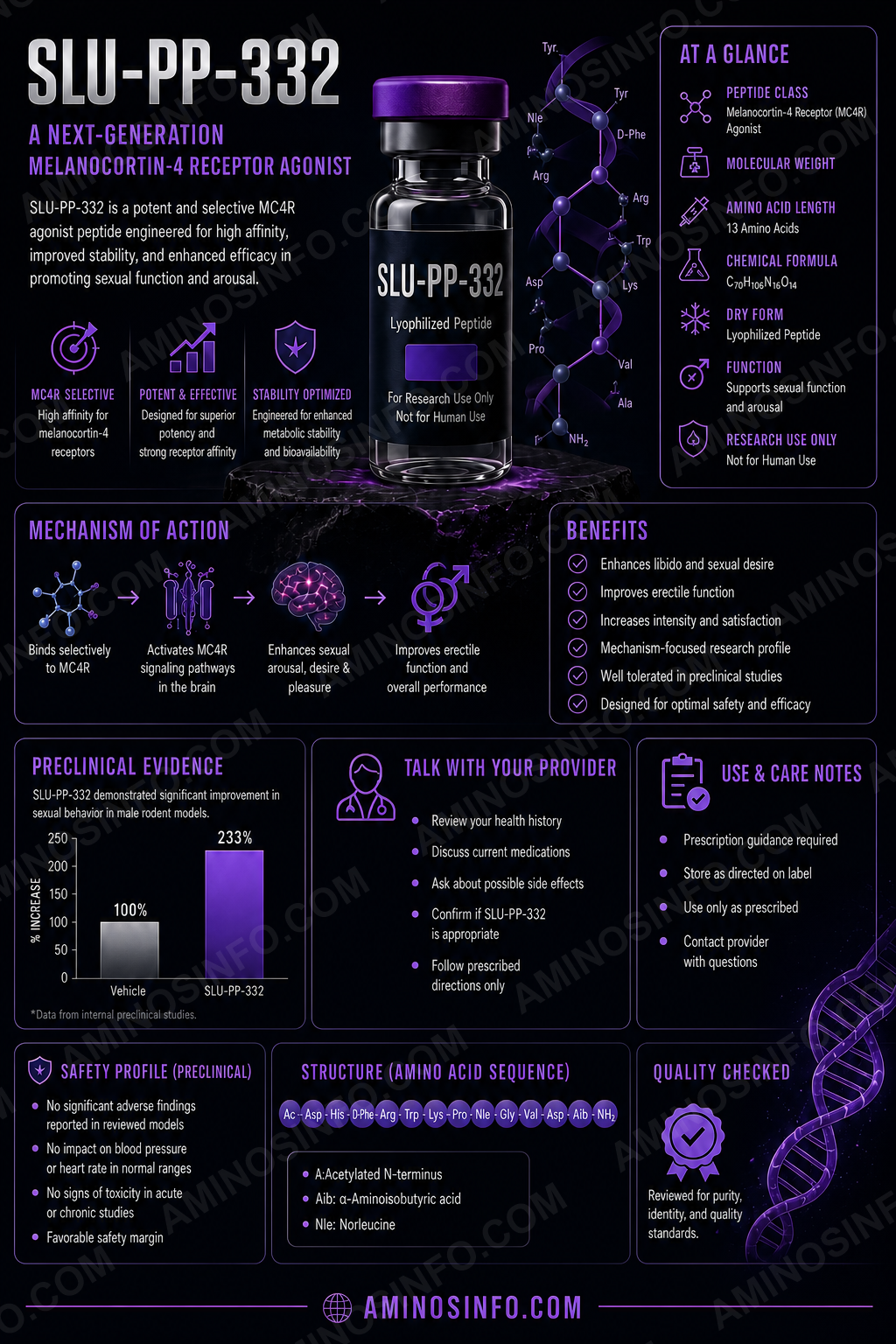
SLU-PP-332 scientific overview content often appears beside peptide research, but SLU-PP-332 is not a peptide. Instead, it is a preclinical synthetic small molecule that activates estrogen-related receptors and has produced exercise-associated metabolic effects in cells and animal models.
What Is SLU-PP-332?
SLU-PP-332 is an investigational pan-estrogen-related receptor agonist with its strongest reported potency at ERRα. It also activates ERRβ and ERRγ. These orphan nuclear receptors regulate transcriptional programs involving mitochondrial respiration, oxidative phosphorylation, fatty-acid oxidation, skeletal-muscle oxidative capacity, and metabolic adaptation.
In 2023, researchers reported that SLU-PP-332 increased mitochondrial function in skeletal-muscle cells and enhanced exercise endurance in mice. Next, a metabolic-syndrome study reported higher energy expenditure, increased fatty-acid oxidation, reduced fat-mass accumulation, and improved insulin sensitivity in mouse models. However, neither study established equivalent human effects.
Quick Scientific Profile
| Property | Information |
|---|---|
| For example, Compound | Meanwhile, SLU-PP-332 |
| Likewise, Compound class | In addition, Synthetic small molecule |
| Moreover, Peptide? | By contrast, No |
| Also, Primary targets | For example, ERRα, ERRβ, and ERRγ |
| Consequently, Strongest reported activity | For example, ERRα |
| Meanwhile, ERRα EC50 | Likewise, Approximately 98 nM |
| In addition, ERRβ EC50 | Moreover, Approximately 230 nM |
| By contrast, ERRγ EC50 | Also, Approximately 430 nM |
| Consequently, Molecular formula | For example, C18H14N2O2 |
| Meanwhile, Molecular weight | Likewise, Approximately 290.32 g/mol |
| In addition, CAS number | Moreover, 303760-60-3 |
| By contrast, Common chemical name | Also, 4-hydroxy-N′-(naphthalen-2-ylmethylene)benzohydrazide |
| Consequently, Development stage | For example, Preclinical |
| Meanwhile, FDA approved | Likewise, No |
| In addition, Established human dosage | None |
| Established human safety | No |
| Reported limitation | Moreover, Poor or absent useful oral bioavailability |
Importantly, the EC50 values came from cell-based transactivation assays. Therefore, researchers should not interpret them as human dose targets, blood concentrations, or safety thresholds.
Chemical Structure and Identity
In addition, SLU-PP-332 contains a 4-hydroxybenzoyl region, an acylhydrazone linker, and a 2-naphthyl region. A simplified representation is 4-hydroxyphenyl—C(=O)—NH—N=CH—2-naphthyl.
Core identifiers
Formula: However, C18H14N2O2
Average molecular weight: about 290.32 g/mol
CAS: 303760-60-3
InChIKey: RNZIMBFHRXYRLL-XDHOZWIPSA-N
Structural caution
Formula and mass alone cannot distinguish geometric isomers. Therefore, a defensible identity package should specify the E/Z configuration and include NMR, chromatographic, and mass-spectrometric evidence.
Does SLU-PP-332 have an amino-acid sequence?
No. It contains no amino-acid chain, N-terminus, C-terminus, or peptide-bond sequence. Consequently, any seller that provides an amino-acid sequence for SLU-PP-332 describes the chemistry incorrectly.
Molecular mass in LC-MS
The expected protonated ion generally appears near [M+H]+ m/z 291.11. However, observed ions can vary with ionization mode, adduct formation, mobile phase, and instrument settings.
Discovery and Research Timeline
Researchers identified the first estrogen-related receptor as an orphan nuclear receptor related to, but distinct from, classical estrogen receptors.
Therefore, Research established roles for ERRα, ERRβ, and ERRγ in mitochondrial gene expression, oxidative metabolism, cardiac energetics, and exercise adaptation.
Likewise, The principal SLU-PP-332 paper described a synthetic pan-ERR agonist with its greatest potency at ERRα and reported exercise-associated effects in cells and mice.
Meanwhile, A metabolic-syndrome study reported higher energy expenditure, fatty-acid oxidation, reduced fat accumulation, and improved insulin sensitivity in mouse models.
Consequently, Heart-failure research reported improved ejection fraction, fibrosis, mitochondrial function, and survival in a pressure-overload mouse model using SLU-PP-332 and SLU-PP-915.
Importantly, Researchers characterized orally active SLU-PP-915, analyzed SLU-PP-332 metabolites by LC-HRMS/MS, and published structure–activity research on the SLU-PP-332 scaffold.
Mechanism of Action
By contrast, SLU-PP-332 directly activates ERRα, ERRβ, and ERRγ. These nuclear receptors act as transcription factors rather than membrane receptors. After activation, they influence metabolic gene expression and interact with coactivator networks that include PGC-1α and PGC-1β.
Why researchers call it an exercise mimetic
The term means that the compound reproduced selected exercise-associated molecular signals in preclinical models. By contrast, SLU-PP-332 does not reproduce mechanical loading, balance, motor learning, bone adaptation, cardiovascular conditioning, or the psychological benefits of physical activity.
Mitochondrial respiration and fatty-acid oxidation
Cell and mouse studies reported increased mitochondrial respiration, oxygen consumption, oxidative muscle features, fatty-acid oxidation, and resting energy expenditure. Nevertheless, these measurements do not prove human fat loss or human athletic improvement.
Skeletal-muscle oxidative phenotype
Researchers reported more type IIa oxidative muscle fibers and improved treadmill endurance in mice. Therefore, the findings support ERRα-dependent metabolic adaptation in that model, not a claim that the compound builds human strength or replaces training.
Receptor Profile
| Receptor | Gene | Reported EC50 | Relative activity | Research relevance |
|---|---|---|---|---|
| ERRα | ESRRA | Approximately 98 nM | Strongest | Finally, Skeletal muscle, mitochondrial metabolism, fatty-acid oxidation, and cardiac energetics |
| ERRβ | ESRRB | Approximately 230 nM | Intermediate | Next, Development, stem-cell biology, and metabolic regulation |
| ERRγ | ESRRG | Approximately 430 nM | For example, Weakest of the three | Moreover, Oxidative metabolism, heart, skeletal muscle, and glucose regulation |
ERRs share evolutionary relationships with estrogen receptors, but they are distinct orphan nuclear receptors. Therefore, Researchers should not describe SLU-PP-332 as estradiol or as a conventional estrogen-receptor medicine. Likewise, claims of “zero hormonal effects” remain too strong without comprehensive human endocrine and off-target data.
Preclinical Research Findings
Exercise capacity
In addition, Mouse studies reported greater running distance and duration together with an ERRα-dependent acute aerobic-exercise transcriptional program.
Metabolic syndrome
However, Mouse models showed higher energy expenditure, increased fatty-acid oxidation, reduced fat-mass accumulation, and improved insulin sensitivity.
Heart failure
Therefore, Pan-ERR agonist studies reported improved ejection fraction, reduced fibrosis, stronger mitochondrial programs, and better survival in a pressure-overload model.
Aging and kidney biology
Likewise, Related ERR-agonist work has examined mitochondrial dysfunction, inflammation, fibrosis, and renal function in aging models.
Human muscle cells
Meanwhile, A pilot study treated cultured myoblasts obtained from women, but this ex-vivo work did not establish human therapeutic safety or efficacy.
Comparison With Other Research Compounds
SLU-PP-332 versus mitochondrial and metabolic compounds
| Compound | Molecule type | Sequence | Primary target | Research theme | Human research |
|---|---|---|---|---|---|
| SLU-PP-332 | Synthetic small molecule | Not applicable | ERRα/β/γ | Exercise-associated oxidative transcription | Consequently, No established human clinical program |
| MOTS-c | Mitochondrial-derived peptide | 16 amino acids | Importantly, Metabolic and stress-response pathways | Metabolic homeostasis | Limited experimental research |
| SS-31 / elamipretide | Synthetic tetrapeptide | 4 amino acids | By contrast, Cardiolipin-rich inner mitochondrial membrane | Finally, Mitochondrial membrane and electron transport | Substantial clinical investigation |
| Tesofensine | Synthetic small molecule | Not applicable | Monoamine transporters | Next, Appetite and weight regulation | Human obesity trials |
SLU-PP-332 versus other ERR modulators
| Compound | Functional profile | Receptor preference | Research role |
|---|---|---|---|
| SLU-PP-332 | Agonist | For example, Pan-ERR; strongest at ERRα | Moreover, Exercise-mimetic and metabolic proof-of-concept compound |
| SLU-PP-915 | Agonist | Pan-ERR | In addition, Newer orally active research analog |
| GSK4716 | Agonist | ERRβ/ERRγ preference | However, Early ERR agonist and chemical scaffold |
| DY131 | Agonist | ERRβ/ERRγ | Therefore, Transcriptional and metabolic research |
| XCT790 | Inverse agonist | Likewise, Commonly used against ERRα | ERRα inhibition studies |
| GSK5182 | Inverse agonist | ERRγ preference | Hepatic glucose-metabolism research |
| CREP-1 | Agonist | ERRα-selective research tool | Meanwhile, Selective ERRα pathway investigation |
Consequently, Direct potency comparisons require caution because assay design, receptor expression, reporter system, incubation time, and reference standards can change numerical results.
Pharmacokinetics and Oral Bioavailability
The original mouse studies used administration routes intended to establish biological proof of concept. More recent peer-reviewed work explicitly states that SLU-PP-332 lacks oral bioavailability. Consequently, researchers developed SLU-PP-915 as a chemically distinct, orally active pan-ERR agonist.
Safety and Research Limitations
Importantly, No adequate clinical evidence defines safe human exposure, maximum tolerated dose, reproductive toxicity, carcinogenicity, genotoxicity, cardiovascular risk, liver safety, kidney safety, endocrine effects, or drug interactions.
Moreover, ERRs regulate fundamental metabolic programs across the heart, liver, skeletal muscle, and other tissues. Therefore, sustained activation could produce complex tissue-specific effects that require formal toxicology and safety-pharmacology studies.
- By contrast, Human pharmacokinetics remain undefined.
- Finally, Long-term toxicology remains incomplete.
- Next, Comprehensive off-target and ion-channel profiling remains unavailable publicly.
- For example, Animal doses cannot establish human safety through simple conversion.
- Moreover, Poor oral exposure limits interpretation of capsule claims.
Recommended Analytical Testing Methods
LC-MS or LC-HRMS identity
Confirm exact mass, isotope pattern, parent ion, and fragments. However, mass alone may not distinguish E/Z or positional isomers.
HPLC or UPLC purity
In addition, Report wavelength, column, mobile phases, gradient, integration, main-peak area, and detectable impurities.
Quantitative assay
However, Determine the actual amount with a validated HPLC, UPLC, qNMR, or LC-MS/MS method and a qualified reference standard.
NMR spectroscopy
Therefore, Use 1H, 13C, and two-dimensional NMR when needed to support connectivity, hydrazone structure, and E/Z configuration.
Residual solvents
Likewise, Use headspace GC-FID or GC-MS with a process-specific panel and science-based limits.
Elemental impurities
Meanwhile, Use ICP-MS or ICP-OES for relevant toxic elements and process-specific catalysts.
Water content
Consequently, Use Karl Fischer titration or a scientifically justified alternative because water affects potency by weight and stability.
Related substances
Importantly, Use a stability-indicating method that separates starting materials, isomers, hydrolysis products, oxidation products, and photodegradation products.
Microbiological testing
By contrast, Match microbial limits or sterility claims to the product type and manufacturing controls.
Dosage-unit testing
Finally, For capsules or tablets, evaluate content uniformity, assay, weight variation, disintegration, and other suitable finished-product tests.
How to Interpret an SLU-PP-332 COA
Identity and batch linkage
First, confirm the product name, chemical name, CAS number, formula, molecular weight, lot number, test date, sample description, laboratory name, and report number. Next, match the lot number to the exact container.
Purity and content
Review the chromatogram, method, wavelength, integration table, largest impurity, and total impurity result. In addition, require a separate quantitative assay because HPLC area percentage does not equal milligrams per capsule or container.
Contaminants and reference standards
Examine residual solvents, elemental impurities, water, microbial limits, and process-specific impurities. Moreover, identify the reference-standard source, lot, assigned purity, and qualification procedure.
COA red flags
- First, the document calls SLU-PP-332 a peptide or lists an amino-acid sequence.
- Next, the lot number does not match the product.
- Also, the report shows “99% purity” without a method or chromatogram.
- Moreover, molecular weight serves as the only identity result.
- In addition, the COA confuses chromatographic purity with milligram content.
- Likewise, the structural isomer remains unspecified.
- Then, the laboratory, report number, or analytical attachments are missing.
- Finally, the document reports implausibly perfect results across every test.
Frequently Asked Questions
Is SLU-PP-332 a peptide?
No. Instead, it is a synthetic small molecule and has no amino-acid sequence.
What is its molecular formula?
Consequently, The molecular formula is C18H14N2O2.
What is its molecular weight?
Importantly, The average molecular weight is approximately 290.32 g/mol.
Which receptors does it activate?
By contrast, It activates ERRα, ERRβ, and ERRγ, with the strongest reported potency at ERRα.
Why is it called an exercise mimetic?
Finally, It reproduced selected aerobic-exercise-associated metabolic and transcriptional signals in preclinical models.
Does it reproduce every benefit of exercise?
Next, No. It does not reproduce mechanical loading, motor learning, bone adaptation, cardiovascular conditioning, or psychological benefits.
Does it burn fat?
Mouse studies reported greater fatty-acid oxidation and reduced fat-mass accumulation. However, comparable human effects remain unestablished.
Does it increase endurance?
For example, Researchers reported improved exercise endurance in mice. Human athletic-performance effects remain unknown.
Is it orally bioavailable?
Peer-reviewed research describes poor oral bioavailability. Therefore, researchers developed SLU-PP-915 partly to address this limitation.
Have researchers tested it in humans?
Moreover, Researchers have used it in cultured human myoblasts, but no established human therapeutic safety or efficacy profile exists.
Is it FDA approved?
In addition, No. It has no FDA-approved indication or established human dosing regimen.
Can researchers convert mouse doses into human doses?
However, Simple conversion cannot establish safety because pharmacokinetics, formulation, toxicology, and tissue exposure remain unknown.
Does 99% HPLC purity prove the labeled amount?
Therefore, No. Chromatographic area purity and quantitative content are different measurements.
Can LC-MS distinguish E and Z isomers?
Not necessarily. Therefore, chromatographic separation and NMR may be necessary.
SLU-PP-332 Scientific Overview: Conclusion
SLU-PP-332 scientific overview Likewise, evidence identifies the compound as a preclinical pan-ERR agonist with its greatest reported potency at ERRα. Cell and animal studies support effects on mitochondrial respiration, fatty-acid oxidation, oxidative muscle features, energy expenditure, and exercise endurance.
However, SLU-PP-332 has not demonstrated safety or effectiveness in humans. Finally, poor oral bioavailability, incomplete toxicology, uncertain long-term effects, and the absence of controlled human trials remain major limitations.
Authoritative References
- Meanwhile, Billon C, et al. Synthetic ERRα/β/γ agonist induces an ERRα-dependent acute aerobic exercise response and enhances exercise capacity. ACS Chemical Biology. 2023.
- Consequently, Billon C, et al. A synthetic ERR agonist alleviates metabolic syndrome. Journal of Pharmacology and Experimental Therapeutics. 2024.
- Importantly, Xu W, et al. Novel pan-ERR agonists ameliorate heart failure through enhancing cardiac fatty-acid metabolism and mitochondrial function.
- By contrast, An orally active estrogen receptor-related receptor agonist, SLU-PP-915, enhances aerobic exercise capacity.
- Finally, Möller T, et al. In-vitro metabolism and analytical characterization of SLU-PP-332 and SLU-PP-915. 2026.
- Next, Avliyakulov NK, et al. Analysis and identification of in-vitro metabolites of SLU-PP-332. 2026.
- For example, Chemical optimization of the exercise mimetic SLU-PP-332 enables insight into estrogen-related receptor signaling. 2026.
- Moreover, FDA: Analytical Procedures and Methods Validation for Drugs and Biologics.
- In addition, ICH Q2(R2): Validation of Analytical Procedures.