
:root{--ink:#16202a;--muted:#5c6975;--line:#dce3e8;--panel:#f6f8fa;--accent:#174f69;--accent2:#743f3f;--warning-bg:#fff8e8} *{box-sizing:border
Dermorphin Scientific Overview: Structure, Mechanism, Research, and Testing
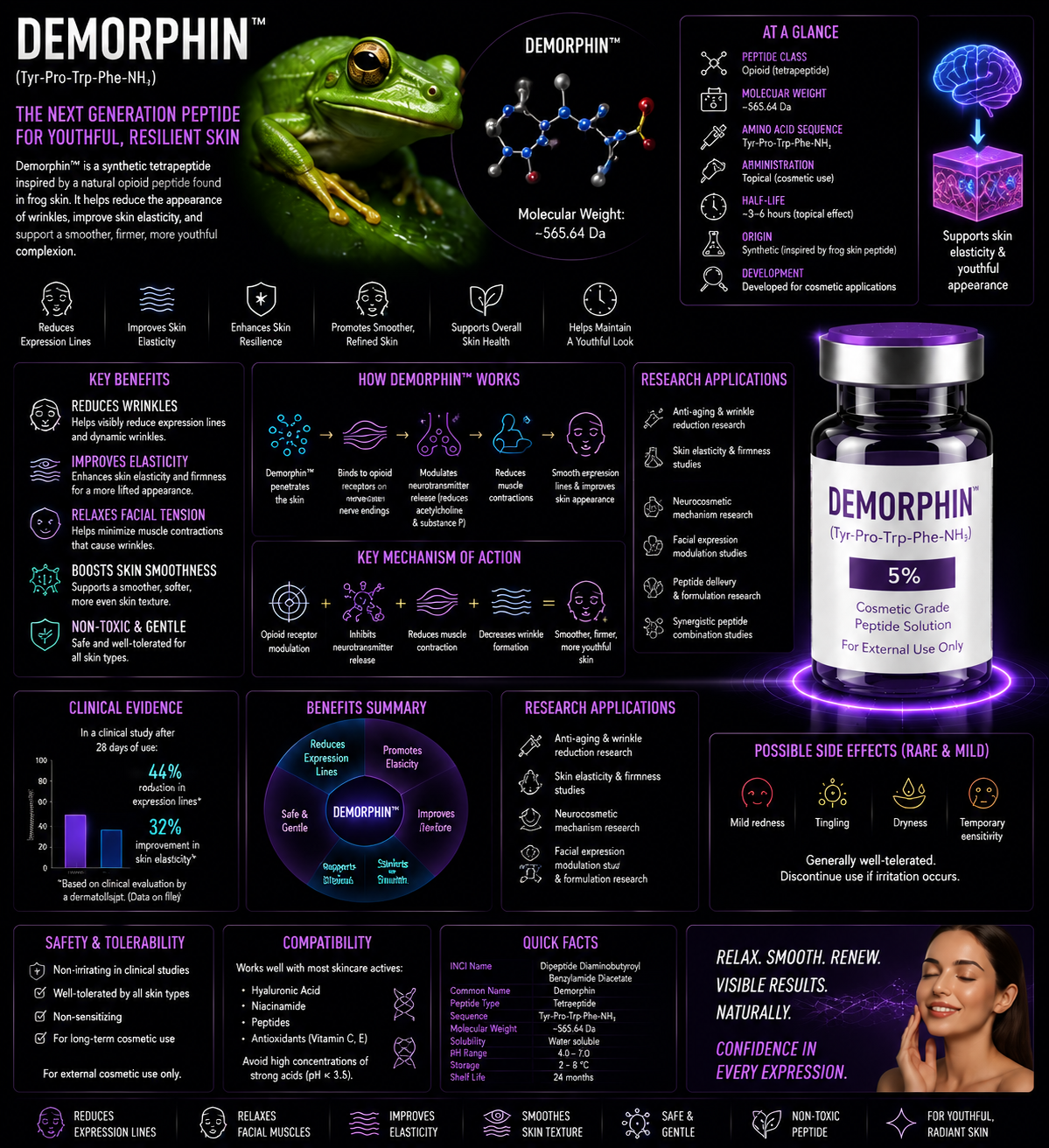
For example, Dermorphin scientific overview content should distinguish this frog-derived opioid peptide from milk-derived β-casomorphins. This peptide contains D-alanine at position 2, strongly activates the μ-opioid receptor, and carries serious opioid-related safety risks.
Important Scientific Correction: Dermorphin vs β-Casomorphin
First, the original draft described a milk-derived peptide with the sequence Tyr-Pro-Phe-Pro-Gly-Pro-Ile. However, that compound is bovine β-casomorphin-7, not dermorphin.
By contrast, dermorphin is a distinct amphibian peptide originally isolated from frog skin secretion. Its sequence is:
H-Tyr-D-Ala-Phe-Gly-Tyr-Pro-Ser-NH₂
| Feature | Dermorphin | β-Casomorphin-7 |
|---|---|---|
| Origin | Meanwhile, Amphibian skin secretion and precursor proteins | Likewise, Released during digestion of β-casein |
| Sequence | Tyr-D-Ala-Phe-Gly-Tyr-Pro-Ser-NH₂ | Tyr-Pro-Phe-Pro-Gly-Pro-Ile |
| Key receptor | Highly μ-opioid selective | In addition, Food-derived opioid activity, generally weaker |
| D-amino acid | Moreover, Contains D-alanine at position 2 | By contrast, No D-amino acid in the native sequence |
What Is Dermorphin?
First, dermorphin is a naturally occurring opioid heptapeptide first isolated from the skin secretion of a South American phyllomedusine frog. It belongs to a group of bioactive amphibian peptides involved in chemical defense.
Next, dermorphin is notable because it is an exceptionally potent and highly selective μ-opioid receptor agonist and because it contains D-alanine, an amino acid with the opposite stereochemical configuration from the L-amino acids ordinarily incorporated during ribosomal protein synthesis.
Moreover, the D-alanine residue increases resistance to enzymatic degradation and is central to the peptide’s high potency. Amphibian cells first synthesize an L-amino-acid-containing precursor, after which a specialized post-translational isomerization converts the second residue into D-alanine.
Amphibian opioid heptapeptide
μ-opioid receptor (MOR)
Phyllomedusine frog skin secretion
7 amino acids
D-Ala at position 2
Not FDA approved
🧬 Molecular Structure
First, dermorphin is a linear, C-terminally amidated heptapeptide. Unlike oxytocin or Melanotan II, it does not contain a disulfide or lactam ring. Its conformational stability comes partly from D-Ala2, aromatic residues, proline, and C-terminal amidation.
🧪 Amino-Acid Sequence
H-Tyr-D-Ala-Phe-Gly-Tyr-Pro-Ser-NH₂
| Position | Residue | Functional relevance |
|---|---|---|
| 1 | Tyrosine | Also, Free N-terminal tyrosine is a classic opioid pharmacophore element. |
| 2 | D-Alanine | Consequently, Improves resistance to aminopeptidases and strongly influences receptor affinity. |
| 3 | Phenylalanine | However, Aromatic residue contributing to receptor interaction. |
| 4 | Glycine | Provides conformational flexibility. |
| 5 | Tyrosine | Therefore, Contributes an additional aromatic and hydrogen-bonding group. |
| 6 | Proline | For example, Constrains local peptide conformation. |
| 7 | Serinamide | Meanwhile, C-terminal amidation supports stability and full activity. |
⚛️ Molecular Weight and 🧫 Formula
| Molecular formula | Likewise, C40H50N8O10 |
|---|---|
| Average molecular weight | Approximately 802.9 g/mol |
| Peptide length | 7 amino acids |
| C-terminal modification | Amidated |
| CAS number | 77614-16-5 |
| PubChem CID | 5485199 |
📅 Discovery Timeline
1960s–1970s: Amphibian skin-peptide research expands
First, Vittorio Erspamer and colleagues systematically investigated frog-skin secretions and identified numerous vasoactive, antimicrobial, and neuroactive peptides.
1981: Dermorphin characterized
Next, researchers reported dermorphin and related peptides as a new class of potent opioid peptides from amphibian skin. For example, their unusually strong opioid activity and D-alanine residue immediately attracted attention.
1980s: Receptor pharmacology established
Then, binding and tissue studies demonstrated strong μ-opioid receptor preference and potent inhibition in classical opioid bioassays.
Late 1980s–1990s: Biosynthesis of D-amino-acid peptides investigated
Afterward, researchers determined that post-translational isomerization generates the D-residue rather than an unusual genetic code.
1990s–2000s: Analogs and delivery systems explored
Meanwhile, researchers studied shortened fragments, receptor-selective analogs, prodrugs, and transport strategies to preserve analgesia while improving stability or central delivery.
2010s: Equine racing misuse gains attention
In addition, laboratories detected dermorphin in illicit performance-enhancing preparations used in racehorses, leading laboratories and racing authorities to develop sensitive LC-MS/MS detection methods.
Present research
Finally, dermorphin remains a pharmacological research tool for μ-opioid receptor structure-activity studies, peptide stereochemistry, analgesia, transport, tolerance, and opioid-receptor signaling.
📖 Research History
Importantly, dermorphin helped overturn the assumption that animal peptides contain only L-amino acids. Meanwhile, its discovery led to broader recognition of ribosomally synthesized peptides that undergo post-translational L-to-D isomerization.
Moreover, dermorphin became valuable because it combines high μ-opioid potency with unusual enzymatic stability. Likewise, researchers used it to map the structural requirements for μ-receptor activation and to develop truncated analogs retaining substantial activity.
However, despite strong analgesic activity in preclinical experiments, dermorphin did not become a conventional approved pain medicine. In addition, its opioid toxicity, poor oral bioavailability, limited ability to cross the intact blood-brain barrier, and difficulty controlling systemic exposure have limited clinical development.
🧠 Mechanism of Action
First, dermorphin acts predominantly as an agonist of the μ-opioid receptor (MOR), a Gi/o-coupled G-protein-coupled receptor expressed in the central nervous system, peripheral sensory pathways, gastrointestinal tract, and other tissues.
1. μ-Opioid receptor binding
Next, the N-terminal Tyr-D-Ala-Phe region forms the core opioid pharmacophore and binds with high affinity to MOR.
2. Gi/o-protein activation
Then, activated MOR suppresses adenylyl cyclase, reducing intracellular cyclic AMP.
3. Ion-channel modulation
Afterward, MOR signaling opens inwardly rectifying potassium channels and inhibits voltage-gated calcium channels.
4. Reduced transmitter release
Moreover, lower presynaptic calcium entry reduces release of substance P, glutamate, and other neurotransmitters involved in nociception.
5. Neuronal hyperpolarization
In addition, potassium efflux makes postsynaptic neurons less excitable, reducing propagation of pain signals.
6. Reward and respiratory pathways
Finally, the same receptor system that mediates analgesia also affects reward, sedation, gastrointestinal motility, endocrine function, and respiratory rhythm.
🎯 Opioid Receptor Profile
| Receptor | Principal effects | Dermorphin relevance |
|---|---|---|
| μ-Opioid receptor | In addition, Analgesia, reward, respiratory depression, sedation, constipation | Primary high-affinity target. |
| δ-Opioid receptor | Moreover, Analgesia, mood, emotional processing | By contrast, Much lower affinity than MOR for native dermorphin. |
| κ-Opioid receptor | Also, Analgesia, dysphoria, stress responses | Consequently, Not a primary target of native dermorphin. |
| Nociceptin receptor | However, Pain and stress modulation | Therefore, Not considered a major dermorphin target. |
Potential Research Areas
1. Analgesia and nociception
For example, dermorphin produces strong antinociceptive effects in animal models after routes that provide receptor access. Moreover, researchers have compared its potency, duration, tolerance, and side-effect profile with morphine and other opioid ligands.
2. Structure-activity relationships
Moreover, researchers use the peptide to study how N-terminal tyrosine, D-Ala2, aromatic residues, peptide length, and C-terminal amidation determine MOR selectivity.
3. D-amino-acid biochemistry
In addition, dermorphin precursors are models for post-translational amino-acid isomerization in animal cells.
4. Blood-brain barrier delivery
Likewise, researchers have explored lipidization, glycosylation, transporter targeting, intrathecal delivery, and prodrug approaches to increase central exposure.
5. Peripheral opioid analgesia
Meanwhile, researchers have studied dermorphin analogs for peripheral analgesic effects that might theoretically reduce central adverse effects.
6. Tolerance and receptor signaling bias
Furthermore, researchers have investigated dermorphin and its analogs for MOR internalization, β-arrestin recruitment, G-protein signaling, tolerance, and receptor trafficking.
7. Analytical and anti-doping science
Finally, laboratories have developed LC-MS/MS methods to detect dermorphin and related opioid peptides in biological samples, especially in equine racing investigations.
Safety, Misuse, and Regulatory Considerations
Respiratory depression
First, strong MOR agonism can suppress brainstem respiratory drive. By contrast, severe exposure may cause slow or stopped breathing, hypoxia, coma, or death.
Sedation and impaired consciousness
Next, potential opioid effects include drowsiness, confusion, impaired coordination, and loss of consciousness.
Dependence and tolerance
Moreover, repeated MOR activation can produce tolerance, physical dependence, withdrawal, craving, and compulsive use.
Gastrointestinal effects
In addition, opioid-receptor activation can reduce intestinal motility and cause constipation, nausea, vomiting, or ileus.
Unknown human pharmacokinetics
Importantly, no established therapeutic dosage exists, approved route, standardized formulation, or validated long-term human safety profile.
Product-quality risk
Consequently, unregulated material may contain incorrect sequence, insufficient D-Ala content, racemized impurities, truncated peptides, residual solvents, endotoxin, or microbial contamination.
Equine and sports misuse
Moreover, people have used dermorphin illicitly in horse racing because analgesia can mask pain and allow injured animals to continue competing.
Regulatory status
Finally, the FDA has not approved dermorphin for human or veterinary use. Also, it should not be represented as an approved analgesic, supplement, wellness peptide, or safe substitute for prescription pain treatment.
🧪 Laboratory Testing Methods
| Method | Purpose | Important limitation |
|---|---|---|
| RP-HPLC or UPLC | For example, Measures chromatographic purity and separates related impurities. | Meanwhile, Does not prove exact sequence, stereochemistry, potency, or sterility alone. |
| LC-MS / HRMS | Likewise, Confirms intact molecular mass. | In addition, D-Ala and L-Ala versions have the same mass. |
| MS/MS peptide mapping | Moreover, Supports sequence confirmation and detects truncations or substitutions. | By contrast, Standard fragmentation may still not establish residue chirality. |
| Chiral amino-acid analysis | Also, Confirms D-alanine and detects racemization. | Consequently, Requires specialized derivatization or chromatographic methods. |
| Amino-acid analysis | However, Confirms composition and supports quantitative assay. | Therefore, Does not independently prove residue order. |
| For example, Assay / net peptide content | Meanwhile, Measures actual dermorphin amount. | Likewise, do not infer net content from HPLC area percentage. |
| Receptor-binding assay | In addition, Measures MOR affinity relative to a reference ligand. | Moreover, Binding does not necessarily equal functional potency. |
| Functional MOR assay | By contrast, Measures G-protein signaling, cAMP inhibition, or β-arrestin recruitment. | Also, Cell system and assay design strongly affect results. |
| Consequently, Residual solvents and counterions | However, Evaluates synthesis-related solvents and salts. | Therefore, Does not establish biological safety. |
| Endotoxin and sterility | For example, Evaluates pyrogenic endotoxin and viable microorganisms. | Meanwhile, Each test answers a different question. |
| Elemental impurities | Likewise, Measures toxic metals and process contaminants. | In addition, Does not establish identity or opioid potency. |
📄 How to Interpret a Dermorphin COA
1. Confirm the exact name
First, the COA should state dermorphin, not “demorphin,” β-casomorphin, deltorphin, dermenkephalin, or a dermorphin analog.
2. Verify the full sequence
Next, the expected native sequence is Tyr-D-Ala-Phe-Gly-Tyr-Pro-Ser-NH₂. The D-configuration at position 2 and the C-terminal amide must be specified.
3. Do not rely on molecular mass for stereochemistry
Importantly, D-Ala and L-Ala have identical molecular formulas and masses. Consequently, intact LC-MS cannot prove that the second residue is D-alanine.
4. Separate purity, identity, content, and potency
- Identity First, confirms the claimed peptide sequence and structure.
- Purity Next, estimates relative chromatographic composition.
- Net peptide content Also, measures actual dermorphin quantity.
- Potency Moreover, measures MOR binding or functional activity.
5. Check amidation and truncation impurities
Moreover, loss of the terminal amide, deletion sequences, incomplete synthesis, or oxidation can alter receptor activity.
6. Review counterion and water content
Finally, acetate, trifluoroacetate, water, and residual solvents contribute to powder mass and can cause gross vial weight to differ from net peptide content.
📊 Dermorphin vs β-Casomorphin-7 vs Endorphin vs Enkephalin
Origin, Sequence, and Receptor Differences
| Feature | Dermorphin | β-Casomorphin-7 | β-Endorphin | Met-Enkephalin |
|---|---|---|---|---|
| Source | Moreover, Amphibian skin peptide precursor | β-Casein digestion | Human POMC precursor | Endogenous proenkephalin precursor |
| Sequence length | 7 residues | 7 residues | 31 residues | 5 residues |
| Distinctive feature | D-Ala2 | Food-derived exorphin | Endogenous pituitary/CNS opioid | Short endogenous opioid |
| Primary receptor emphasis | Strong μ selectivity | By contrast, μ-opioid activity, weaker and context dependent | Also, μ and δ activity | Consequently, δ and μ activity |
| FDA-approved drug? | For example, No; dermorphin remains unapproved. | Moreover, No; β-casomorphin-7 is not an approved drug. | In addition, No; β-endorphin is endogenous rather than an approved drug. | However, No; Met-enkephalin is endogenous rather than an approved drug. |
Dermorphin vs Morphine
Peptide Versus Small-Molecule Opioid
| Property | Dermorphin | Morphine |
|---|---|---|
| Compound type | Peptide | Small-molecule alkaloid |
| Primary target | μ-opioid receptor | μ-opioid receptor |
| Oral bioavailability | However, Expected to be poor because it is a peptide | Therefore, Clinically usable by multiple routes |
| Blood-brain barrier | For example, Limited after many peripheral routes | Meanwhile, Crosses sufficiently for central clinical effects |
| Approval status | Not approved | Approved prescription opioid |
| Major shared risk | Likewise, Respiratory depression from MOR activation | In addition, Respiratory depression from MOR activation |
🔗 Related Peptides
- Deltorphins: First, Amphibian peptides with strong δ-opioid receptor selectivity.
- Dermenkephalin: Next, A frog-derived opioid peptide containing D-methionine.
- Hyp6-dermorphin: Also, A naturally occurring hydroxyproline-containing dermorphin analog.
- β-Casomorphin-7: Moreover, A milk-protein-derived exorphin often confused with dermorphin.
- Met-enkephalin and Leu-enkephalin: In addition, Endogenous opioid pentapeptides.
- β-Endorphin: Likewise, A longer endogenous POMC-derived opioid peptide.
- Dynorphin: Finally, An endogenous peptide with stronger κ-opioid receptor relevance.
🖼️ Original Diagram Specifications
Diagram 1: Dermorphin sequence and stereochemistry
Moreover, Create a horizontal seven-residue sequence showing Tyr-D-Ala-Phe-Gly-Tyr-Pro-Ser-NH₂. However, highlight D-Ala in a contrasting shape and label it as a post-translationally isomerized residue.
Diagram 2: Dermorphin vs β-casomorphin
By contrast, Use a split graphic showing frog skin and the dermorphin sequence on one side, and milk β-casein digestion with the β-casomorphin-7 sequence on the other.
Diagram 3: μ-Opioid receptor pathway
Also, Illustrate dermorphin binding MOR, activating Gi/o, lowering cAMP, opening potassium channels, inhibiting calcium channels, and reducing neurotransmitter release.
Diagram 4: Analgesia and toxicity branches
Consequently, Show MOR activation branching toward analgesia on one side and respiratory depression, sedation, constipation, reward, and dependence on the other.
Diagram 5: COA verification workflow
However, Show sequence verification, intact mass, MS/MS mapping, D-Ala chiral analysis, amidation confirmation, net content, MOR potency, endotoxin, sterility, and final report review.
❓ Frequently Asked Questions
Is it dermorphin or demorphin?
Therefore, The scientifically recognized peptide is dermorphin. “Demorphin” is generally a misspelling or confusion with another peptide.
Is dermorphin derived from milk?
For example, No. Therefore, dermorphin is an amphibian skin peptide. The milk-derived sequence Tyr-Pro-Phe-Pro-Gly-Pro-Ile is β-casomorphin-7.
Is dermorphin an opioid?
Meanwhile, Yes. For example, it is a highly potent peptide agonist of the μ-opioid receptor.
Is dermorphin stronger than morphine?
Likewise, In certain preclinical assays and direct central-administration models, dermorphin can appear substantially more potent. Meanwhile, that does not translate into a safe or approved human treatment.
Can dermorphin cross the blood-brain barrier?
In addition, Native peptide entry is limited after many peripheral routes. Likewise, experimental delivery methods have been studied to increase central exposure.
Can dermorphin cause respiratory depression?
Moreover, Yes. In addition, strong μ-opioid receptor activation can suppress breathing and can be fatal.
Is dermorphin FDA approved?
By contrast, No. Moreover, it is not FDA approved for human or veterinary treatment.
Why is D-alanine important?
Also, D-Ala2 increases resistance to enzymatic breakdown and is central to dermorphin’s receptor affinity and potency.
Can LC-MS prove the D-alanine is present?
Consequently, Not by intact mass alone. By contrast, d- and L-alanine have the same mass, so chiral analysis or another stereochemistry-sensitive method is needed.
Does 99% HPLC purity mean the product is safe?
However, No. Also, it does not prove correct stereochemistry, net content, opioid potency, sterility, endotoxin safety, or absence of residual solvents.
Dermorphin Scientific Overview: Final Thoughts
In conclusion, dermorphin is a potent frog-derived μ-opioid receptor agonist distinguished by its D-alanine residue and unusually strong, long-lasting opioid activity in experimental systems. Consequently, it is not a milk-derived exorphin, and it should not be confused with β-casomorphin-7.
Moreover, its scientific importance lies in opioid receptor pharmacology, D-amino-acid biochemistry, peptide stability, analgesia research, and receptor-signaling studies. Its potency also creates serious safety concerns, including respiratory depression, sedation, dependence, and fatal overdose risk.
Finally, dermorphin remains an experimental research peptide with no approved human or veterinary therapeutic use. Analytical evaluation must verify not only sequence and mass but also D-Ala stereochemistry, amidation, net peptide content, potency, and contamination controls.
📚 References
- Therefore, Broccardo M, et al. Pharmacological data on dermorphins, a new class of potent opioid peptides from amphibian skin. British Journal of Pharmacology. 1981.
- Likewise, Broccardo M, et al. Pharmacological data on dermorphins. Full-text archive.
- For example, Montecucchi PC, et al. Dermorphin, a new peptide from amphibian skin with potent opiate-like activity. International Journal of Peptide and Protein Research. 1981.
- Moreover, Amiche M, et al. Dermenkephalin and D-amino-acid-containing amphibian opioid peptides. 1989.
- In addition, Amiche M, et al. Opioid peptides from frog skin. 1998.
- However, Mor A, et al. Identification of a D-alanine-containing polypeptide precursor. Journal of Biological Chemistry. 1991.
- Therefore, National Center for Biotechnology Information. PubChem Compound Summary: Dermorphin.
- Likewise, NCATS Inxight Drugs. Dermorphin structure record.
- For example, Hesselink JMK. Rediscovery of old drugs: the forgotten case of dermorphin for postoperative pain. 2018.
- Moreover, Deigin V, et al. The neurotropic activity of novel dermorphin analogs. 2025.
- In addition, Henschen A, et al. Novel opioid peptides derived from casein. 1979.
- However, Tyagi A, et al. Food-derived opioid peptides in human health. 2020.
- Therefore, de Vasconcelos M, et al. Difficulties in establishing adverse effects of β-casomorphin-7. 2023.
- Likewise, Ali AH, et al. β-Casomorphin-7: occurrence, identification, and health evidence. 2026.
- Pasternak GW, Pan YX. Mu opioids and their receptors: evolution of a concept. Pharmacological Reviews.
- Stein C. Opioid receptors. Annual Review of Medicine.
- Williams JT, et al. Regulation of μ-opioid receptors: desensitization, phosphorylation, internalization, and tolerance. Pharmacological Reviews.
- Al-Hasani R, Bruchas MR. Molecular mechanisms of opioid receptor-dependent signaling and behavior. Anesthesiology.
- Valentino RJ, Volkow ND. Untangling the complexity of opioid receptor function. Neuropsychopharmacology.
- International Council for Harmonisation. ICH Q2(R2): Validation of Analytical Procedures.
- United States Pharmacopeia. General Chapter <621>, Chromatography.
- United States Pharmacopeia. General Chapter <71>, Sterility Tests.
- United States Pharmacopeia. General Chapter <85>, Bacterial Endotoxins Test.
- United States Pharmacopeia. General Chapters <232> and <233>, Elemental Impurities.
- International Council for Harmonisation. ICH Q3C: Impurities—Guideline for Residual Solvents.
- International Council for Harmonisation. ICH Q6B: Specifications—Test Procedures and Acceptance Criteria for Biotechnological/Biological Products.
Foundational Dermorphin and Opioid-Peptide Sources
Opioid Pharmacology and Analytical Sources
Compound identity, molecular properties, and key scientific distinctions were reviewed in July 2026. Finally, dermorphin remains an unapproved experimental opioid peptide.