
:root{--ink:#16202a;--muted:#5c6975;--line:#dce3e8;--panel:#f6f8fa;--accent:#174f69;--accent2:#5f536f;--warning-bg:#fff8e8} *{box-sizing:border
SYN-AKE Scientific Overview: Identity, Mechanism, Evidence, and Testing
For example, SYN-AKE scientific overview content should distinguish this cosmetic active from waglerin-1, snake venom, botulinum toxin, and unrelated peptide sequences. This small synthetic peptide-derived ingredient marketed for the visible appearance of expression lines.
Important Scientific Correction
First, the original draft called SYN-AKE a “dipeptide hexapeptide” and listed the sequence H-His-Dap-Ala-His-Dap-Arg-OH. However, that is not the recognized identity of SYN-AKE.
Instead, the accepted cosmetic INCI name is Dipeptide Diaminobutyroyl Benzylamide Diacetate. Despite the word “dipeptide” in the INCI name, the ingredient is commonly described in supplier and chemistry literature as a compact synthetic tripeptide-derived compound rather than a six-residue hexapeptide.
Meanwhile, H-β-Ala-Pro-Dab-NH-Bzl · 2 AcOH
What Is SYN-AKE?
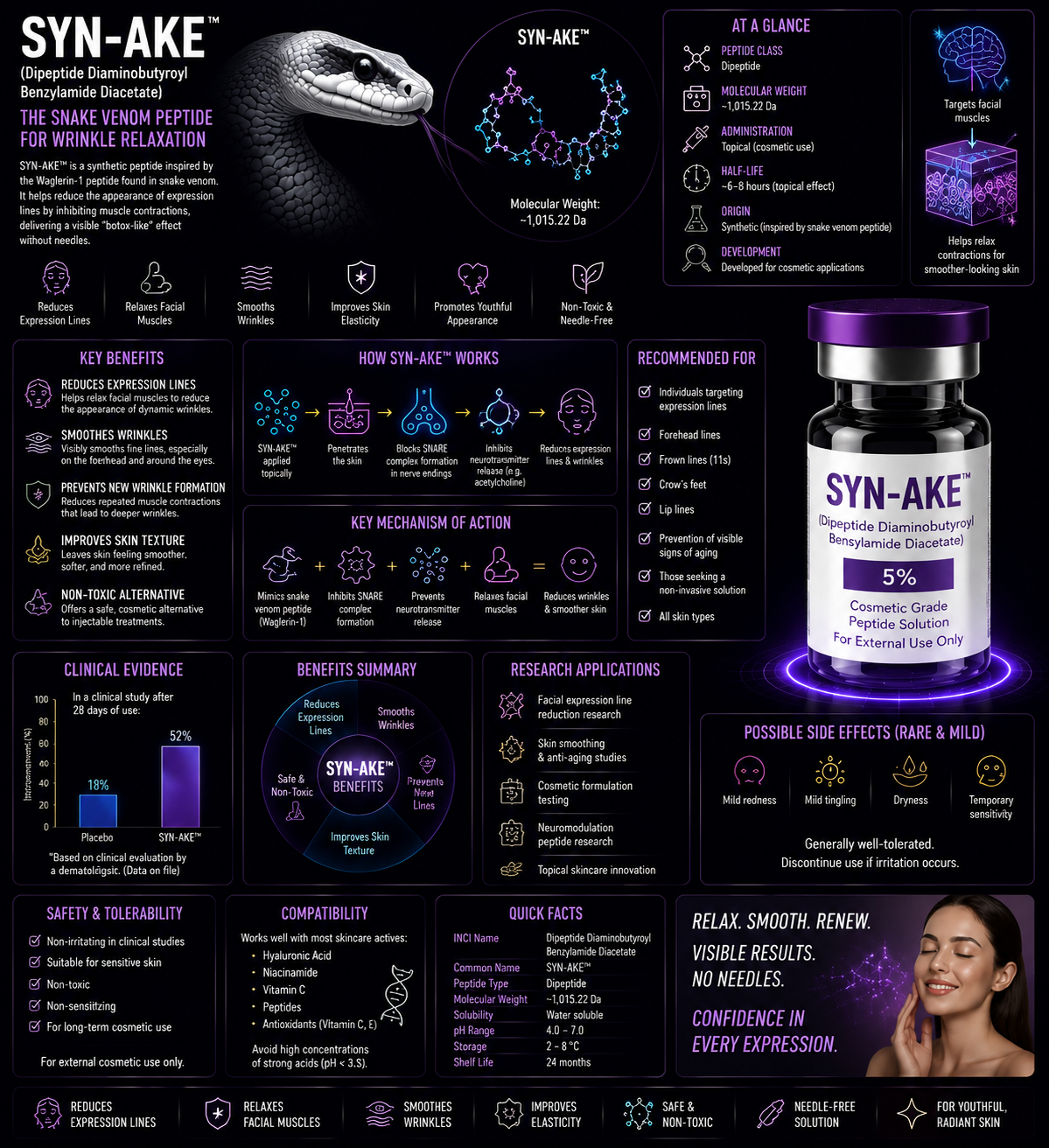
First, SYN-AKE® is a trademarked cosmetic active inspired by waglerin-1, a peptide toxin found in the venom of the Temple viper, Tropidolaemus wagleri. It was designed to imitate a small portion of waglerin-related biological activity without reproducing the complete venom peptide.
Next, formulators use the ingredient primarily in topical anti-aging products intended to reduce the visible appearance of dynamic expression lines, including forehead lines, glabellar lines, and crow’s feet.
Importantly, SYN-AKE is not purified snake venom and does not contain the full 22-amino-acid waglerin-1 toxin. For example, it is a synthetic, much smaller biomimetic ingredient.
Dipeptide Diaminobutyroyl Benzylamide Diacetate
SYN-AKE®
Small synthetic peptide-derived cosmetic active
Waglerin-1
Muscle-type nicotinic acetylcholine receptor
Cosmetic ingredient, not an approved drug
🧬 Molecular Structure
First, SYN-AKE is a compact synthetic molecule containing β-alanine, proline, diaminobutyric acid, a benzylamide group, and acetate counterions. Moreover, its design preserves selected functional features associated with waglerin-inspired receptor antagonism while remaining far smaller than the natural toxin.
🧪 Structural Notation
Likewise, H-β-Ala-Pro-Dab-NH-Bzl · 2 AcOH
| Component | Meaning | Relevance |
|---|---|---|
| β-Ala | β-Alanine | In addition, Nonstandard amino-acid residue contributing to the compact scaffold. |
| Pro | Proline | Restricts local conformation. |
| Dab | Diaminobutyric acid | Moreover, Provides an additional amino group important to the compound’s functional design. |
| NH-Bzl | Benzylamide terminus | By contrast, Hydrophobic terminal modification influencing binding and formulation behavior. |
| 2 AcOH | Two acetate counterions | Also, Forms the diacetate salt reflected in the INCI name. |
⚛️ Molecular Weight and 🧫 Formula
| Molecular formula | Consequently, C23H37N5O7 |
|---|---|
| Average molecular weight | Approximately 495.6 g/mol |
| CAS number | 823202-99-9 |
| PubChem CID | 71465152 |
| UNII | 38H206R00R |
Therefore, some suppliers describe the active portion separately from its acetate counterions. Meanwhile, cOAs should clearly state whether values apply to the free active, diacetate salt, or a diluted commercial solution.
📅 Development Timeline
Late 1980s–1990s: Waglerin pharmacology characterized
First, researchers identified waglerin peptides in Temple viper venom and established their ability to block muscle-type nicotinic acetylcholine receptors.
1999–2002: Receptor-subtype selectivity clarified
Next, studies showed that waglerin-1 has strong preference for the adult muscle receptor containing the epsilon subunit and that affinity varies significantly across species.
2000s: Biomimetic cosmetic development
Then, developers patented and marketed as SYN-AKE, designed to imitate selected waglerin-like receptor antagonism for topical cosmetic use.
2000s–2010s: Supplier-sponsored wrinkle studies
Afterward, manufacturer data reported improvements in skin smoothness and visible wrinkle depth after repeated topical use in formulations containing the commercial ingredient.
2010s–2020s: Broader neurocosmetic category develops
Finally, SYN-AKE became part of a broader class of topical ingredients marketed to influence expression wrinkles through neuromuscular signaling. Likewise, reviews increasingly emphasized limited skin penetration and the need for more independent clinical trials.
📖 Research History
Importantly, the scientific rationale for SYN-AKE comes from waglerin-1, but evidence for the cosmetic ingredient itself should not be treated as identical to evidence for the venom peptide. In addition, waglerin-1 is a 22-amino-acid toxin with species-sensitive receptor pharmacology. SYN-AKE is a separate synthetic molecule designed to mimic only selected functional features.
However, most efficacy claims trace back to supplier-sponsored in vitro studies and small topical-use studies. Moreover, these data are useful for formulation development but are not equivalent to large, independent, randomized clinical trials.
🧠 Mechanism of Action
First, suppliers describe SYN-AKE as a reversible antagonist of the muscle-type nicotinic acetylcholine receptor (mnAChR).
1. Acetylcholine normally activates muscle nAChRs
Next, at the neuromuscular junction, motor neurons release acetylcholine. By contrast, acetylcholine binds nicotinic receptors on muscle cells and opens cation channels.
2. Sodium influx depolarizes the muscle membrane
Then, channel opening permits sodium entry, producing endplate depolarization and triggering downstream calcium-dependent muscle contraction.
3. SYN-AKE competes at the receptor level
Moreover, supplier research describes SYN-AKE as a reversible receptor antagonist. Also, by reducing receptor activation, the ion channel is more likely to remain closed.
4. Local contraction signaling may be reduced
However, if sufficient active ingredient reaches the relevant target, reduced receptor signaling may mildly reduce repetitive superficial muscle contraction and soften the appearance of expression lines.
5. Effect is not equivalent to botulinum toxin
By contrast, botulinum toxin cleaves presynaptic SNARE proteins and blocks acetylcholine release for months. Consequently, sYN-AKE is topical, reversible, less potent, and limited by skin delivery.
🎯 Target Profile
| Target or pathway | Role | SYN-AKE relevance |
|---|---|---|
| However, Muscle nicotinic acetylcholine receptor | Therefore, Ligand-gated cation channel at the neuromuscular junction | Proposed primary target. |
| Acetylcholine release machinery | For example, Presynaptic vesicle fusion through SNARE proteins | Meanwhile, Not the main proposed SYN-AKE target. |
| Collagen synthesis | Dermal extracellular-matrix production | Likewise, Not the primary mechanism. |
| Skin hydration barrier | In addition, Controls smoothness and optical appearance | Moreover, Often improved by the vehicle and co-ingredients rather than SYN-AKE alone. |
Potential Cosmetic Benefits
Dynamic wrinkle appearance
First, SYN-AKE is intended for expression lines caused partly by repeated facial movement. However, static wrinkles caused by collagen loss, sun damage, tissue descent, or volume loss are less likely to respond substantially to a neuromuscular cosmetic peptide alone.
Temporary skin smoothing
Next, manufacturer-sponsored studies have reported measurable improvements in skin smoothness and wrinkle appearance after several weeks of topical use. Therefore, reported results vary by formulation, concentration, measurement method, and participant.
Noninvasive application
In addition, formulators can incorporate into creams, serums, gels, and emulsions, avoiding needles and procedure-related downtime.
Compatibility with other skincare actives
Moreover, formulators often pair with humectants, antioxidants, retinoids, niacinamide, barrier lipids, or matrix-support peptides. For example, improvements from a finished product may reflect the combined formulation rather than SYN-AKE alone.
Limitations of the Evidence
- First, Much of the published efficacy information is supplier sponsored.
- Next, independent randomized trials remain limited.
- Also, Topical peptide penetration through intact stratum corneum is a major constraint.
- Moreover, Commercial products may contain very different active concentrations.
- In addition, “4% SYN-AKE solution” does not necessarily mean 4% pure active.
- Likewise, Visible smoothing may partly reflect hydration and film-forming effects.
Formulation and Topical-Delivery Considerations
Commercial solution vs pure active
First, suppliers often sell SYN-AKE to formulators as a diluted aqueous or glycerin-based solution. Meanwhile, a formulation containing 4% of the supplier solution may contain far less than 4% active molecule.
Skin penetration
Next, at approximately 495.6 Da, the molecule is near the traditional molecular-weight boundary often discussed for passive skin penetration. Charge, polarity, vehicle, skin condition, and formulation architecture also strongly affect delivery.
pH and compatibility
Moreover, peptide-derived cosmetic actives can degrade under extreme pH, high heat, oxidation, or prolonged incompatible storage. Likewise, supplier-specific formulation guidance should be followed.
Packaging
In addition, airless, opaque, or low-exposure packaging may help protect peptide-containing formulations from contamination and environmental stress.
Application claims
Finally, exact frequency, concentration, and duration should be based on the finished product’s validated formulation and directions. In addition, generic online concentration recommendations should not be treated as universally applicable.
Safety and Regulatory Considerations
Cosmetic status
First, manufacturers use SYN-AKE as a cosmetic ingredient. Moreover, cosmetic marketing cannot legally convert it into an approved drug or support claims that it treats disease or produces the same pharmacological outcome as injected botulinum toxin.
Local skin reactions
Next, potential reactions include redness, itching, stinging, dryness, contact irritation, or allergy to the active or other formulation ingredients.
Systemic neuromuscular effects
Importantly, finished topical products are not expected to behave like injected neuromuscular blockers under normal cosmetic use. Claims of “paralysis” or systemic muscle relaxation are inappropriate and unsupported.
Venom allergy misconception
Finally, SYN-AKE is synthetic and is not whole snake venom. A snake-venom allergy does not automatically predict a reaction, but any cosmetic can cause irritation or sensitization.
🧪 Laboratory Testing Methods
| Method | Purpose | Important limitation |
|---|---|---|
| HPLC or UPLC | By contrast, Measures chromatographic purity and related impurities. | Also, Does not establish exact active concentration in a diluted commercial solution unless quantitatively validated. |
| LC-MS / HRMS | Consequently, Confirms molecular mass and supports identity. | However, Does not establish cosmetic efficacy or receptor activity. |
| NMR spectroscopy | Therefore, Supports structural confirmation, terminal modifications, and salt characterization. | For example, Requires suitable purity and specialist interpretation. |
| Acetate/counterion analysis | Meanwhile, Confirms diacetate content and salt form. | Likewise, analysts must integrate counterion results with active-content calculations. |
| In addition, Assay / active content | Moreover, Measures the actual quantity of active ingredient. | By contrast, Must distinguish pure active from supplier solution percentage. |
| Residual-solvent testing | Also, Detects synthesis and purification solvents. | Consequently, Does not establish microbiological safety. |
| Microbial limits | However, Evaluates bacteria, yeast, and mold in cosmetic raw materials. | Therefore, Not equivalent to pharmaceutical sterility testing. |
| Preservative efficacy testing | For example, Assesses whether a finished cosmetic resists microbial growth after challenge. | Meanwhile, Applies to the finished formulation, not simply the isolated active. |
| Stability testing | Likewise, Monitors appearance, pH, assay, impurities, and microbial quality over time. | In addition, laboratories must perform the test in the actual product and packaging. |
| Cell-based nAChR assay | Moreover, Evaluates receptor antagonism or ion-channel inhibition. | By contrast, In vitro activity does not prove skin penetration or clinical wrinkle reduction. |
📄 How to Interpret a SYN-AKE COA
1. Confirm the exact INCI identity
First, the report should state Dipeptide Diaminobutyroyl Benzylamide Diacetate and should not identify the material as waglerin-1, snake venom, a hexapeptide, or botulinum toxin.
2. Identify the material format
Next, determine whether the COA covers pure active powder, diacetate salt, a 1,000-ppm solution, or another diluted cosmetic raw material.
3. Separate supplier-solution percentage from active percentage
Moreover, a product formulated with “4% SYN-AKE” may mean 4% of a commercial solution. The actual active concentration depends on the solution’s stated potency.
4. Review identity, purity, and assay separately
- Identity First, confirms the expected compound.
- Purity Next, estimates relative chromatographic composition.
- Assay Also, measures actual active content.
5. Review cosmetic microbiology
Finally, for aqueous supplier solutions, microbial limits and preservative status are essential. A raw-material COA does not replace challenge testing of the finished product.
📊 SYN-AKE vs Argireline vs Botulinum Toxin vs Matrixyl
Mechanisms, Routes, and Evidence Levels
| Feature | SYN-AKE | Argireline | Botulinum toxin type A | Matrixyl-type peptides |
|---|---|---|---|---|
| Compound type | Also, Small peptide-derived cosmetic active | Acetyl hexapeptide-8 | Consequently, Large bacterial neurotoxin protein | Palmitoylated signal peptides |
| Proposed target | However, Postsynaptic muscle nAChR antagonism | Presynaptic SNARE-related modulation | Therefore, SNARE cleavage and acetylcholine-release blockade | Extracellular-matrix signaling |
| Route | Topical | Topical | For example, Injection by licensed professional | Topical |
| Expected muscle effect | Meanwhile, Mild and temporary if sufficient target exposure occurs | Mild and temporary | Clinically significant chemodenervation | Likewise, No primary muscle-relaxation effect |
| Evidence level | In addition, Limited; many supplier-sponsored data | Limited-to-moderate cosmetic literature | Moreover, Extensive controlled clinical evidence | Varies by peptide |
| FDA drug approval | No | No | By contrast, Yes, specific products and indications | No |
SYN-AKE vs Waglerin-1
Synthetic Cosmetic Active Versus Venom Peptide
| Property | SYN-AKE | Waglerin-1 |
|---|---|---|
| Origin | Synthetic cosmetic ingredient | Also, Temple viper venom peptide |
| Size | Small tripeptide-derived compound | 22-amino-acid peptide toxin |
| Use | Topical cosmetics | Research toxin |
| Target concept | Consequently, Reversible muscle nAChR antagonism | However, Competitive antagonism with receptor-subtype and species dependence |
| Same molecule? | No | No |
🔗 Related Cosmetic Peptides
- Acetyl Hexapeptide-8 (Argireline): First, A topical peptide marketed to reduce expression-line appearance through SNARE-related signaling.
- Pentapeptide-18 (Leuphasyl): Next, A cosmetic peptide marketed around enkephalin-receptor-related neurotransmission.
- Palmitoyl Pentapeptide-4: Also, A Matrixyl-family signal peptide associated with extracellular-matrix support.
- Palmitoyl Tripeptide-1 and Palmitoyl Tetrapeptide-7: Moreover, A commonly paired Matrixyl combination.
- Copper Tripeptide-1: In addition, A cosmetic peptide associated with skin remodeling research.
🖼️ Original Diagram Specifications
Diagram 1: SYN-AKE molecular map
Therefore, Show β-Ala-Pro-Dab-NH-Bzl with two acetate counterions. Label each nonstandard component and distinguish it from a conventional six-amino-acid peptide.
Diagram 2: Waglerin inspiration vs cosmetic analog
For example, Use a split graphic showing the 22-residue waglerin-1 venom peptide on one side and the much smaller synthetic SYN-AKE compound on the other.
Diagram 3: Neuromuscular receptor pathway
Meanwhile, Show acetylcholine released from the nerve terminal, binding the muscle nicotinic receptor, sodium entering, depolarization, and contraction. Add SYN-AKE at the receptor as a reversible antagonist.
Diagram 4: SYN-AKE vs botulinum toxin
Likewise, Show botulinum toxin acting presynaptically on SNARE proteins and SYN-AKE acting postsynaptically at the receptor. Avoid depicting equivalent strength.
Diagram 5: Cosmetic delivery barriers
In addition, Illustrate topical formulation, stratum corneum, viable epidermis, deeper muscle target, and the challenge of obtaining sufficient target exposure from a surface-applied ingredient.
❓ Frequently Asked Questions
Is SYN-AKE a peptide?
Moreover, It is a small synthetic peptide-derived cosmetic ingredient commonly described as a tripeptide mimic. Its INCI name is Dipeptide Diaminobutyroyl Benzylamide Diacetate.
Is SYN-AKE a hexapeptide?
By contrast, No. The recognized ingredient is not the six-residue sequence listed in the original draft.
Does SYN-AKE contain snake venom?
Also, No. It is synthetic and was inspired by waglerin-1 pharmacology; it is not whole venom and is not identical to waglerin-1.
Does SYN-AKE work like Botox?
Consequently, Not in a clinically equivalent way. Botulinum toxin is injected and blocks acetylcholine release by cleaving SNARE proteins. SYN-AKE is topical and is proposed to reversibly antagonize muscle nicotinic receptors.
Does SYN-AKE block acetylcholine release?
However, That is not its primary proposed mechanism. It is described as acting at the postsynaptic nicotinic acetylcholine receptor.
How quickly does it work?
Therefore, Supplier studies report visible cosmetic changes after repeated topical use, often assessed around four weeks. Results depend heavily on formulation and use.
Is 4% SYN-AKE the same as 4% pure active?
For example, Not necessarily. It often means 4% of a commercial supplier solution containing a much lower active concentration.
Is SYN-AKE FDA approved?
Meanwhile, It is not an FDA-approved wrinkle-treatment drug. It is used as a cosmetic ingredient.
Does 99% HPLC purity prove a finished serum is effective?
Likewise, No. Purity of a raw ingredient does not prove skin penetration, receptor exposure, finished-product stability, microbiological quality, or clinical wrinkle reduction.
SYN-AKE Scientific Overview: Final Thoughts
In conclusion, SYN-AKE is a synthetic waglerin-inspired cosmetic active whose correct INCI identity is Dipeptide Diaminobutyroyl Benzylamide Diacetate. It is not a hexapeptide, not whole snake venom, and not a topical version of botulinum toxin.
However, its proposed mechanism is reversible antagonism of the muscle-type nicotinic acetylcholine receptor, potentially reducing superficial contraction signaling and softening the visible appearance of dynamic wrinkles. The concept is scientifically plausible, but topical delivery and limited independent clinical evidence are important constraints.
📚 References
- For example, DSM-Firmenich. SYN-AKE® product overview and proposed mechanism.
- Moreover, National Center for Biotechnology Information. PubChem: Dipeptide Diaminobutyroyl Benzylamide Diacetate.
- In addition, Molles BE, et al. Residues in the epsilon subunit of the nicotinic acetylcholine receptor interact with waglerin-1. Molecular Pharmacology. 2002.
- However, McArdle JJ, et al. Waglerin-1 selectively blocks the epsilon form of the muscle nicotinic acetylcholine receptor. Journal of Pharmacology and Experimental Therapeutics. 1999.
- Therefore, Bekbossynova A, et al. Venom-derived neurotoxins targeting nicotinic acetylcholine receptors. Molecules. 2021.
- Likewise, Nguyen TTM, et al. Non-invasive peptides as alternatives to botulinum toxin in cosmetic research. Cosmetics. 2024.
- For example, Bang J, et al. Wrinkle-improving peptide targeting acetylcholine binding to nAChR. 2024.
- Moreover, Moisă DG, et al. Viper venom and synthetic peptides as emerging cosmetic actives. Applied Sciences. 2025.
- In addition, US Patent Application US20150361137A1. Peptide inhibitors of nicotinic acetylcholine receptor.
- However, WO 2006/047900. Cosmetic peptides and neuromuscular receptor antagonism.
- Therefore, A shortened, protecting-group-free synthesis of the anti-wrinkle venom analogue SYN-AKE. Tetrahedron Letters. 2014.
- Likewise, Lintner K, Peschard O. Biologically active peptides in skin care. International Journal of Cosmetic Science.
- For example, Gorouhi F, Maibach HI. Role of topical peptides in preventing or treating aged skin. International Journal of Cosmetic Science.
- Moreover, Schagen SK. Topical peptide treatments with effective anti-aging results. Cosmetics. 2017.
- In addition, Bos JD, Meinardi MMHM. The 500 Dalton rule for skin penetration. Experimental Dermatology. 2000.
- However, Prausnitz MR, Langer R. Transdermal drug delivery. Nature Biotechnology. 2008.
- Therefore, ISO 11930. Cosmetics—Microbiology—Evaluation of antimicrobial protection.
- Likewise, ISO 17516. Cosmetics—Microbiology—Microbiological limits.
- ICH Q2(R2): Validation of Analytical Procedures.
- USP General Chapter <621>, Chromatography.
- ICH Q3C: Impurities—Guideline for Residual Solvents.
Identity, Waglerin, and Cosmetic-Evidence Sources
Formulation, Skin Delivery, and Quality-Control Sources
In addition, Ingredient identity, molecular properties, and mechanism were reviewed in July 2026. Trademark ownership and supplier formulations may change; consult current supplier documentation for formulation-specific details.