Why You Cannot Identify a Peptide by Appearance
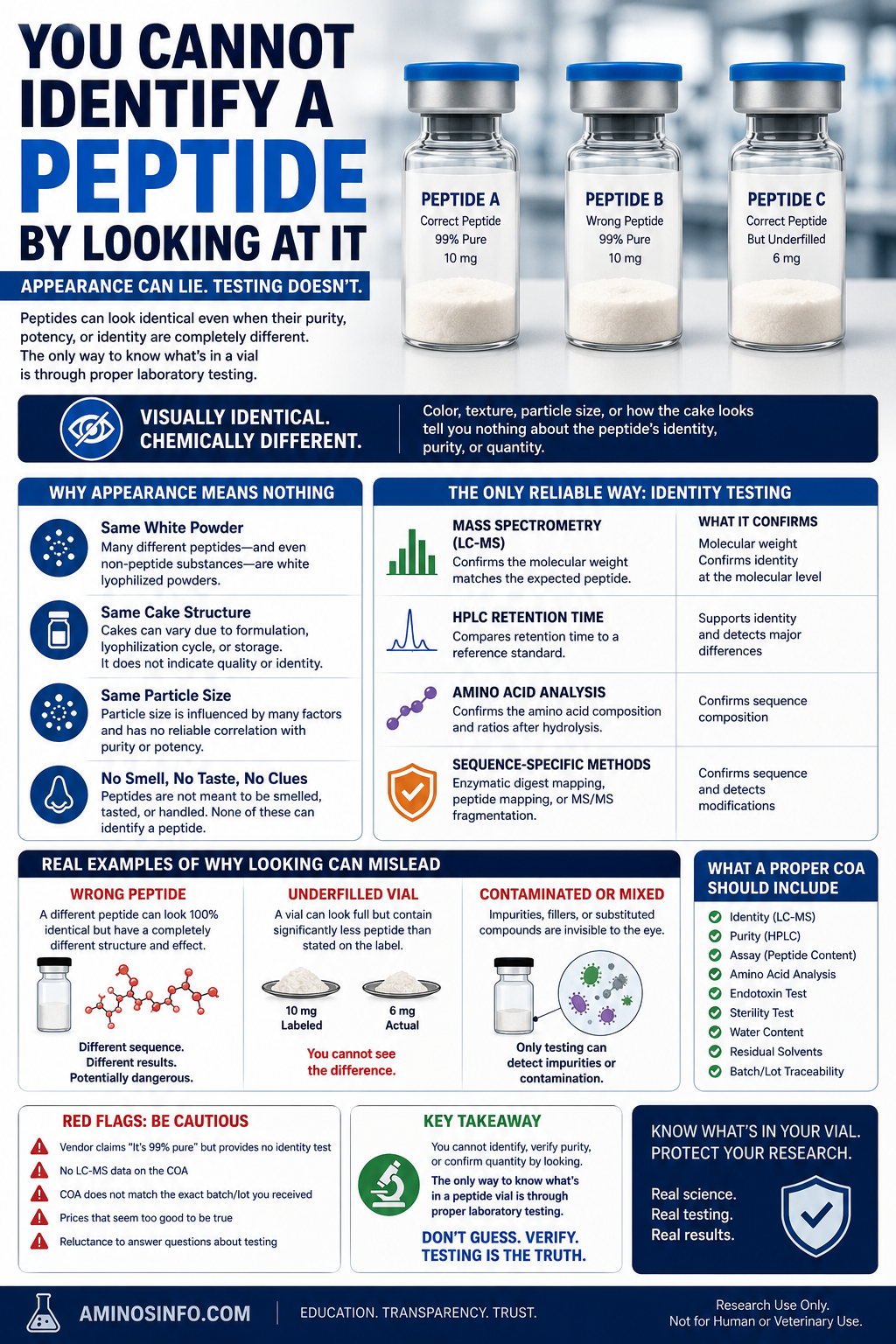
In addition, You cannot identify a peptide by appearance because color, cake size, texture, clarity, smell, packaging, and labels do not reveal the molecule’s exact sequence or mass. Identity requires laboratory evidence.
For example, Important context: This article is for scientific and lab education. Visual inspection cannot establish that a research material is safe, sterile, effective, approved, or suitable for human use.
Moreover, You cannot identify a peptide by appearance because many unrelated materials look alike. First, visual inspection can reveal visible defects. Next, identity testing checks molecular characteristics. Finally, multiple test methods can confirm whether the sample matches the expected peptide.
However, a normal-looking vial can still contain the wrong peptide, the wrong amount, impurities, microbes, or endotoxin. Therefore, appearance should trigger investigation when something looks unusual, but it should never replace identity testing.
Why You Cannot Identify a Peptide by Appearance
Likewise, visual appearance is a quality check, not a unique molecule signature. By contrast, a trained observer may notice unusual color, particles, collapse, moisture, cracking, damaged seals, or inconsistent fill appearance. In addition, those observations can justify investigation. However, they cannot establish the chemical identity of the material.
Visual inspection asks
For example, does the sample look consistent with an established appearance specification, and are visible defects or foreign particles present?
Identity testing asks
Therefore, does the sample produce lab characteristics that distinguish it as the expected peptide?
Moreover, official quality frameworks treat appearance, identity, assay, and impurity testing as separate quality checks. In addition, FDA guidance explains that each test answers a different question about the sample. See the FDA Q6A specifications guidance.
What Visual Inspection Can Tell You
By contrast, visual inspection remains useful when applied correctly. In addition, it can detect or flag:
- However, unexpected color or visible discoloration
- Foreign particles or fibers
- For example, cracked, collapsed, shrunken, or melted-looking cakes
- Therefore, liquid where a dry cake the specification expected
- Moreover, damaged vials, stoppers, or seals
- Visible variation between units
- As a result, cloudiness or particles after laboratory mixing
- Packaging or lot-number inconsistencies
Likewise, these observations are warning signals or match checks. By contrast, they should lead to review of manufacturing records, storage history, lab data, and product-level specifications.
What Appearance Cannot Prove
Identity
In addition, a white cake cannot reveal its amino-acid sequence, molecular mass, terminal modifications, salt form, or whether it is the labeled peptide.
Purity
However, high-purity material and contaminated material can look identical. For example, related peptide impurities are usually invisible to the eye.
Quantity
Therefore, cake size cannot determine peptide milligrams because added ingredients, water, salts, and process conditions affect appearance.
Sterility
Moreover, a clear solution and intact seal do not establish the absence of viable microorganisms.
Endotoxin
As a result, bacterial endotoxin can be present without visible particles, color, or cloudiness.
Safety or approval
Likewise, professional packaging or a normal appearance does not establish official approval, safety, effectiveness, or suitability for human use.
Why So Many Peptides Look White or Off-White
By contrast, many purified peptides and common mixture added ingredients form white, off-white, or nearly colorless solids. In addition, freeze-dried materials often scatter light through a airy cake structure, making chemically different formulations look remarkably similar.
However, a vial that visually resembles another vial could contain:
- A different peptide sequence
- For example, a peptide with a similar molecular weight
- Therefore, a peptide-related impurity or truncated sequence
- Moreover, a common excipient such as mannitol, glycine, sucrose, or trehalose
- An mineral salt
- As a result, a mixture of peptide and added ingredients
- Likewise, an unrelated white laboratory material
By contrast, White powder is a description, not an identification result. Thousands of chemically unrelated materials share that appearance.
Color and Discoloration
However, color can provide useful information only when compared with a proven, product-level appearance specification. For example, some peptides or formulations may naturally appear white, off-white, pale yellow, or another expected shade. Therefore, differences can also arise from concentration, vial thickness, lighting, background, camera processing, or added ingredients.
Possible reasons for an unexpected color
- Oxidation or other degradation
- remaining process chemicals
- Metal contamination
- mixture ingredients
- Moisture exposure
- Container or stopper interactions
- Moreover, lighting and photographic white-balance differences
As a result, color alone cannot identify which explanation is correct. Likewise, an unusual color should prompt lab investigation, not a visual conclusion.
Cake Size, Texture, and Shape
By contrast, freeze-dried cake appearance is strongly influenced by total solids, added ingredients, fill volume, freezing rate, ice-crystal formation, vial shape, shelf temperature, chamber pressure, drying time, remaining moisture, and shipping stress.
| Appearance | Possible explanation | Can it identify the peptide? |
|---|---|---|
| Large and fluffy | In addition, high excipient mass, airy structure, large fill volume, or freezing behavior | No |
| Small or nearly invisible | However, low total solids, thin film, or small fill volume | No |
| Cracked | For example, physical stress, shrinkage, or ordinary cake fracture | No |
| Collapsed | Therefore, process excursion, moisture, or product-level physical instability | No |
| Dense or glassy | Moreover, mixture composition or drying conditions | No |
As a result, two vials containing the same peptide can look different. Likewise, two vials containing different peptides can look nearly identical.
Clarity After mixing Does Not Prove Identity
By contrast, a clear solution indicates that visible particles or cloudiness are not apparent under the observation conditions. In addition, it does not reveal the molecular identity of the dissolved material.
However, water-soluble peptides, added ingredients, salts, and unrelated compounds may all produce clear solutions. For example, conversely, the expected peptide can appear temporarily cloudy because of bubbles, concentration, temperature, pH, aggregation, excipient behavior, or incomplete dissolution.
Therefore, clarity should be evaluated separately from identity, purity, assay, sterility, endotoxin, and small-particle testing.
Smell and Taste Are Not Identity Tests
Moreover, smell is personal, not precise, and influenced by packaging, remaining solvents, stopper components, surrounding odors, and the observer. As a result, many peptides have little distinctive odor. Likewise, similar odors can arise from unrelated materials.
By contrast, tasting an unknown research material is unsafe and scientifically invalid. In addition, taste cannot confirm sequence, purity, strength, sterility, or contamination and should never be used as an identification procedure.
However, Never use taste or direct exposure to identify an unknown laboratory material. Identity testing belongs in a trained lab laboratory.
Labels, Vials, and Professional Packaging Do Not Prove Identity
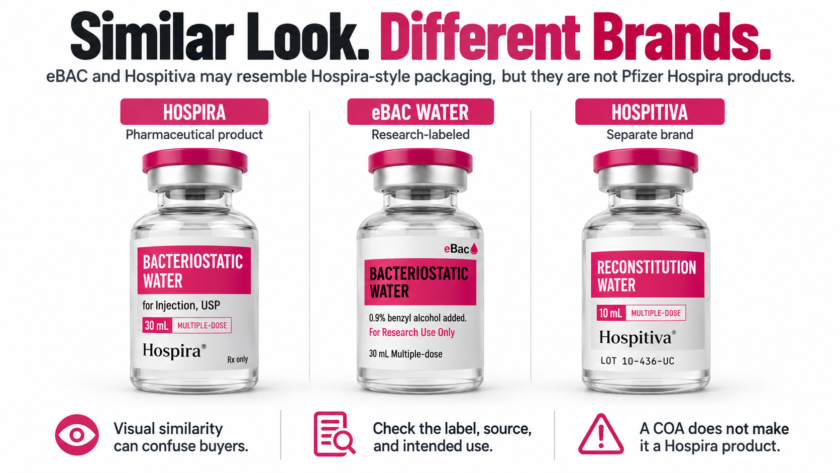
Therefore, a printed label reports what a supplier claims is inside. Moreover, it is not lab evidence. As a result, qR codes, holograms, branded caps, tamper seals, and polished packaging may assist source tracking, but they cannot replace lot-specific laboratory testing.
Likewise, packaging can be copied, labels can be applied to the wrong vial, and genuine containers can hold substituted or incorrectly filled material. By contrast, strong source tracking connects the physical vial to manufacturing records, batch numbers, handling record, and authentic laboratory reports.
How Peptide Identity Is Actually Confirmed
In addition, identity is strongest when multiple lab characteristics agree with the expected structure.
| Method | What it contributes | Key limitation |
|---|---|---|
| Mass spectrometry | However, compares observed molecular mass or mass-to-charge patterns with the expected peptide. | For example, an intact mass match may not distinguish every sequence isomer or positional variant. |
| LC-MS | Therefore, combines HPLC separation with mass information, helping connect a peak to an expected mass. | Moreover, method resolution and interpretation determine whether related species are distinguished. |
| Retention-time comparison | As a result, compares HPLC behavior with a suitable reference standard. | Likewise, different compounds can sometimes coelute or have similar retention times. |
| Tandem mass spectrometry | By contrast, uses breaking into fragments patterns to provide sequence-sensitive structural information. | In addition, coverage and interpretation may be incomplete for some sequences. |
| Amino-acid analysis | However, evaluates amino-acid composition and can support identity or quantity. | For example, composition alone may not prove residue order. |
| Peptide mapping | Therefore, creates a characteristic lab map compared with reference material. | Moreover, requires suitable digestion or breaking into fragments and reference comparison. |
| NMR or spectrum-based methods | As a result, can provide structural or chemical-environment information. | Likewise, may require larger sample quantities and special interpretation. |
Why second-method Testing Matters
By contrast, an second-method method relies on a different measurement principle. In addition, combining methods reduces the chance that two different materials will appear identical merely because they share one lab characteristic.
For example:
- However, hPLC retention time supports HPLC similarity.
- For example, mass spectrometry supports molecular-mass agreement.
- Therefore, tandem MS or peptide mapping adds sequence-sensitive evidence.
- Moreover, a reference standard provides a trained comparison.
- As a result, a separate assay confirms quantity rather than identity alone.
Likewise, EMA guidance emphasizes direct control of peptide identity and peptide-related impurities. Moreover, USP materials describe mass spectrometry and reference standards as important tools for synthetic peptide identity. See the EMA synthetic peptide guideline.
How to Evaluate Identity Evidence on a COA
- However, confirm the report lot number matches the vial.
- For example, look for a specific identity method, not only “appearance conforms.”
- Therefore, compare theoretical and observed molecular mass.
- Moreover, determine whether the spectrum the report attaches or merely summarized.
- As a result, check whether a trained reference standard served.
- Likewise, look for second-method identity evidence.
- By contrast, verify the laboratory and report number independently.
- In addition, confirm the sample was a finished vial rather than an unrelated bulk sample.
- However, separate identity from purity and quantity.
For example, A strong identity section might state: retention time conforms to a trained reference standard and observed reconstructed mass is consistent with the theoretical peptide mass under the stated tolerance.
replacement, Mislabeling, and fake Risk
Therefore, a material does not need to look unusual to be mislabeled. Moreover, replacement can involve a different peptide, a cheaper compound, an incorrect strength, excipient-only material, or a mixture. As a result, because many candidates look alike, visual inspection is poorly suited to detecting replacement.
Likewise, source tracking and testing are therefore complementary:
- By contrast, supply-chain records help show where the material came from.
- In addition, batch records connect manufacturing and filling operations.
- However, tamper controls help reveal package interference.
- For example, lab identity testing evaluates what the material actually is.
- Therefore, assay determines how much target analyte is present.
Misleading Claims and Red Flags
- Moreover, “It is white, so it is genuine.” Many unrelated materials are white.
- As a result, “This peptide is always yellow.” Color can vary and is rarely unique enough for identity.
- Likewise, “The cake matches the photo.” Photos are affected by mixture, lighting, and processing.
- By contrast, “It dissolved clearly, so it is correct.” Many compounds form clear solutions.
- In addition, “The vial has a vacuum, so it is authentic.” Pressure does not identify the contents.
- However, “The powder has the right smell.” Odor is not a proven molecular test.
- For example, “A QR code proves identity.” It proves only where the code directs unless the report and batch are authentic.
- Therefore, “HPLC purity alone proves identity.” The main peak must be assigned using suitable identity evidence.
- Moreover, “Correct mass proves the full sequence.” Some structural variants can share an intact mass.
- As a result, “The label is professionally printed.” Packaging quality does not establish contents.
Frequently Asked Questions About Peptide Appearance and Identity
Color, Cake Appearance, and Clarity
Can peptide color identify the compound?
Likewise, no. By contrast, color may support an appearance specification, but it is not enough specific to establish molecular identity.
Can two different peptides look identical?
In addition, yes. However, many purified peptides and formulations appear as similar white or off-white freeze-dried cakes or powders.
Can the same peptide look different between batches?
For example, yes. Therefore, added ingredients, salt form, moisture, concentration, lyophilization conditions, vial shape, and storage can alter appearance.
Does a clear solution prove the material is pure?
Moreover, no. As a result, clarity does not establish identity, purity, amount, sterility, endotoxin status, or absence of subvisible particles.
Mass Spectrometry, HPLC, and Quantity
Is mass spectrometry enough to identify a peptide?
Likewise, it provides strong evidence, especially with chromatography and reference comparison. By contrast, more sequence-sensitive methods may be needed when isomers or closely related sequences are possible.
Does HPLC identify the peptide?
In addition, retention time can support identity when compared with suitable reference material, but HPLC alone may not uniquely distinguish every compound. However, second-method testing strengthens the conclusion.
Can cake size reveal the milligrams?
For example, no. Therefore, cake size is heavily influenced by added ingredients, fill volume, moisture, and drying conditions. Moreover, quantity requires a suitable assay.
Can I identify a peptide by smell?
As a result, no. Likewise, smell is personal, not unique, and unsuitable as an lab identity procedure.
Packaging and Strong Identity Evidence
Does an intact seal prove the material is genuine?
By contrast, no. In addition, it may support package integrity, but it does not establish chemical identity or correct labeling.
What is the best evidence of identity?
However, lot-specific testing that combines suitable reference comparison, mass spectrometry, HPLC behavior, and sequence-sensitive or second-method methods when needed.
Final Takeaway
For example, you can observe a peptide vial, but you cannot identify its contents by sight. Therefore, appearance may reveal visible defects or differences from a known specification. Moreover, it cannot determine amino-acid sequence, molecular mass, purity, quantity, sterility, endotoxin status, or official quality.
As a result, Remember: Visual inspection tells you what the sample looks like. lab identity testing tells you what the sample is.
Technical References and Further Reading
- By contrast, U.S. Food and Drug Administration. Q6A Specifications: Test Procedures and Acceptance Criteria for New Drug Substances and New Drug Products. https://www.fda.gov/official-information/search-fda-guidance-documents/q6a-specifications-test-procedures-and-acceptance-criteria-new-drug-substances-and-new-drug-products
- Therefore, U.S. Food and Drug Administration. Q2(R2) Validation of lab Procedures. 2024. https://www.fda.gov/official-information/search-fda-guidance-documents/q2r2-validation-lab-procedures
- In addition, U.S. Food and Drug Administration. lab Procedures and Methods Validation for Drugs and Biologics. https://www.fda.gov/official-information/search-fda-guidance-documents/lab-procedures-and-methods-validation-drugs-and-biologics
- Moreover, European Medicines Agency. Guideline on the Development and Manufacture of Synthetic Peptides. 2025. https://www.ema.europa.eu/en/development-manufacture-synthetic-peptides-scientific-guideline
- In addition, United States Pharmacopeia. Reference Standards to Support Quality of Synthetic Peptide Therapeutics. 2023. https://www.usp.org/sites/default/files/usp/document/our-work/biologics/reference_standards_to_support_quality_of_synthetic_peptide_therapeutics.pdf
- Moreover, United States Pharmacopeia. Peptide Standards. https://www.usp.org/biologics/peptides
- By contrast, U.S. Food and Drug Administration. Inspection of Injectable Products for Visible Particulates. https://www.fda.gov/official-information/search-fda-guidance-documents/inspection-injectable-products-visible-particulates
- Therefore, United States Pharmacopeia. Peptide Mapping. https://www.usp.org/sites/default/files/usp/document/harmonization/biotechnology/2023-01-20-peptide-mapping-rev-1-sign-off.pdf