Inside a Lyophilized Peptide Vial: What Is Actually There?
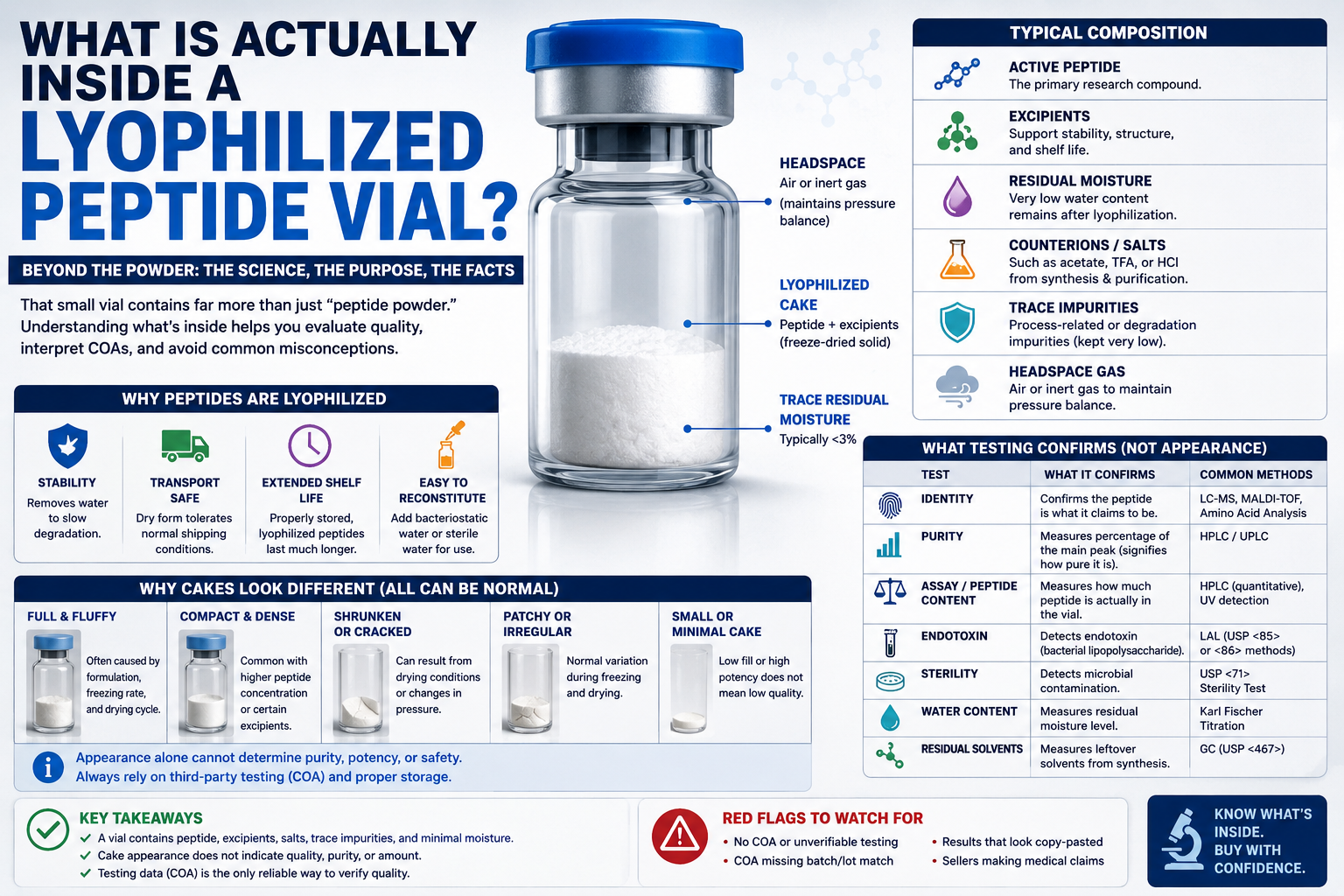
In addition, Inside a freeze-dried peptide vial, the visible cake may contain much more than the target peptide. mixture ingredients, counterions, remaining water, solvents, impurities, and headspace can all contribute to the final vial system.
For example, Important context: This article is for scientific and lab education. Vial appearance does not establish identity, purity, quantity, sterility, endotoxin status, safety, or suitability for human use. Research-use-only materials should be handled only in properly controlled research settings.
Inside a lyophilized peptide vial, the dried cake can include peptide, added ingredients, salts, water, and related material. First, freeze-drying removes much of the water. Next, non-evaporating ingredients remain in the vial. Finally, laboratory testing separates identity, purity, quantity, moisture, and other quality questions.
However, cake size, color, cracking, or fluffiness cannot reveal the peptide amount. Therefore, a credible report should use lot-specific tests rather than visual assumptions.
Inside a Lyophilized Peptide Vial: The Short Answer
By contrast, a freeze-dried peptide vial may contain much more than the amino-acid chain named on the label. In addition, the dried material can include the intended peptide, one or more added ingredients, counterions associated with the peptide salt, remaining water, remaining solvents, synthesis-related impurities, degradation products, inorganic residues, and traces of materials introduced during manufacturing.
However, the vial also contains a gas-filled headspace above the cake. For example, depending on the process, that headspace may contain air, nitrogen, another nonreactive gas, reduced pressure, or a mixture that changes over time through gas movement through materials and stopper interactions.
Therefore, nothing about the cake’s color, height, fluffiness, cracking, or apparent volume can by itself establish how much target peptide the vial contains. Moreover, those questions require suitable lab testing.
What freeze-drying Actually Does
As a result, Freeze-drying removes water from a frozen mixture under reduced pressure. In addition, FDA describes three linked stages: freezing, primary drying, and secondary drying. See the FDA freeze-drying inspection guide.
Freezing
In addition, the liquid mixture is cooled until ice and concentrated solute phases form. However, the freezing rate and ice-starting behavior influence ice-crystal size, pore structure, and final cake appearance.
Primary drying
For example, pressure is reduced and heat is carefully supplied so ice changes directly to vapor directly from solid to vapor. Therefore, the spaces once occupied by ice become pores within the dried cake.
Secondary drying
Moreover, additional bound or adsorbed water the process removes by release from the solid. As a result, secondary drying reduces moisture but does not normally make the product absolutely water-free.
Likewise, freeze-drying can improve the storage stability of molecules that are less stable in water-based solution. However, the process itself can expose peptides to stresses from freezing, concentration, pH shifts, surfaces, dehydration, and temperature. In addition, mixture ingredients and process design are therefore used to protect product quality.
However, freeze-drying does not create purity. It removes water from a mixture. Any non-evaporating solutes present before drying—including peptide, added ingredients, salts, and many impurities—generally remain in the vial.
Possible Components Inside the Vial
1. The Target Peptide
Moreover, the target peptide is the intended amino-acid chain, including any deliberate structural modifications such as terminal amidation, acetylation, cyclization, lipidation, disulfide bonds, or other chemical groups.
As a result, its amount may be expressed in several ways:
- Likewise, milligrams of the peptide salt as supplied
- Milligrams of free-peptide equivalent
- By contrast, net peptide content after correction for water, counterions, and purity
- Total peptide-related material
- Percent of label claim
In addition, these bases are not interchangeable. However, a vial containing 10 mg of a peptide salt may contain less than 10 mg of the amino-acid chain alone because part of the measured mass belongs to counterions and remaining water.
Identity and quantity require different tests
Identity
For example, mass spectrometry, chromatographic comparison, sequence-sensitive methods, or other second-method tests help determine whether the expected peptide the vial contains.
Quantity
Therefore, a calibrated assay, amino-acid analysis, measured NMR, or another suitable measured method the method must determine how much target peptide the vial contains.
Moreover, a high HPLC purity percentage does not automatically establish the labeled milligrams. As a result, the sample can be highly pure but underfilled, correctly filled, or overfilled.
2. added ingredients and Bulking Agents
Likewise, added ingredients are non-active mixture ingredients included for a technical purpose. By contrast, they may improve cake formation, protect the peptide during freezing and drying, control pH, reduce surface adsorption, support solubility, or improve physical stability.
Common excipient roles
Bulking agents
In addition, ingredients such as mannitol or glycine can create a more substantial and mechanically stable cake when the peptide dose alone is too small to form a visible structure.
stabilizing ingredients
However, sugars such as sucrose or trehalose may help preserve molecular structure during freezing and dehydration by replacing interactions normally provided by water and forming a protective solid matrix.
Buffers
For example, histidine, phosphate, citrate, acetate, or other buffer systems may help control pH, although freezing can cause local concentration changes and pH shifts.
surface-active ingredients
Therefore, low concentrations of surface-active ingredients may reduce adsorption or aggregation at air-liquid, ice-liquid, glass-liquid, and filter surfaces.
Antioxidant strategies
Moreover, mixture design, oxygen control, chelating agents, or antioxidants may serve when the peptide contains oxidation-sensitive residues.
Tonicity agents
As a result, some formulations include ingredients intended to influence solute concentration after reconstitution. Likewise, their presence adds mass to the cake.
Why added ingredients can dominate the visible cake
By contrast, many peptide doses are only a few milligrams or less. In addition, a mixture may include greatly more excipient mass than peptide mass to create a robust cake. As a result, most of what is visible could be bulking or stabilizing material rather than the peptide itself.
Illustrative cake composition
For example, in this hypothetical vial, the peptide represents only a minority of the cake’s dry mass. Therefore, the cake can look large even though the target peptide amount is small.
3. counterions and Peptide Salt Forms
Moreover, peptides contain charge-forming chemical groups and are often isolated as salts. As a result, during synthesis and purification, acidic or basic counterions can associate with charged sites on the molecule. Likewise, commonly encountered examples include acetate and TFA, although other forms are possible.
counterions matter because they:
- By contrast, add physical mass to the material
- In addition, can influence solubility and pH
- May affect lab calculations
- However, can vary depending on purification and salt-exchange procedures
- For example, are not part of the amino-acid sequence itself
Why molecular weight reports can list differently
Therefore, a molecular weight listed for the neutral peptide sequence may not include counterions, water, or attached ions. Moreover, a measured bulk material can therefore have a different mass composition from the theoretical sequence alone. As a result, reports should state whether content the report expresses as the peptide salt, free peptide, or another defined basis.
Likewise, Important: “10 mg of material” and “10 mg of free-peptide equivalent” can be different claims. Without a clearly defined reporting basis, a weight number is easy to misinterpret.
4. remaining Moisture
In addition, freeze-dried products are not always completely dry. However, after primary drying removes ice, secondary drying reduces water that remains adsorbed or bound to the solid matrix. For example, some remaining moisture normally remains.
remaining moisture can affect:
- Therefore, molecular mobility within the solid
- Hydrolysis and deamidation rates
- Oxidation and aggregation behavior
- Glass-transition temperature
- Moreover, cake collapse, shrinkage, or stickiness
- Long-term storage stability
As a result, the driest possible condition is not always automatically the most stable condition for every molecule and mixture. Likewise, the optimal moisture range is product-specific and must be established through development and stability studies.
How remaining moisture the lab measures
By contrast, karl Fischer titration is widely used for measured water determination. In addition, other methods may include heat-and-weight approaches, loss-on-drying methods, near-infrared testing, or product-specific lab techniques. However, visual inspection cannot determine moisture content.
Moisture can vary between vials
For example, heat transfer and drying conditions can vary by shelf position, vial location, fill volume, stopper configuration, and equipment performance. Therefore, edge vials and center vials may experience different temperature histories. Moreover, this is why freeze-drying-cycle development and moisture mapping matter.
5. remaining Solvents, Reagents, and Inorganic Material
As a result, synthetic peptide production can involve organic solvents, coupling reagents, cleavage reagents, cleanup chemicals, purification solvents, acids, bases, and salts. Likewise, purification and drying the labels intend to reduce these materials, but traces can remain.
Possible non-peptide remaining categories
| Category | Possible source | Typical lab approach |
|---|---|---|
| remaining organic solvents | By contrast, synthesis, cleavage, purification, cleaning, or mixture | In addition, gas chromatography or another proven solvent method |
| counterions and inorganic ions | However, salt formation, buffers, purification, and process water | For example, ion chromatography or other suitable ionic analysis |
| metal impurities | Therefore, raw materials, equipment, catalysts, water systems, or processing | Moreover, iCP-MS, ICP-OES, or another elemental method |
| remaining synthesis reagents | As a result, coupling, protecting-group removal, cleavage, or scavenger chemistry | Likewise, compound-specific chromatographic or mass-based methods |
By contrast, a standard HPLC purity chromatogram may not detect or accurately measure many of these components. In addition, “99% HPLC purity” should therefore not be read as “99% of the physical cake mass is target peptide.”
6. Peptide-Related Impurities and Degradation Products
However, solid-phase peptide synthesis builds a sequence one residue at a time. For example, each coupling and protecting-group removal step creates opportunities for incomplete reactions or side products. Therefore, purification removes many impurities, but trace related species can remain.
Deletion sequences
Moreover, one or more amino acids are missing because a coupling step did not proceed to completion.
Truncated peptides
As a result, the chain terminated before the full sequence the process assembled.
Insertion or addition products
Likewise, an unintended residue, protecting-group remnant, or other chemical group remains.
Oxidized forms
By contrast, oxidation-sensitive residues can form modified species during manufacturing, drying, storage, or exposure to oxygen and light.
chemically changed or rearranged forms
In addition, chemical rearrangements can change charge, structure, retention time, and potentially biological behavior.
Aggregates
However, peptide molecules can associate into dimers, oligomers, or larger structures that may require size-based or second-method methods to detect.
For example, some impurities are structurally similar to the target peptide and can resist separation. Therefore, a method that reports high purity must be capable of resolving relevant known and potential impurities, not merely producing one large peak.
7. Headspace, Stopper, and Container Contributions
Moreover, the space above the dried cake is part of the vial system. As a result, it may contain air, nitrogen, another gas, or reduced pressure depending on how the vial was stoppered and sealed. Likewise, the headspace can influence oxidation and long-term stability, especially for peptides with oxidation-sensitive residues.
Possible headspace concerns
- Oxygen exposure
- Moisture ingress
- By contrast, loss of vacuum or pressure equilibration
- In addition, gas movement through materials through rubber components
- However, volatile compounds released from product or packaging
For example, the stopper and glass are also part of the product-contact system. Therefore, potential interactions include adsorption of peptide to surfaces, materials released from packaging from rubber closures, silicone oil or lubricants, glass glass flaking particles, and changes in seal integrity.
A noticeable vacuum is not an identity or purity test
Moreover, some vials may exhibit a noticeable pressure difference when punctured, while others may not. As a result, pressure can change because of process design, altitude, temperature, gas movement through materials, stopper behavior, or storage time. Likewise, the absence of a dramatic vacuum sensation does not by itself prove that the vial is defective, contaminated, or mislabeled.
Why freeze-dried Cakes Look Different
By contrast, a freeze-dried cake is a physical structure produced by a complex interaction between mixture and process conditions. In addition, its appearance can vary even when the target peptide amount is the same.
Factors that affect appearance
- Peptide concentration before drying
- However, type and amount of added ingredients
- Buffer and salt concentration
- For example, fill volume and vial geometry
- Therefore, freezing rate and ice-starting temperature
- Moreover, ice-crystal size and pore structure
- Product collapse temperature
- As a result, shelf temperature and chamber pressure
- Primary- and secondary-drying duration
- remaining moisture
- Likewise, shipping vibration and mechanical shock
- By contrast, storage temperature and humidity exposure
Common cake appearances
| Appearance | Possible explanation | Can appearance alone determine quality? |
|---|---|---|
| Tall and fluffy | In addition, large ice crystals, porous structure, high excipient mass, or larger fill volume | No |
| Flat or thin | However, low total solids, small fill volume, vial geometry, or mixture behavior | No |
| Cracked | For example, thermal and mechanical stress, shrinkage, or ordinary cake fracture | Needs context |
| Therefore, shrunken or pulled from wall | Moreover, mixture contraction, moisture change, or process conditions | Needs context |
| Collapsed or melted-looking | As a result, product temperature may have exceeded a critical limit, or moisture exposure occurred | lab review needed |
| Nearly invisible | Likewise, very low total solids or a thin transparent film | Not proof of emptiness |
By contrast, appearance can be a useful quality-control attribute when compared with a proven product-specific standard. In addition, it is not a universal test that allows a person to infer content, purity, identity, sterility, or potency by sight.
Why Cake Size Does Not Prove Peptide Quantity
However, FDA has noted that a low fill in a freeze-dried vial may not be obvious by sight, especially when the active amount is only a few milligrams. Therefore, a normal-looking cake can still contain less material than expected. See the FDA biotechnology inspection guide.
Two vials can look opposite to what the peptide quantity suggests
Why gross weight can also mislead
Moreover, weighing the dried material may determine total recovered mass, but it does not automatically reveal the amount of target peptide. As a result, measured peptide content requires a method capable of distinguishing the intended analyte from the rest of the mixture.
Purity is not quantity
Likewise, a vial can contain 7 mg of peptide that is 99% chromatographically pure and still be underfilled relative to a 10 mg label. By contrast, conversely, a vial can contain the expected 10 mg while having a less favorable impurity profile. In addition, both purity and content must be evaluated separately.
Which Tests Reveal What Is Inside?
| Question | Possible lab approach | What it does not automatically prove |
|---|---|---|
| However, is the expected peptide present? | For example, mass spectrometry, retention comparison, peptide mapping, sequence-sensitive methods | Therefore, quantity, sterility, or complete purity |
| Moreover, how much chromatographic impurity the test detects? | As a result, proven or fit-for-purpose HPLC/UPLC purity method | Likewise, total vial content or non-detected contaminants |
| By contrast, how much target peptide is in the vial? | In addition, calibrated HPLC assay, amino-acid analysis, measured NMR, or another suitable content method | However, all impurity categories or vial-to-vial uniformity |
| How much water remains? | For example, karl Fischer titration or another suitable moisture method | Peptide quantity or identity |
| Therefore, which counterions the vial contains? | Moreover, ion chromatography or other ionic analysis | Sequence identity or sterility |
| Are remaining solvents present? | As a result, gas chromatography or solvent-specific method | All non-evaporating impurities |
| Are metal impurities present? | Likewise, iCP-MS, ICP-OES, or other elemental analysis | By contrast, organic impurities or microbial quality |
| Are viable microorganisms detected? | In addition, sterility or microbial load testing, depending on the question | Endotoxin status |
| However, is bacterial endotoxin below a limit? | Bacterial endotoxins test | For example, sterility or absence of all pyrogens |
| Therefore, is the cake physically acceptable? | Moreover, appearance, reconstitution, moisture, microscopy, thermal, or solid-state testing | As a result, identity and labeled quantity by itself |
No single test describes the complete vial
Likewise, a complete evaluation combines supporting methods. By contrast, hPLC purity may reveal related chromatographic components. In addition, mass spectrometry supports identity. However, assay measures content. For example, karl Fischer measures water. Therefore, ion chromatography can measure counterions. Moreover, gas chromatography evaluates certain remaining solvents. As a result, microbial methods address sterility, microbial load, or endotoxin.
Likewise, one impressive result should never be used as proof of every quality attribute.
Misleading Claims and Red Flags
- By contrast, “The entire cake is peptide.” added ingredients, water, counterions, and other material may contribute substantial mass.
- In addition, “A bigger cake means more milligrams.” Cake volume depends heavily on added ingredients and process conditions.
- However, “The vial looks empty.” Low-solids formulations may form a thin, nearly invisible film.
- For example, “The cake weighs 10 mg, so it contains 10 mg of peptide.” Gross weight is not net peptide content.
- Therefore, “99% HPLC purity means 99% of the cake is peptide by weight.” Area purity is not automatically a physical mass fraction.
- Moreover, “White powder proves identity.” Many peptides and added ingredients have similar visual appearance.
- As a result, “Cracking proves degradation.” Cracks can be physical defects without establishing chemical failure.
- Likewise, “No visible moisture means the vial is dry.” remaining moisture requires lab measurement.
- By contrast, “freeze-drying sterilizes the vial.” Freeze-drying is not automatically a sterilization process.
- In addition, “A vacuum proves sterility.” Pressure status does not establish microbial quality.
- However, “Clear reconstitution proves purity.” A clear solution does not establish identity, quantity, sterility, or endotoxin status.
- For example, “One tested vial represents every vial.” Uniformity depends on process control and properly selected sampling.
How to Evaluate a freeze-dried Vial More Scientifically
- Therefore, match the vial lot number to a lot-specific COA.
- Moreover, separate identity, purity, quantity, moisture, and microbial claims.
- As a result, look for a measured peptide-content result in mg per vial.
- Likewise, determine whether the result the report states as free peptide, salt, or another basis.
- By contrast, check whether added ingredients and mixture ingredients are disclosed.
- In addition, review water and counterion results when net peptide content matters.
- However, verify whether finished vials or only bulk powder were tested.
- For example, ask how many vials were sampled and whether results were individual or pooled.
- Therefore, do not infer content from cake size, color, or texture.
- Moreover, use product-specific quality limits rather than generic visual expectations.
Frequently Asked Questions About freeze-dried Peptide Vials
Cake Appearance and Added Ingredients
Is the white cake entirely peptide?
As a result, not always. Likewise, the cake may contain peptide, added ingredients, counterions, remaining water, related impurities, and other non-evaporating material. By contrast, in some formulations, excipient mass can greatly exceed peptide mass.
Why do two vials with the same peptide amount look different?
In addition, differences in fill volume, added ingredients, freezing, ice-crystal formation, drying conditions, vial geometry, remaining moisture, and shipping stress can change cake appearance without changing peptide quantity.
Can a nearly invisible cake still contain the labeled peptide?
However, yes. For example, a low-solids mixture can leave a thin film or small deposit that can be hard to see. Therefore, visual inspection cannot determine the peptide amount.
Does a large cake mean the vial is overfilled?
Moreover, no. As a result, a large cake can result from bulking agents or a larger solution fill volume. Likewise, only a measured peptide assay can determine whether the target peptide amount is low, correct, or high.
Moisture, Counterions, and HPLC Limits
What is the most common bulking agent?
By contrast, mannitol is widely used as a crystalline bulking agent, but mixture choice is product-specific. In addition, glycine, sucrose, trehalose, and other ingredients can also be used for bulking, stabilization, buffering, or related purposes.
What is remaining moisture?
However, remaining moisture is water that remains in the dried product after freeze-drying. For example, it may be bound or adsorbed within the solid matrix and can influence stability even when the cake looks dry.
Does freeze-drying remove all solvents and impurities?
Therefore, no. Moreover, freeze-drying primarily removes water and other sufficiently volatile components under the process conditions. As a result, many non-evaporating added ingredients, salts, impurities, and remaining materials remain. Likewise, separate purification and testing are required.
What is a peptide counterion?
By contrast, a counterion is an oppositely charged species associated with charged groups on the peptide. In addition, acetate and TFA are common examples. However, counterions add mass but are not amino acids in the peptide sequence.
Cracks, Collapse, and Sterility
Can HPLC purity show how much peptide is in the vial?
For example, a standard area-normalized purity method does not establish total vial quantity. Therefore, a calibrated measured assay or another suitable content method is required.
Does a cracked cake mean the peptide is damaged?
Moreover, not automatically. As a result, cracks can arise from ordinary physical stresses during drying, handling, or shipping. Likewise, chemical quality should be evaluated using appropriate lab tests rather than appearance alone.
Does a collapsed cake indicate a problem?
By contrast, collapse can indicate that the product exceeded a critical temperature or absorbed moisture, and it may affect reconstitution or stability. In addition, its significance is product-specific and should be assessed against proven quality limits and lab results.
Is a freeze-dried vial automatically sterile?
However, no. For example, freeze-drying is not inherently a sterilization process. Therefore, sterility depends on raw-material controls, filtration or sterilization strategy, aseptic processing, equipment, environment, container closure, and proven microbial testing.
Final Takeaway
Inside a lyophilized peptide vial, the dried cake is part of a complete formulation and container system. It may contain target peptide, stabilizing ingredients, bulking agents, buffers, counterions, remaining water, solvents, related impurities, and other trace material. In addition, the headspace, stopper, and glass can influence product quality.
By contrast, because mixture and freeze-drying strongly affect appearance, visual cake size cannot determine peptide identity or quantity. In addition, the most reliable assessment comes from supporting lot-specific testing that separately evaluates identity, chromatographic purity, measured peptide content, water, counterions, residuals, and relevant microbial attributes.
However, Remember: The cake is what remains after a mixture is freeze-dried. It is not automatically pure peptide, and its appearance does not tell you how many milligrams of target peptide are inside.
Technical References and Further Reading
- Therefore, U.S. Food and Drug Administration. freeze-drying of Parenteral Products. https://www.fda.gov/inspections-compliance-enforcement-and-criminal-investigations/inspection-guides/freeze-drying-parenteral-793
- By contrast, U.S. Food and Drug Administration. Biotechnology Inspection Guide. Discussion of freeze-dried product fill volumes and remaining moisture. https://www.fda.gov/inspections-compliance-enforcement-and-criminal-investigations/inspection-guides/biotechnology-inspection-guide-1191
- Moreover, United States Pharmacopeia. McCarthy D. Reference Standards to Support Quality of Synthetic Peptide Therapeutics. 2023. https://www.usp.org/sites/default/files/usp/document/our-work/biologics/reference_standards_to_support_quality_of_synthetic_peptide_therapeutics.pdf
- However, U.S. Food and Drug Administration. Q6A quality limits: Test Procedures and Acceptance Criteria for New Drug Substances and New Drug Products. https://www.fda.gov/regulatory-information/search-fda-guidance-documents/q6a-quality limits-test-procedures-and-acceptance-criteria-new-drug-substances-and-new-drug-products
- As a result, Kasper JC, Friess W. The freezing step in freeze-drying: physico-chemical fundamentals, freezing methods and consequences on process performance and quality attributes of biopharmaceuticals. European Journal of Pharmaceutics and Biopharmaceutics. 2011.
- However, Carpenter JF, Pikal MJ, Chang BS, Randolph TW. Rational design of stable freeze-dried protein formulations: some practical advice. Pharmaceutical Research. 1997.
- As a result, Towns JK. Moisture content in proteins: its effects and measurement. Journal of Chromatography A. 1995.
- However, Fakes MG, Dali MV, Haby TA, Morris KR, Varia SA, Serajuddin ATM. Moisture sorption behavior of selected bulking agents used in freeze-dried products. Journal of Pharmaceutical Sciences. 2000.
- As a result, Baffi RA, et al. Quality control issues in the analysis of freeze-dried proteins. Developments in Biological Standardization. 1992.
- However, Chen Y, et al. Photolytic labeling to measure peptide-water interactions in freeze-dried formulations. Molecular Pharmaceutics. 2019.