Lyophilized Vial Powder Appearance: Why MG Can Look Similar
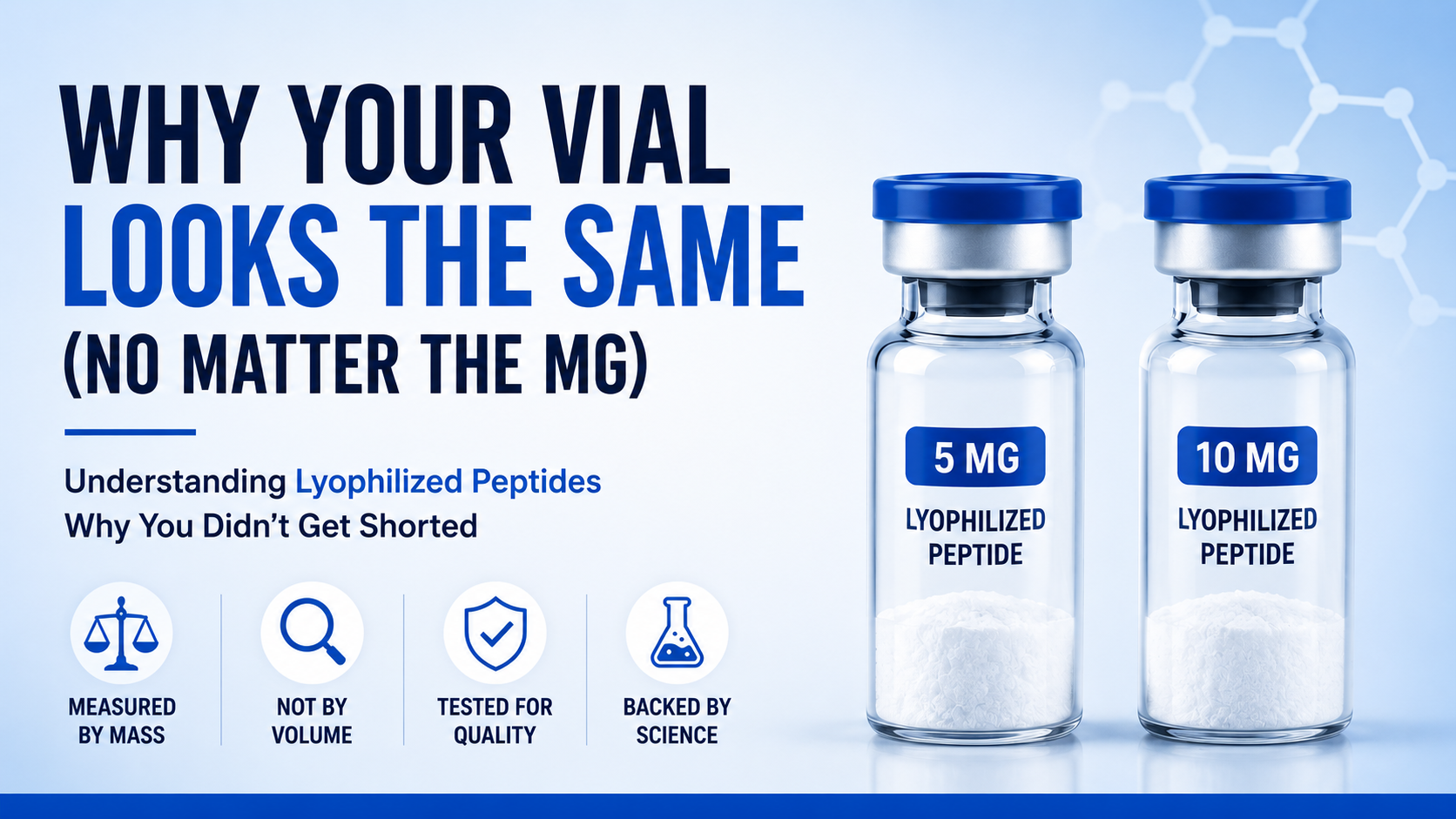
However, lyophilized vial powder appearance can vary even when labeled milligram content is accurate. Therefore, researchers should not use cake height, fluffiness, or visible volume as a substitute for quantitative testing.
1 Why Lyophilized Vial Powder Appearance Can Mislead
Therefore, a similar-looking vial does not prove an incorrect fill.
In addition, a 5 mg vial and a 10 mg vial can appear to contain nearly the same amount of dry material. However, visible volume does not directly measure the mass of the target compound.
In addition, the freeze-dried cake may contain excipients, residual moisture, salts, buffers, or a different pore structure. As a result, appearance alone cannot confirm the labeled amount.
2 What Lyophilized Powder Is
For example, lyophilization freezes a preparation and removes most water through sublimation under reduced pressure. As a result, consequently, the process leaves a porous cake or dry deposit inside the vial.
However, the physical size of that cake depends on more than peptide mass. Moreover, formulation, vial geometry, freezing rate, solids concentration, collapse, shrinkage, and residual moisture can all change its appearance.
3 What Milligram Strength Actually Means
Meanwhile, a label such as 5 mg, 10 mg, or 15 mg refers to mass. By contrast, the eye sees height, width, texture, and apparent volume.
4 Why Higher Milligrams May Look Similar
By contrast, several variables can make different strengths look alike. For instance, the same vial size can exaggerate small visual differences or hide them completely.
5 The Visual Illusion: Volume Is Not Mass
Your eyes estimate volume. The label states mass. Those measurements answer different questions.
Likewise, a simple comparison is sand and cotton. The same container volume can hold very different masses because the materials have different densities and pore spaces.
6 How Vial Content Should Be Evaluated
Visual inspection can reveal obvious damage, collapse, discoloration, or seal problems. However, it cannot measure net peptide content, purity, identity, water, counterions, or batch uniformity.
7 Common Misconception About Vial Fill
Misconception: “A 10 mg vial should look twice as full as a 5 mg vial.”
Reality: Visible volume does not scale predictably with target-compound mass.
9 Testing Methods That Address the Real Questions
Quantitative content testing
A calibrated assay can estimate how much target compound is present. Therefore, it directly addresses the labeled milligram claim more effectively than a visual comparison.
Chromatographic purity
HPLC or UPLC can estimate the relative amount of detected chromatographic components. However, area purity does not automatically prove total mass per vial.
Residual moisture and formulation solids
Karl Fischer testing can measure water, while other methods can characterize salts, counterions, or excipients. As a result, researchers can better explain why gross cake mass and target-compound mass differ.
Batch and vial sampling
One vial describes only that tested unit. Therefore, multiple-vial sampling and controlled filling data provide stronger evidence about batch uniformity.
10 Frequently Asked Questions
Can two strengths look exactly the same?
Yes. Different target masses can produce similar cake sizes when density, excipients, pore structure, vial shape, and drying conditions differ.
Does a larger cake mean more peptide?
Not necessarily. For example, a formulation with more bulking agent may create a larger cake without increasing the target-compound mass.
Can appearance prove a vial is underfilled?
No. Visual appearance may justify further review, but a quantitative method must evaluate the actual content claim.
Can appearance prove a vial is correctly filled?
No. Likewise, a normal-looking cake cannot establish identity, purity, content, sterility, or endotoxin status.
11 Authoritative References
Lyophilization and analytical guidance
- PubMed: Pharmaceutical lyophilization, residual moisture, and cake structure
- ICH quality guidelines for analytical methods and stability
- United States Pharmacopeia standards and analytical resources
- FDA pharmaceutical quality resources
These sources provide broader context for freeze-drying, analytical testing, stability, packaging, and quality evaluation. However, compound-specific conclusions still require suitable methods and representative samples.
8 Final Takeaway on Lyophilized Vial Powder Appearance
- First, milligrams describe mass, not visual cake size.
- Next, visible volume can change with density, excipients, moisture, and freeze-drying conditions.
- Therefore, similar-looking vials do not automatically indicate the same content.
- However, appearance alone also cannot prove that a fill is correct.
- Finally, quantitative testing and traceable batch records provide stronger evidence.
Research-Use and Analytical Notice
This article explains general analytical and lyophilization concepts for laboratory research materials.
Lyophilized vial powder appearance does not provide a reliable measurement of labeled milligram content. Therefore, researchers should use suitable testing, batch documentation, and professional interpretation.
In addition, this information does not provide medical advice, dosing instructions, reconstitution directions, or assurance that any material is safe for human or veterinary use.