Lyophilized peptide storage and how to read a vial
In addition, lyophilized peptide storage shapes what you see in the vial, because temperature history, moisture control, and transit movement all influence the final visual result. In routine practice, lyophilized peptide appearance shifts during shipping, yet most cosmetic changes stay unrelated to actual content or quality.
However, as you move through this overview on lyophilized peptide storage, you will see how primary storage conditions, short shipping windows, and visual inspection work together. You will also gain a simple checklist you can follow whenever a new shipment arrives and learn how to pair appearance with documentation and testing.
Research Use Only • Educational Resource
Therefore, lyophilized peptide storage and handling influence appearance after transit, yet analytical verification and batch documentation carry more weight than appearance alone.
1What changing appearance really says about quality
For example, across modern supply chains, variation in lyophilized peptide storage conditions before shipment and during transit creates frequent shifts in how a vial looks on arrival. A previously cohesive structure can arrive partially broken, lightly powdered, or more loosely distributed inside the glass.
Moreover, during transport, movement and vibration apply mechanical stress to the dry matrix, which behaves like a brittle solid. Because of that property, the material often shifts, cracks, or fragments even when the vial, stopper, and seal stay intact and storage instructions have been followed.
As a result, in day-to-day work, visual review works best as an initial screen rather than a final judgment. You can note what you see, document it with photos if needed, and then rely on batch records, lyophilized peptide storage history, and analytical data for any actual quality decision.
2What “lyophilized” means in everyday lab work
Many research peptides stay stable because suppliers preserve them through lyophilization, also called freeze-drying. In this process, a peptide solution first undergoes freezing and then exposure to a strong vacuum. Under those conditions, water transitions directly from ice to vapor through sublimation instead of melting to a liquid.
Likewise, as water leaves, a dry matrix that contains peptide and any excipients remains in the vial. Because of that outcome, lyophilized peptide storage supports distribution and long-term holding by removing the bulk of free water while keeping the solid material in place until reconstitution.
Meanwhile, for everyday lab work, this process means that a single vial can travel through normal shipping channels and still arrive ready for careful reconstitution. With suitable lyophilized peptide storage on site, the same batch can often support several experiments when teams follow their internal handling procedures.
3Typical lyophilized appearance in a vial
In routine orders, lyophilized peptide appearance varies with formulation, fill volume, excipient choice, and freeze-drying settings. In addition, handling during transit and the quality of lyophilized peptide storage at the destination influence how the solid structure presents when a carton is opened.
- Texture: compact, cohesive, brittle, fragmented, or slightly granular. Because of these options, researchers often see more than one texture type even within a single order.
- Location: settled at the bottom, attached along the side, or shifted to one edge of the vial. Since the matrix stays dry and fragile, modest shipping motion easily changes where it rests.
- Color: usually white to off-white, with occasional pale cream or faint yellow tones related to composition. Any sudden darkening or obvious discoloration deserves a support review and a check of lyophilized peptide storage conditions.
- Form: a single cake, several fragments, loose material, or a partially broken structure. Form alone rarely shows whether a batch meets its analytical targets.
4Why appearance often changes during shipping
During transport, a lyophilized plug behaves more like a delicate ceramic than a flexible sponge. Repeated bumps, vibration, and changes in orientation frequently cause visible cracking, edge chipping, or small areas of loose powder inside the vial, even when lyophilized peptide storage has otherwise remained appropriate.
- Because the dried matrix usually shows brittleness and sensitivity to impact, even routine courier handling often changes how it looks on arrival.
- For instance, vibration and movement during transit can fragment the matrix or shift it to one side, so a cake that started centered may slide or rotate.
- Normal pressure changes and package handling sometimes introduce minor cracks, which do not automatically signal a loss of quality or failed lyophilized peptide storage.
- A cohesive cake might arrive as smaller pieces or a partially broken puck, and in many cases that change simply reflects mechanical stress rather than instability.
5Variations in appearance and how to interpret them
In real-world production runs, lyophilized peptide appearance responds to many factors, including freezing profile, chamber pressure, formulation concentration, and excipient system. For that reason, vials from different manufacturers, or even different lots from one source, may not look identical while still meeting the same analytical specifications.
Common presentation
A cohesive or compact cake or puck at the bottom of the vial appears in many freeze-dried preparations. This form often develops when the solution volume and container geometry support even freezing and drying under well-controlled lyophilized peptide storage before shipment.
Researchers sometimes feel more confident when the structure looks neat and uniform. Even then, you still need supporting data and confirmation that lyophilized peptide storage instructions were followed before drawing any conclusions about quality.
Also common
A more granular, fragmented, or loosely structured appearance occurs with certain formulations, fill volumes, or shipping histories. Although this presentation looks less uniform, it still aligns with normal lyophilized product behavior when other quality markers and lyophilized peptide storage details check out.
Both styles show up across reputable suppliers, and both can support reliable work. You should treat each vial as acceptable or not based on objective documentation, storage records, and analytical data instead of appearance preference alone.
6Why lyophilization and storage matter for research use
Across pharmaceutical and research settings, lyophilization helps extend usable shelf life when products remain under suitable storage conditions. Because of these benefits, many peptide reference materials and investigational products now ship in a dry form rather than as ready-to-use solutions.
- Reduced moisture content slows many hydrolysis and oxidation pathways, so a dry matrix often tolerates short temperature excursions better than a liquid form.
- Dry form simplifies cold-chain logistics for short shipping intervals, which allows couriers to deliver material efficiently to many regions.
- Laboratories can reconstitute material under controlled conditions, which gives each team control over solvent quality, technique, and timing.
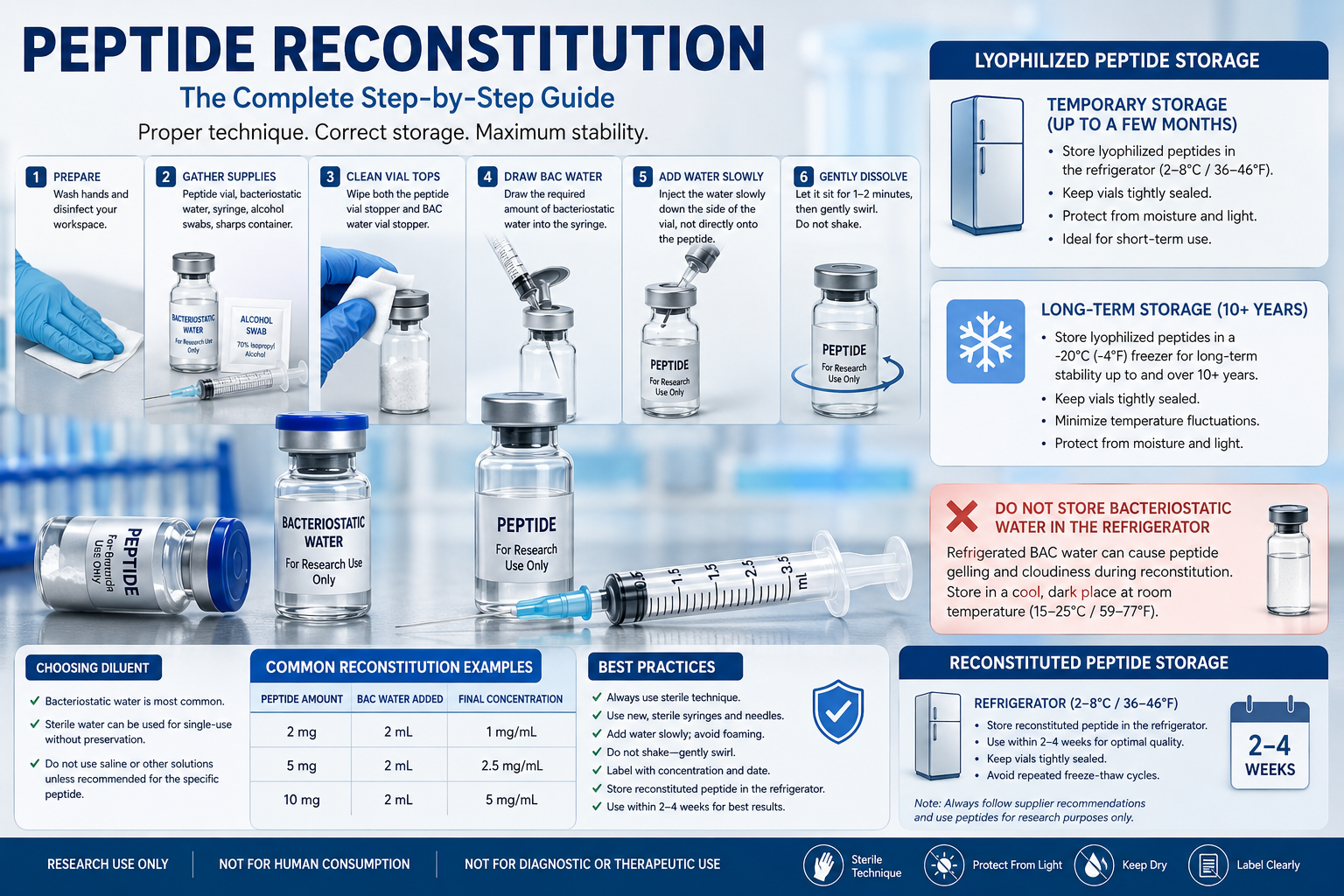
Even with these benefits, stability still depends on temperature history, light exposure, formulation design, and container-closure integrity. Because of that, lyophilized peptide storage should follow instructions on the product label and in accompanying documentation closely.
For further context, you can review general expectations around storage and solid products in quality guidance from the U.S. Food and Drug Administration (FDA) and from the United States Pharmacopeia (USP).
7How quality is evaluated beyond what you see
Reliable assessment of a research peptide draws on manufacturing controls, traceable documentation, and analytical data rather than appearance alone. In practice, quality systems adapt principles from standards such as Good Manufacturing Practice and pharmacopeial guidance and align them with responsible lyophilized peptide storage.
For reference on broader expectations, readers can review guidance from organizations such as the U.S. Food and Drug Administration (FDA) and the United States Pharmacopeia (USP). Although research-use products do not follow the same regulatory pathway as approved drugs, many suppliers adapt similar quality concepts so that internal standards stay consistent.
In day-to-day practice, you can treat appearance as one data point next to these structured checks. When something seems unusual, it helps to confirm that labeling, batch numbers, lyophilized peptide storage instructions, and supporting reports all align before you decide how to proceed.
8Helpful standards and educational references
When evaluating lyophilized peptide storage and appearance in context, independent references can support laboratory decision-making. Because those sources focus on general principles, they help frame appearance as one observation among many.
- European Medicines Agency quality guidelines discuss expectations for solid and parenteral products.
- ICH quality guidelines outline concepts around stability, impurities, and analytical validation.
- Peer‑reviewed articles on freeze-drying of peptides and proteins on PubMed provide deeper background on formulation and process design.
For readers who want to connect these ideas to specific molecules, trial listings on ClinicalTrials.gov sometimes describe lyophilized investigational products and their handling instructions. Those examples can further illustrate how experts treat appearance and lyophilized peptide storage as supportive information instead of a stand‑alone metric.
To explore related topics on documentation and testing, you can also review other education pages on AminosInfo such as how to read a peptide COA, which shows how appearance fits within a broader quality toolkit.
9When to contact Southern Aminos support
Customers should reach out to support when something suggests a packaging, storage, or documentation issue rather than routine cosmetic variation in lyophilized peptide appearance. Early contact allows faster review and, when needed, replacement or further investigation.
- Broken vial, chipped glass, or obviously compromised container. In these situations, stop using the vial, keep current lyophilized peptide storage conditions steady, and document what you see.
- Missing, incorrect, or unreadable label information. Because accurate labels support traceability and link to lyophilized peptide storage instructions, they matter as much as the vial contents.
- Visible foreign material that appears unrelated to typical lyophilized presentation, such as fibers or colored particles. When in doubt, share clear photos with the support team.
- Unclear batch number, missing paperwork, or mismatch with records. Confirmation from the supplier helps protect your data set and verifies that lyophilized peptide storage recommendations were followed.
- Seal, cap, or stopper concerns suggesting loss of container integrity. Because container-closure issues may impact stability, they deserve prompt review.
10Simple takeaway on lyophilized peptide storage
- In day-to-day work, lyophilized products may appear as a puck, cake, fragments, powder, or loose material, even within the same product line.
- Routine shipping movement and handling often change the visible structure without altering content or identity when lyophilized peptide storage conditions remain within the recommended range.
- Visual inspection offers a useful quick check but does not define overall quality on its own, so you should always view it alongside lyophilized peptide storage details and analytical reports.
- Analytical verification, batch traceability, storage records, and documentation carry the most weight when evaluating any vial.