
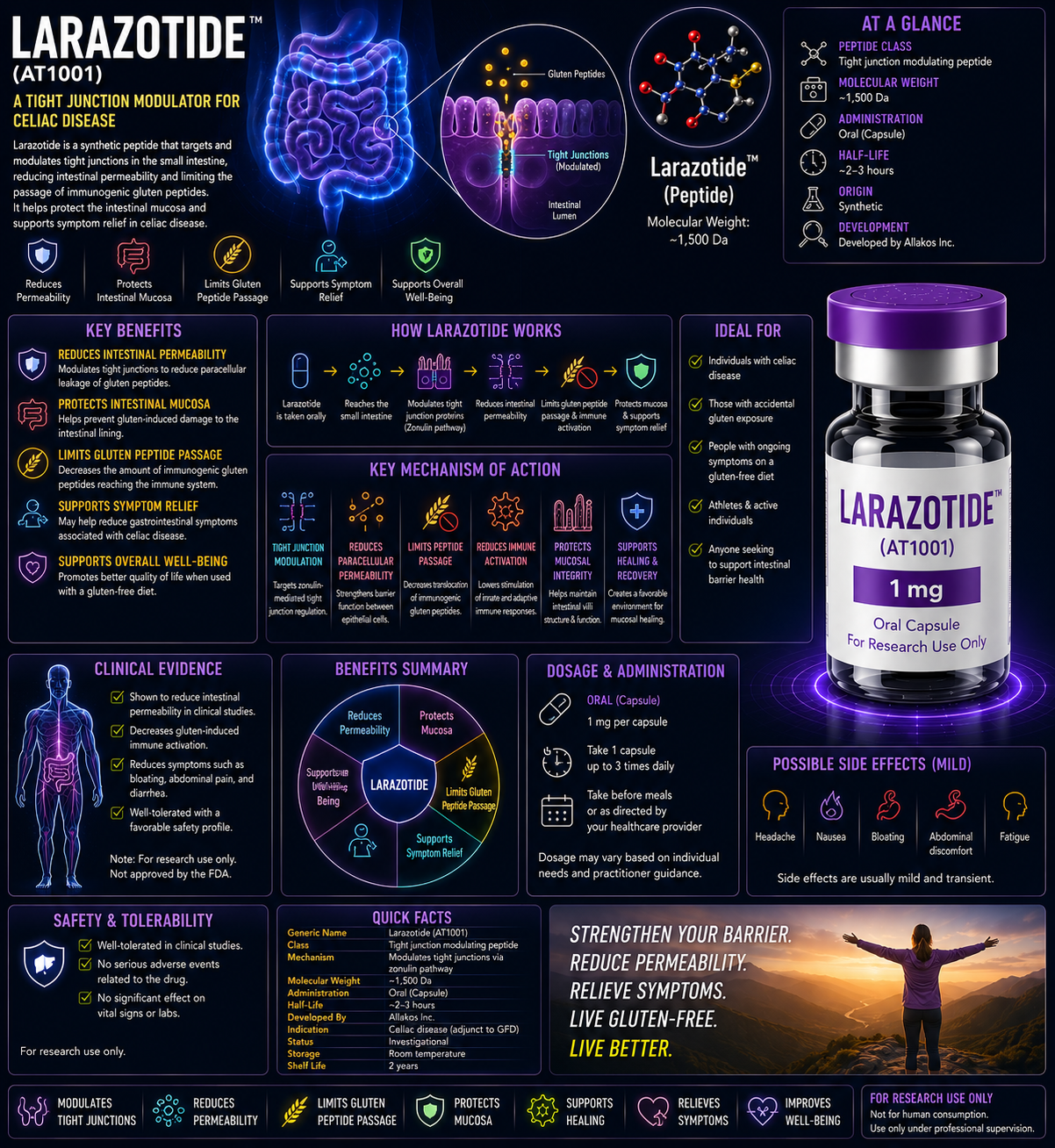
Larazotide (Larazotide Acetate / AT-1001): What It Is, How It Works, Benefits, and Research Overview What Is Larazotide? Larazotide (also called Lar
Larazotide (Larazotide Acetate / AT-1001): What It Is, How It Works, Benefits, and Research Overview
What Is Larazotide?
Larazotide (also called Larazotide Acetate or AT-1001) is an investigational peptide therapeutic studied for its potential role in intestinal barrier function, gut permeability (“leaky gut”), inflammation regulation, and gastrointestinal disease research. Unlike many regenerative or bioregulator peptides, Larazotide has undergone human clinical trials, particularly for celiac disease. (en.wikipedia.org)
Researchers investigate Larazotide in relation to:
- Intestinal permeability and tight junction regulation
- Celiac disease and gluten-triggered gut dysfunction
- Gastrointestinal inflammation and barrier integrity
- Autoimmune and inflammatory gut signaling
- Intestinal epithelial resilience and mucosal repair (pubmed.ncbi.nlm.nih.gov)
Important: Larazotide is not FDA approved and remains investigational, although it progressed through multiple Phase II and Phase III clinical development programs for celiac disease. Evidence includes human clinical trials, animal studies, and mechanistic research. (clinicaltrials.gov)
What Is Larazotide Made Of?
Larazotide is a synthetic octapeptide (8 amino acids) derived from:
Zonula occludens toxin (ZOT) signaling research.
Researchers designed Larazotide to act as a:
Tight junction regulator
meaning it is studied for how it influences the microscopic junctions between intestinal epithelial cells. (pubmed.ncbi.nlm.nih.gov)
Unlike broad anti-inflammatory drugs, Larazotide is designed to:
Help regulate barrier function rather than suppress the immune system directly.
How Does Larazotide Work?
Larazotide is studied for its effects on:
Tight junctions
These are microscopic protein structures between intestinal cells that regulate:
- What enters the bloodstream
- Nutrient absorption
- Barrier integrity against toxins, microbes, and food antigens. (pubmed.ncbi.nlm.nih.gov)
Researchers believe Larazotide works by:
Reducing inappropriate opening of intestinal tight junctions
particularly in response to:
Zonulin signaling, a pathway associated with increased intestinal permeability. (pubmed.ncbi.nlm.nih.gov)
In simple terms:
Larazotide says:
“Help keep the gut barrier tighter and less permeable.”
1. Intestinal Barrier Function (“Leaky Gut”) Research
The largest research area focuses on:
Intestinal permeability
Researchers investigate whether Larazotide may help:
- Reduce excessive intestinal permeability
- Support epithelial barrier integrity
- Limit inappropriate passage of inflammatory molecules across the gut wall. (pubmed.ncbi.nlm.nih.gov)
This is often discussed in relation to:
“Leaky gut” research, though the scientific literature typically refers to it as:
Increased intestinal permeability. (pubmed.ncbi.nlm.nih.gov)
2. Celiac Disease Research
Larazotide is most heavily studied for:
Celiac disease
In celiac disease:
Gluten exposure → zonulin activation → increased gut permeability → immune activation
Researchers investigated whether Larazotide may:
- Reduce symptoms associated with accidental gluten exposure
- Improve gut barrier function
- Reduce inflammation-triggering permeability responses. (clinicaltrials.gov)
Clinical trials reported:
- Improvement in some gastrointestinal symptoms
- Mixed outcomes regarding biomarkers and histologic changes
- Better tolerability than many anticipated. (pubmed.ncbi.nlm.nih.gov)
Importantly:
Larazotide is not a substitute for a gluten-free diet.
3. Gastrointestinal Inflammation Research
Researchers also study Larazotide for:
- Inflammatory bowel signaling
- Mucosal barrier dysfunction
- Intestinal epithelial stress responses
- GI inflammation associated with permeability disruption. (pubmed.ncbi.nlm.nih.gov)
Experimental work explores whether improving:
Barrier integrity
may indirectly reduce inflammatory signaling.
4. Autoimmune and Metabolic Research
Because intestinal permeability has been implicated in broader immune and metabolic signaling, researchers investigate Larazotide in experimental models involving:
- Autoimmune disease pathways
- Gut-immune communication
- Systemic inflammatory signaling
- Metabolic dysfunction associated with epithelial barrier disruption. (pubmed.ncbi.nlm.nih.gov)
These applications remain exploratory.
Why Is Larazotide Getting Attention?
Larazotide attracts attention because it combines several important research themes:
- Gut barrier integrity
- Tight junction regulation
- Celiac disease research
- Inflammation and permeability biology
- Non-immunosuppressive gut signaling approaches (pubmed.ncbi.nlm.nih.gov)
Researchers are especially interested in:
Treating gut dysfunction by improving barrier integrity rather than suppressing immunity.
Potential Research Areas of Interest
1. Intestinal Permeability Research
Researchers investigate whether Larazotide may support:
- Tight junction signaling
- Reduced intestinal permeability
- Mucosal barrier resilience. (pubmed.ncbi.nlm.nih.gov)
2. Celiac Disease Research
Experimental and clinical work explores Larazotide in relation to:
- Gluten-induced GI symptoms
- Intestinal barrier dysfunction
- Celiac-associated permeability signaling. (clinicaltrials.gov)
3. Gastrointestinal Inflammation Research
Researchers study whether Larazotide influences:
- Gut epithelial inflammation
- Barrier-mediated inflammatory signaling
- Intestinal resilience. (pubmed.ncbi.nlm.nih.gov)
4. Autoimmune and Gut-Immune Research
Researchers investigate Larazotide for:
- Gut-immune communication
- Systemic inflammatory signaling linked to permeability
- Experimental autoimmune biology. (pubmed.ncbi.nlm.nih.gov)
Larazotide vs KPV vs BPC-157 vs LL-37
| Feature | Larazotide | KPV | BPC-157 | LL-37 |
|---|---|---|---|---|
| Main Focus | Gut permeability & tight junctions | GI inflammation | Tissue protection/repair | Immune & antimicrobial signaling |
| Primary Mechanism | Tight-junction regulation | Anti-inflammatory signaling | Cytoprotective repair signaling | Innate immune signaling |
| Major Research Area | Celiac & intestinal barrier | GI inflammation | GI & systemic repair | Immune defense |
| Human Clinical Trials? | Yes | Limited | No major formal trials | Limited |
| FDA Approved? | No | No | No | No |
Researchers generally view:
- Larazotide → gut barrier/tight-junction peptide
- KPV → GI anti-inflammatory peptide
- BPC-157 → tissue repair peptide
- LL-37 → immune/antimicrobial peptide (pubmed.ncbi.nlm.nih.gov)
Potential Side Effects and Safety Considerations
Because Larazotide remains investigational:
- Regulatory approval is not established
- Long-term outcomes remain under study
- Human safety data are stronger than many peptides due to clinical trial exposure. (pubmed.ncbi.nlm.nih.gov)
Across trials, Larazotide was generally:
- Well tolerated
- Associated mostly with mild gastrointestinal symptoms when adverse events occurred. (pubmed.ncbi.nlm.nih.gov)
Researchers still emphasize findings should be interpreted as:
Investigational and not established clinical therapy.
Frequently Asked Questions
Is Larazotide a peptide?
Yes. Larazotide is an 8-amino-acid synthetic peptide studied for intestinal barrier and tight-junction regulation. (en.wikipedia.org)
Is Larazotide FDA approved?
No. Larazotide is not FDA approved and remains investigational. (clinicaltrials.gov)
What is Larazotide studied for?
Researchers study Larazotide for intestinal permeability, celiac disease, gut barrier integrity, GI inflammation, and tight-junction regulation. (pubmed.ncbi.nlm.nih.gov)
Does Larazotide help “leaky gut”?
Research investigates whether Larazotide may reduce increased intestinal permeability, commonly called “leaky gut,” but robust clinical evidence outside celiac disease remains limited. (pubmed.ncbi.nlm.nih.gov)
What makes Larazotide different from BPC-157 or KPV?
Larazotide specifically targets tight junction regulation and gut permeability, whereas BPC-157 is studied more broadly for tissue repair, and KPV for anti-inflammatory GI signaling. (pubmed.ncbi.nlm.nih.gov)
Final Thoughts
Larazotide is an investigational gut-barrier peptide studied for its potential role in tight-junction regulation, intestinal permeability, celiac disease, and GI inflammatory signaling. Unlike many peptides focused on broad regeneration, Larazotide targets a very specific mechanism:
Maintaining intestinal barrier integrity.
While clinical research is more advanced than for many peptides, Larazotide remains experimental, not FDA approved, and broader therapeutic relevance continues to be investigated. (pubmed.ncbi.nlm.nih.gov)
