
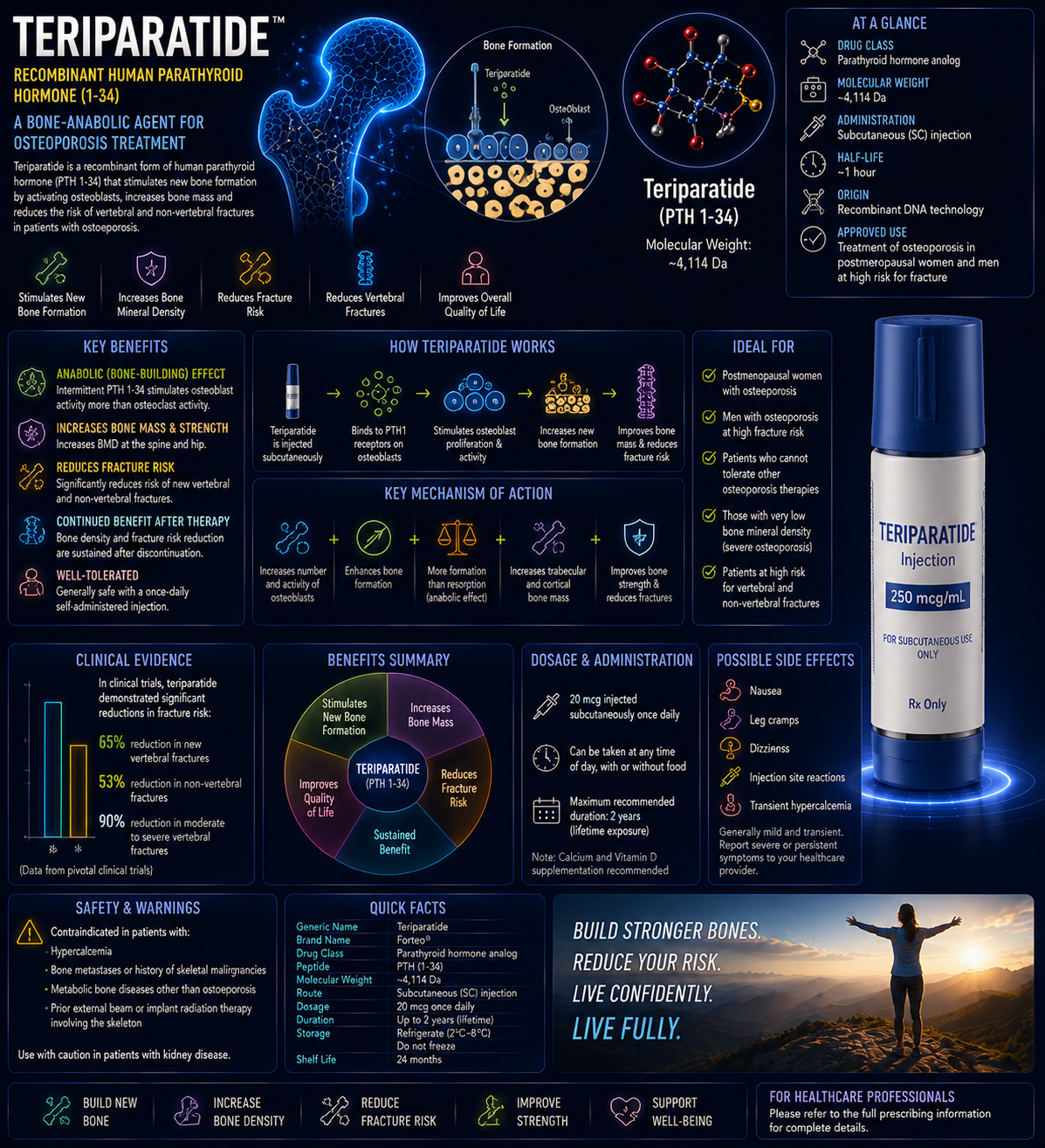
Teriparatide: What It Is, How It Works, Benefits, and Research Overview What Is Teriparatide? Teriparatide is a recombinant form of parathyroid horm
Teriparatide: What It Is, How It Works, Benefits, and Research Overview
What Is Teriparatide?
Teriparatide is a recombinant form of parathyroid hormone (PTH 1–34) used clinically as an anabolic (bone-building) agent. Unlike many investigational peptides, Teriparatide is FDA approved for certain indications. It is primarily prescribed for:
- Osteoporosis in postmenopausal women
- Osteoporosis in men at high risk of fracture
- Glucocorticoid-induced osteoporosis
Teriparatide is a synthetic peptide consisting of the first 34 amino acids of human parathyroid hormone, which retains full biological activity. Its primary effect is to stimulate bone formation by activating osteoblasts. (nih.gov)
How Does Teriparatide Work?
Teriparatide works by mimicking the actions of endogenous parathyroid hormone (PTH), but its effects depend on intermittent dosing:
1. Osteoblast Stimulation
- Teriparatide binds to PTH receptors on osteoblasts
- Stimulates osteoblast differentiation, activity, and survival
- Increases bone formation more than bone resorption when given intermittently
2. Bone Remodeling Balance
- Osteoclast activity (bone resorption) is also stimulated, but intermittent dosing favors net bone formation
- Increases bone mass and trabecular thickness
- Improves bone microarchitecture (nih.gov)
3. Calcium Regulation
- Teriparatide increases intestinal calcium absorption indirectly via calcitriol activation
- Enhances renal calcium reabsorption, supporting serum calcium homeostasis
Benefits of Teriparatide
- Increased Bone Mineral Density (BMD)
- Primarily in the spine and hip
- Reduces risk of vertebral and nonvertebral fractures
- Improved Bone Quality
- Enhances trabecular microarchitecture
- Strengthens cortical bone
- Rapid Onset
- Bone formation markers rise within 1–3 months of therapy
- Adjunct for High-Risk Osteoporosis
- Effective in patients unresponsive to antiresorptive therapy
- Potential Wound-Healing and Fracture Repair (Investigational)
- Studies explore perioperative and fracture healing benefits in preclinical models
Administration
- Route: Subcutaneous injection
- Typical Dose: 20 µg daily
- Treatment Duration: Maximum 24 months (due to risk of osteosarcoma in animal studies)
- Post-Treatment: Usually followed by anti-resorptive therapy to maintain gains
Side Effects
Common side effects include:
- Injection site reactions
- Nausea
- Leg cramps
- Dizziness or lightheadedness
Rare but serious risks:
- Hypercalcemia
- Hypotension
- Osteosarcoma risk observed in rodents (not confirmed in humans)
Monitoring: Serum calcium and renal function may be monitored during therapy (nih.gov)
Teriparatide vs Abaloparatide vs Romosozumab
| Feature | Teriparatide | Abaloparatide | Romosozumab |
|---|---|---|---|
| Type | Recombinant PTH 1–34 | PTHrP analog | Monoclonal antibody (sclerostin inhibitor) |
| Mechanism | Osteoblast activation | Osteoblast activation | Dual: stimulates formation, inhibits resorption |
| Administration | Daily subcutaneous injection | Daily subcutaneous injection | Monthly subcutaneous injection |
| FDA Approved | Yes | Yes | Yes |
| Duration Limit | 24 months | 24 months | 12 months |
| Primary Use | Osteoporosis, fracture prevention | Osteoporosis, postmenopausal | Osteoporosis, high fracture risk |
Frequently Asked Questions
Is Teriparatide a peptide?
Yes. Teriparatide is a 34-amino-acid recombinant peptide derived from human parathyroid hormone.
What is Teriparatide used for?
It is used to treat osteoporosis in postmenopausal women, men, and glucocorticoid users at high fracture risk.
How does it increase bone?
By stimulating osteoblasts, increasing bone formation more than resorption when administered intermittently.
Can it be used long-term?
Maximum approved duration is 24 months, followed by antiresorptive therapy to maintain gains.
Is it safe?
Generally safe when monitored. Common side effects are mild; serious risks are rare.
Final Thoughts
Teriparatide is a clinically approved anabolic peptide therapy that significantly increases bone mass and strength by activating osteoblasts and enhancing bone formation. Unlike many investigational peptides, it has extensive clinical trial evidence and FDA approval for osteoporosis management. While its primary use is for bone health, ongoing research explores additional benefits in fracture healing and tissue repair.
