
:root{ --ink:#16202a; --muted:#5c6975; --line:#dce3e8; --panel:#f6f8fa; --accent:#174f69; --accent2:#6c3f75; --warning:#7a4
PT-141 Scientific Overview: Structure, Mechanism, Research, and Testing
For example, PT-141 scientific overview content should distinguish the approved VYLEESI formulation from unregulated products sold under the PT-141 name. This cyclic melanocortin agonist with a narrowly defined FDA-approved indication in certain premenopausal women.
What Is PT-141?
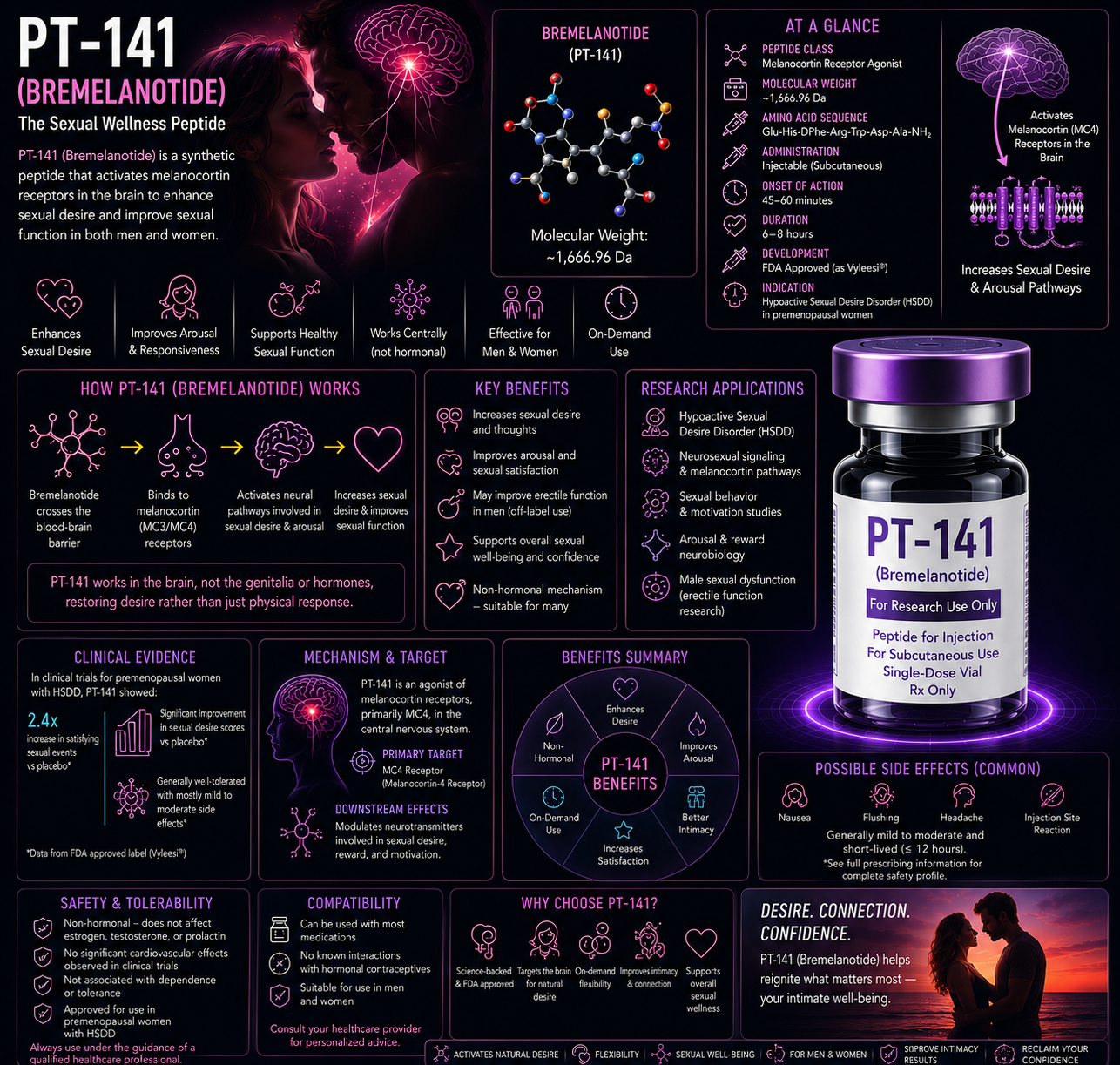
First, PT-141, also known as bremelanotide, is a synthetic cyclic peptide that activates melanocortin receptors. It was developed from the melanocortin research program that produced Melanotan II, but its clinical development shifted away from tanning and toward central nervous-system pathways involved in sexual desire and arousal.
By contrast, phosphodiesterase type 5 inhibitors such as sildenafil or tadalafil, bremelanotide does not primarily act by increasing genital blood flow through nitric-oxide signaling. Its therapeutic action is believed to arise mainly from melanocortin receptor signaling in the brain, including pathways involving the hypothalamus, medial preoptic area, limbic system, and dopamine-associated sexual-motivation networks.
Importantly, the FDA-approved product VYLEESI® treats for premenopausal women with acquired, generalized hypoactive sexual desire disorder (HSDD) that causes marked distress or interpersonal difficulty and is not due to another medical or psychiatric condition, relationship problems, or the effects of a medication or drug substance.
Synthetic cyclic melanocortin peptide
Central sexual-desire signaling
VYLEESI® bremelanotide injection
June 21, 2019
Premenopausal women with acquired, generalized HSDD
Men, postmenopausal women, ED, or performance enhancement
🧬 Molecular Structure
First, bremelanotide is a cyclic heptapeptide analog derived from Melanotan II. It contains a lactam ring formed between the side chains of aspartic acid and lysine. This ring constrains the peptide into a receptor-active shape and improves resistance to enzymatic degradation compared with a flexible linear peptide.
Next, PT-141 differs from Melanotan II primarily at the C-terminus. Bremelanotide contains a free carboxylic acid rather than the C-terminal amide found in Melanotan II. This structural change reduces emphasis on pigmentation while preserving central melanocortin activity relevant to sexual behavior.
🧪 Amino-Acid Sequence
Ac-Nle-c[Asp-His-D-Phe-Arg-Trp-Lys]-OH
| Component | Meaning | Structural relevance |
|---|---|---|
| Ac | N-terminal acetyl group | Meanwhile, Protects the N-terminus and contributes to stability. |
| Nle | Norleucine | Likewise, Oxidation-resistant substitute related to α-MSH analog design. |
| Asp and Lys | In addition, Aspartic acid and lysine | Moreover, Form the lactam bridge that creates the cyclic ring. |
| D-Phe | D-phenylalanine | By contrast, Improves proteolytic stability and melanocortin potency. |
| -OH | Also, Free C-terminal carboxyl group | Consequently, Distinguishes bremelanotide from C-terminally amidated Melanotan II. |
⚛️ Molecular Weight and 🧫 Formula
| Bremelanotide free-base formula | However, C50H68N14O10 |
|---|---|
| Free-base molecular weight | Approximately 1,025.2 g/mol |
| Bremelanotide acetate formula | Therefore, C52H72N14O12 |
| Acetate molecular weight | Approximately 1,085.2 g/mol |
| CAS number, free base | 189691-06-3 |
| PubChem CID | 9941379 |
Therefore, a COA must state whether it reports the free base, acetate salt, hydrate, or another material form. Formula and molecular-weight values differ among these forms.
📅 Discovery Timeline
1980s–early 1990s: Melanocortin analog development
First, researchers developed increasingly potent and stable α-MSH analogs to study pigmentation and melanocortin receptor biology. Melanotan II emerged as a cyclic analog with broad receptor activity.
1990s: Unexpected sexual effects observed
Next, human studies of Melanotan II reported spontaneous erections and changes in sexual desire. These observations suggested that melanocortin signaling could influence central sexual-arousal pathways independently of conventional vascular mechanisms.
Late 1990s–early 2000s: PT-141 created
Then, researchers developed bremelanotide as a metabolite-inspired derivative of Melanotan II. The C-terminal modification reduced its melanotropic emphasis while retaining central prosexual activity.
2000s: Male erectile-response and female-arousal studies
Afterward, early clinical trials evaluated intranasal PT-141 in healthy men, men with erectile dysfunction, and women with sexual-arousal concerns. The program demonstrated biological activity but also identified cardiovascular effects that influenced development strategy.
2010s: Subcutaneous formulation and HSDD development
Meanwhile, clinical development moved to a subcutaneous formulation and focused on acquired, generalized HSDD in premenopausal women.
2019: FDA approval
Finally, on June 21, 2019, the FDA approved VYLEESI for the treatment of premenopausal women with acquired, generalized HSDD under the limitations described in the prescribing information.
Present research
In addition, bremelanotide remains a research tool for studying melanocortin-dependent desire, motivation, dopamine release, sexual behavior, erectile physiology, and central autonomic signaling. Broader applications remain investigational unless separately approved.
📖 Research History
Importantly, the development of bremelanotide is unusual because it began with pigmentation research and evolved into a centrally acting sexual-medicine program. Investigators studying Melanotan II repeatedly observed erectile responses that could not be explained solely by peripheral vasodilation. This redirected attention toward melanocortin receptors in brain regions that organize sexual motivation and behavior.
Next, early human studies showed dose-related erectile responses in men, including some participants with erectile dysfunction. Research then expanded into female sexual-arousal and desire disorders. The most important later evidence came from the two Phase 3 RECONNECT trials, which assessed as-needed subcutaneous bremelanotide in premenopausal women with HSDD.
Moreover, those trials found statistically significant improvements in sexual-desire scores and reductions in distress related to low desire. The average clinical benefit was modest and responses varied. Long-term extension data did not identify new major safety signals, but nausea and transient blood-pressure effects remained important limitations.
🧠 Mechanism of Action
For example, Researchers have not fully established the exact mechanism by which bremelanotide improves HSDD. It is a nonselective melanocortin receptor agonist, and its therapeutic effects are believed to arise mainly through central MC4R-mediated signaling, with possible contributions from MC3R and other melanocortin receptors.
1. Central melanocortin receptor activation
First, bremelanotide reaches functionally relevant central pathways and activates melanocortin receptors in brain regions involved in motivation, reward, autonomic activity, and sexual behavior.
2. Medial preoptic area and hypothalamus
Next, animal and translational studies indicate that MC4R activation in the medial preoptic area of the hypothalamus may increase dopamine release. Dopamine is an excitatory neurotransmitter involved in wanting, anticipation, motivation, and sexual behavior.
3. Limbic and reward networks
Moreover, melanocortin signaling interacts with neural circuits that evaluate salience and reward. Bremelanotide is therefore better described as a modulator of sexual-interest and arousal signaling than as a direct mechanical trigger.
4. Autonomic pathways
In addition, central melanocortin activation can influence sympathetic and parasympathetic output. These autonomic effects may contribute to genital responses but also explain transient increases in blood pressure and reductions in heart rate.
5. Erectile physiology
For example, experimental bremelanotide produced erectile responses through central neural pathways. This differs from sildenafil and tadalafil, which inhibit PDE5 and enhance nitric-oxide-mediated smooth-muscle relaxation in penile tissue.
6. Pigmentation signaling
Finally, bremelanotide can activate MC1R and may cause focal or generalized hyperpigmentation, especially with repeated exposure. Pigmentation is not the therapeutic target of VYLEESI but remains a class-related effect.
🎯 Receptor Profile
| Receptor | Principal biology | Relevance to bremelanotide |
|---|---|---|
| MC1R | Meanwhile, Pigmentation and melanocyte signaling | Likewise, Contributes to possible hyperpigmentation; not the desired therapeutic target. |
| MC2R | ACTH-dependent adrenal steroidogenesis | In addition, Not a principal target; MC2R requires ACTH-specific structural interactions. |
| MC3R | Moreover, Energy balance, limbic and hypothalamic signaling | By contrast, May contribute to central behavioral effects. |
| MC4R | Also, Sexual behavior, appetite, autonomic control, motivation | Consequently, Believed to be the main receptor underlying therapeutic sexual-desire effects. |
| MC5R | However, Peripheral and exocrine signaling | Therefore, Not considered the primary mechanism of approved clinical benefit. |
Clinical Evidence and Potential Research Areas
Approved use in acquired, generalized HSDD
Importantly, the FDA indication covers premenopausal women whose previously normal desire becomes low across situations and partners, causes marked distress or interpersonal difficulty, and does not result from another condition, relationship issue, or drug effect.
Phase 3 RECONNECT trials
For example, two randomized, placebo-controlled Phase 3 trials evaluated as-needed bremelanotide in premenopausal women with HSDD. Bremelanotide produced statistically significant improvements in validated sexual-desire measures and reductions in distress related to low desire. The trials did not establish a large or uniform response in all participants, and the magnitude of average improvement was modest.
Female sexual arousal research
Moreover, earlier studies evaluated subjective arousal, genital response, sexual satisfaction, and distress. Current interpretation emphasizes desire and distress because those outcomes underpin the approved indication.
Male erectile-dysfunction research
By contrast, intranasal bremelanotide produced erectile responses in early studies of healthy men and men with erectile dysfunction. Research also examined combination use with PDE5 inhibitors. These findings did not result in FDA approval for men or erectile dysfunction.
Dopamine and reward-pathway research
In addition, researchers use bremelanotide to study how melanocortin receptors interact with dopamine, GABA, oxytocin, and hypothalamic circuits involved in sexual motivation.
Appetite and autonomic research
Finally, because MC4R also regulates appetite and cardiovascular autonomic function, researchers continue examining the extent to which therapeutic and adverse effects share overlapping receptor pathways.
Safety, Adverse Effects, and Regulatory Status
Common adverse reactions
First, the approved label identifies nausea as the most common adverse reaction. Other reported effects include:
- First, Flushing
- Next, Headache
- Also, Vomiting
- Moreover, Injection-site reactions
- In addition, Fatigue
- Likewise, Dizziness
- For example, Cough or nasal symptoms in some trial participants
Blood-pressure and heart-rate effects
Importantly, bremelanotide can transiently increase blood pressure and reduce heart rate after administration. VYLEESI is contraindicated in patients with uncontrolled hypertension or known cardiovascular disease. Cardiovascular risk should be assessed before prescribed use.
Hyperpigmentation
Moreover, focal hyperpigmentation involving the face, gingiva, or breasts has been reported. It may be more likely with repeated exposure and may not fully resolve in every patient.
Renal and hepatic considerations
In addition, severe renal or hepatic impairment may increase drug exposure in severe renal impairment or hepatic impairment. The current prescribing information should be consulted for complete precautions and clinical recommendations.
Limitations of approved use
For example, VYLEESI is not indicated for:
- First, Postmenopausal women
- Next, Men
- Also, Enhancement of sexual performance
- Moreover, Treatment of erectile dysfunction
- In addition, Low desire caused by another medical or psychiatric condition
- Likewise, Low desire caused by relationship problems or medication effects
Unregulated product concerns
However, products sold as “PT-141” outside regulated pharmaceutical channels may differ in peptide identity, salt form, concentration, sterility, endotoxin burden, residual solvents, degradation products, and dose uniformity. A high-purity chromatogram alone does not establish equivalence to VYLEESI.
🧪 Laboratory Testing Methods
First, a scientifically credible analytical program should confirm identity, purity, quantity, chemical form, and relevant contamination risks. Therefore, no single test provides all of this information.
| Method | Purpose | Important limitation |
|---|---|---|
| RP-HPLC or UPLC | Meanwhile, Separates the target peptide from detectable impurities and estimates chromatographic purity. | Likewise, Does not conclusively prove identity or labeled peptide amount. |
| LC-MS or HRMS | In addition, Confirms molecular mass and supports identification. | Moreover, Does not prove sterility, endotoxin safety, or exact sequence. |
| MS/MS peptide mapping | By contrast, Provides stronger sequence and fragment-level confirmation. | Also, May not fully resolve stereochemistry without complementary analysis. |
| Chiral analysis | Consequently, Assesses D-Phe configuration and possible racemization. | However, Does not quantify total vial content by itself. |
| Amino-acid analysis | Therefore, Supports composition confirmation and quantitative assay. | For example, Does not independently prove sequence order. |
| Meanwhile, Assay / net peptide content | Likewise, Measures the actual amount of bremelanotide present. | In addition, do not infer quantity from HPLC area percentage. |
| Water determination | Moreover, Karl Fischer testing measures moisture. | By contrast, Does not establish identity. |
| Residual-solvent testing | Also, Detects acetonitrile, DMF, methanol, and other process solvents. | Consequently, Does not establish potency. |
| Elemental impurities | However, ICP-MS measures toxic metals and process-related elements. | Therefore, Does not establish microbial safety. |
| Endotoxin testing | For example, LAL or recombinant-factor methods detect bacterial endotoxin. | Meanwhile, A passing result does not prove sterility. |
| Sterility testing | Likewise, Assesses viable bacteria and fungi under validated conditions. | In addition, Does not prove correct identity or concentration. |
| Particulate testing | Moreover, Evaluates visible or subvisible particles in injectable preparations. | By contrast, Does not replace chemical analysis. |
📄 How to Interpret a PT-141 COA
1. Match the exact batch
First, the batch number on the report must match the tested material. A COA from a different lot cannot establish the quality of the current sample.
2. Identify the chemical form
Next, the report should state whether the material is bremelanotide free base, acetate salt, acetate hydrate, or another form. This affects expected mass, assay calculations, and label interpretation.
3. Separate identity, purity, and quantity
- Identity First, asks whether the compound is bremelanotide.
- Purity Next, estimates the proportion of detected material represented by the target peak.
- Assay or net peptide content Also, measures how much target peptide is present.
4. Interpret mass-spectrometry charge states
Moreover, peptides frequently appear as multiply protonated ions. The raw m/z peak may therefore be much lower than the neutral molecular weight. A useful report identifies charge states or provides a deconvoluted mass.
5. Verify cyclization and stereochemistry
However, basic HPLC and intact-mass testing may not fully prove correct lactam-ring formation or D-Phe stereochemistry. Peptide mapping, chiral methods, or other orthogonal analyses can strengthen confirmation.
6. Do not treat “99% purity” as a complete safety result
Likewise, a 99% HPLC result does not establish correct fill amount, sterility, endotoxin level, residual-solvent compliance, elemental purity, or equivalence to an approved injectable product.
7. Review the laboratory and method details
Finally, a useful COA should identify the laboratory, sample identifier, received and test dates, test methods, acceptance criteria, numerical results, reviewer, and report authorization.
📊 PT-141 vs Sildenafil vs Kisspeptin vs Oxytocin
| Feature | PT-141 / Bremelanotide | Sildenafil | Kisspeptin | Oxytocin |
|---|---|---|---|---|
| Primary focus | Also, Sexual desire and central arousal signaling | Erectile blood-flow response | Consequently, Reproductive-axis and GnRH signaling | However, Social, reproductive, and uterotonic signaling |
| Primary mechanism | Melanocortin receptor agonism | Therefore, PDE5 inhibition and nitric-oxide pathway enhancement | KISS1 receptor activation | Oxytocin receptor activation |
| Central brain activity | High relevance | For example, Not the main mechanism | High neuroendocrine relevance | Meanwhile, High central and peripheral relevance |
| Direct blood-flow mechanism | No | Yes | No | No |
| Likewise, FDA approval relevant to sexual desire | In addition, Yes, for a specific premenopausal HSDD indication | Moreover, No; approved for erectile dysfunction | No | No |
PT-141 vs Melanotan II
| Property | PT-141 / Bremelanotide | Melanotan II |
|---|---|---|
| Structure | By contrast, Cyclic heptapeptide with free C-terminal carboxyl group | Also, Cyclic analog with C-terminal amide |
| Primary development goal | Consequently, Sexual-desire and arousal signaling | However, Pigmentation with broader melanocortin effects |
| Pigmentation activity | Therefore, Possible but not the therapeutic target | More prominent |
| Regulatory status | For example, Approved in VYLEESI for a specific indication | Not FDA approved |
🔗 Related Peptides and Compounds
- Melanotan II: First, The cyclic melanocortin analog from which bremelanotide development emerged.
- Afamelanotide: Next, A linear α-MSH analog approved for erythropoietic protoporphyria.
- α-MSH: Also, The endogenous melanocortin peptide that inspired both pigmentation and sexual-function analogs.
- Setmelanotide: Moreover, An MC4R agonist approved for selected rare genetic obesity disorders.
- Kisspeptin: In addition, this reproductive neuropeptide regulates GnRH and has appeared in sexual-emotion research.
- Oxytocin: Likewise, A neuropeptide involved in social behavior, reproduction, lactation, and uterine contraction.
🖼️ Original Diagram Specifications
Diagram 1: PT-141 cyclic structure map
Meanwhile, Create a labeled peptide-ring diagram showing Ac-Nle, the Asp-Lys lactam bridge, His, D-Phe, Arg, Trp, Lys, and the free C-terminal carboxyl group. Include a side-by-side callout showing the C-terminal difference from Melanotan II.
Diagram 2: Central sexual-desire pathway
Likewise, Illustrate bremelanotide entering central signaling pathways, activating MC4R-associated neurons in the medial preoptic area and hypothalamus, increasing dopamine-associated motivation signaling, and influencing desire and arousal. Label the pathway as proposed rather than fully established.
Diagram 3: PT-141 vs PDE5 inhibitor mechanism
In addition, Use a split graphic. The PT-141 side should show brain, hypothalamus, motivation, and autonomic signaling. The sildenafil side should show nitric oxide, cGMP, smooth-muscle relaxation, and penile blood flow.
Diagram 4: Benefit-risk pathway
Moreover, Show therapeutic central melanocortin activation leading toward desire and reduced distress, while parallel autonomic and peripheral receptor activation leads toward nausea, blood-pressure elevation, heart-rate reduction, flushing, and pigmentation.
❓ Frequently Asked Questions
Is PT-141 a peptide?
By contrast, Yes. PT-141 is a synthetic cyclic melanocortin peptide. Its pharmaceutical name is bremelanotide.
Is PT-141 FDA approved?
Also, Yes, but only as the prescription product VYLEESI for premenopausal women with acquired, generalized HSDD meeting the conditions stated in the prescribing information.
Does PT-141 work like Viagra?
Consequently, No. Sildenafil primarily enhances nitric-oxide-dependent blood flow. Bremelanotide acts centrally through melanocortin pathways involved in desire and arousal.
Does PT-141 directly force sexual arousal?
However, No. It modulates central signaling associated with sexual desire and arousal. Individual response depends on biological, psychological, relational, and situational factors.
Can men use PT-141?
Therefore, Men have participated in clinical research involving erectile responses, but VYLEESI is not FDA approved for men or for erectile dysfunction.
Is it approved for postmenopausal women?
For example, No. The current VYLEESI indication is limited to premenopausal women with acquired, generalized HSDD.
What is the most common side effect?
Meanwhile, Nausea is the most common adverse reaction reported with the approved product.
Why can PT-141 affect blood pressure?
Likewise, Central melanocortin receptors participate in autonomic cardiovascular regulation. Activation can temporarily increase blood pressure and reduce heart rate.
Can PT-141 cause skin darkening?
In addition, Yes. Because bremelanotide can activate melanocortin receptors involved in pigmentation, focal or generalized hyperpigmentation can occur.
Does a peptide COA prove that a product is equivalent to VYLEESI?
No. A COA may provide information about a tested sample, but equivalence to an approved drug also depends on formulation, concentration, excipients, device performance, sterility assurance, manufacturing controls, stability, pharmacokinetics, and regulatory review.
Is HPLC purity the same as dose accuracy?
Moreover, No. HPLC purity estimates the composition of detected chromatographic material. Dose accuracy requires a separate quantitative assay or net peptide content measurement.
Is PT-141 a hormone?
By contrast, No. It is a synthetic peptide agonist of melanocortin receptors. It does not replace testosterone, estrogen, or another endogenous sex hormone.
PT-141 Scientific Overview: Final Thoughts
In conclusion, PT-141, or bremelanotide, is a cyclic melanocortin peptide that acts through central neural pathways involved in sexual desire, motivation, arousal, and autonomic function. Its mechanism is fundamentally different from blood-flow medications such as sildenafil and tadalafil.
Importantly, the approved formulation, VYLEESI, has a narrow and clearly defined indication: acquired, generalized HSDD in premenopausal women when low desire causes marked distress and is not explained by another condition, relationship issue, or medication. Research in men, erectile dysfunction, broader libido enhancement, and other populations remains investigational.
Therefore, bremelanotide also demonstrates why receptor pharmacology must be considered as a complete benefit-risk system. The same melanocortin network associated with sexual desire can also influence nausea, pigmentation, blood pressure, heart rate, appetite, and autonomic signaling.
📚 References
Regulatory, Clinical, and Analytical Sources
- For instance, DailyMed. VYLEESI (bremelanotide injection), current prescribing information.
- Also, U.S. Food and Drug Administration. VYLEESI prescribing information. 2019.
- As a result, U.S. Food and Drug Administration. VYLEESI approval package. June 21, 2019.
- Nevertheless, U.S. Food and Drug Administration. Multidiscipline review for NDA 210557. 2019.
- Instead, National Center for Biotechnology Information. PubChem Compound Summary: Bremelanotide.
- Then, National Center for Biotechnology Information. PubChem Compound Summary: Bremelanotide acetate.
- Meanwhile, Kingsberg SA, et al. Bremelanotide for the treatment of hypoactive sexual desire disorder: two randomized Phase 3 trials. Obstetrics & Gynecology. 2019.
- Likewise, Simon JA, et al. Long-term safety and efficacy of bremelanotide for hypoactive sexual desire disorder. Obstetrics & Gynecology. 2019.
- For instance, Clayton AH, et al. Bremelanotide for the treatment of hypoactive sexual desire disorder. 2019.
- Also, Cipriani S, et al. An evaluation of bremelanotide injection for the treatment of hypoactive sexual desire disorder. Expert Opinion on Pharmacotherapy. 2023.
- As a result, Althof SE, et al. The neurobiology of bremelanotide for the treatment of hypoactive sexual desire disorder in premenopausal women. Journal of Sexual Medicine. 2021.
- Nevertheless, Simon JA, et al. Prespecified and integrated subgroup analyses from the RECONNECT trials. 2022.
- Instead, Molinoff PB, et al. PT-141: a melanocortin agonist for the treatment of sexual dysfunction. Annals of the New York Academy of Sciences. 2003.
- Then, Diamond LE, et al. Double-blind, placebo-controlled evaluation of PT-141 in men. International Journal of Impotence Research. 2004.
- Meanwhile, Shadiack AM, et al. Melanocortins in the treatment of male and female sexual dysfunction. Current Topics in Medicinal Chemistry. 2007.
- Likewise, Ericson MD, et al. Bench-top to clinical therapies: a review of melanocortin ligands from 1954 to 2016. Biochimica et Biophysica Acta. 2017.
- For instance, Kim S, et al. Novel emerging therapies for erectile dysfunction. World Journal of Men's Health. 2021.
- Also, Mayer D, Lynch SE. New drug approved for treating hypoactive sexual desire disorder in premenopausal women. Annals of Pharmacotherapy. 2020.
- As a result, NCBI Bookshelf. Bremelanotide — LiverTox.
- Nevertheless, ClinicalTrials.gov. Phase 3 study of bremelanotide in premenopausal women with HSDD.
- Instead, Cone RD, editor. The Melanocortin Receptors. Humana Press.
- Then, Mountjoy KG, Robbins LS, Mortrud MT, Cone RD. The cloning of a family of genes that encode the melanocortin receptors. Science. 1992.
- Meanwhile, Gantz I, Fong TM. The melanocortin system. American Journal of Physiology-Endocrinology and Metabolism. 2003.
- Likewise, Tao YX. The melanocortin-4 receptor: physiology, pharmacology, and pathophysiology. Endocrine Reviews.
- For instance, International Council for Harmonisation. ICH Q2(R2): Validation of Analytical Procedures.
- Also, United States Pharmacopeia. General Chapter <621>, Chromatography.
- As a result, United States Pharmacopeia. General Chapter <71>, Sterility Tests.
- Nevertheless, United States Pharmacopeia. General Chapter <85>, Bacterial Endotoxins Test.
- Instead, United States Pharmacopeia. General Chapters <232> and <233>, Elemental Impurities.
- Then, International Council for Harmonisation. ICH Q3C: Impurities—Guideline for Residual Solvents.
- Meanwhile, International Council for Harmonisation. ICH Q6B: Specifications—Test Procedures and Acceptance Criteria for Biotechnological/Biological Products.
Mechanistic and Quality-Control References
Also, Regulatory status, molecular properties, and current labeling were reviewed for this article in July 2026. Always consult the latest official prescribing information for time-sensitive medical and regulatory details.