Cagrilintide: What It Is, How It Works, Benefits, and Research Overview
A comprehensive, evidence-graded review of cagrilintide, a once-weekly investigational long-acting amylin analogue being developed as monotherapy and in combination with semaglutide for obesity and metabolic disease.
What Is Cagrilintide?
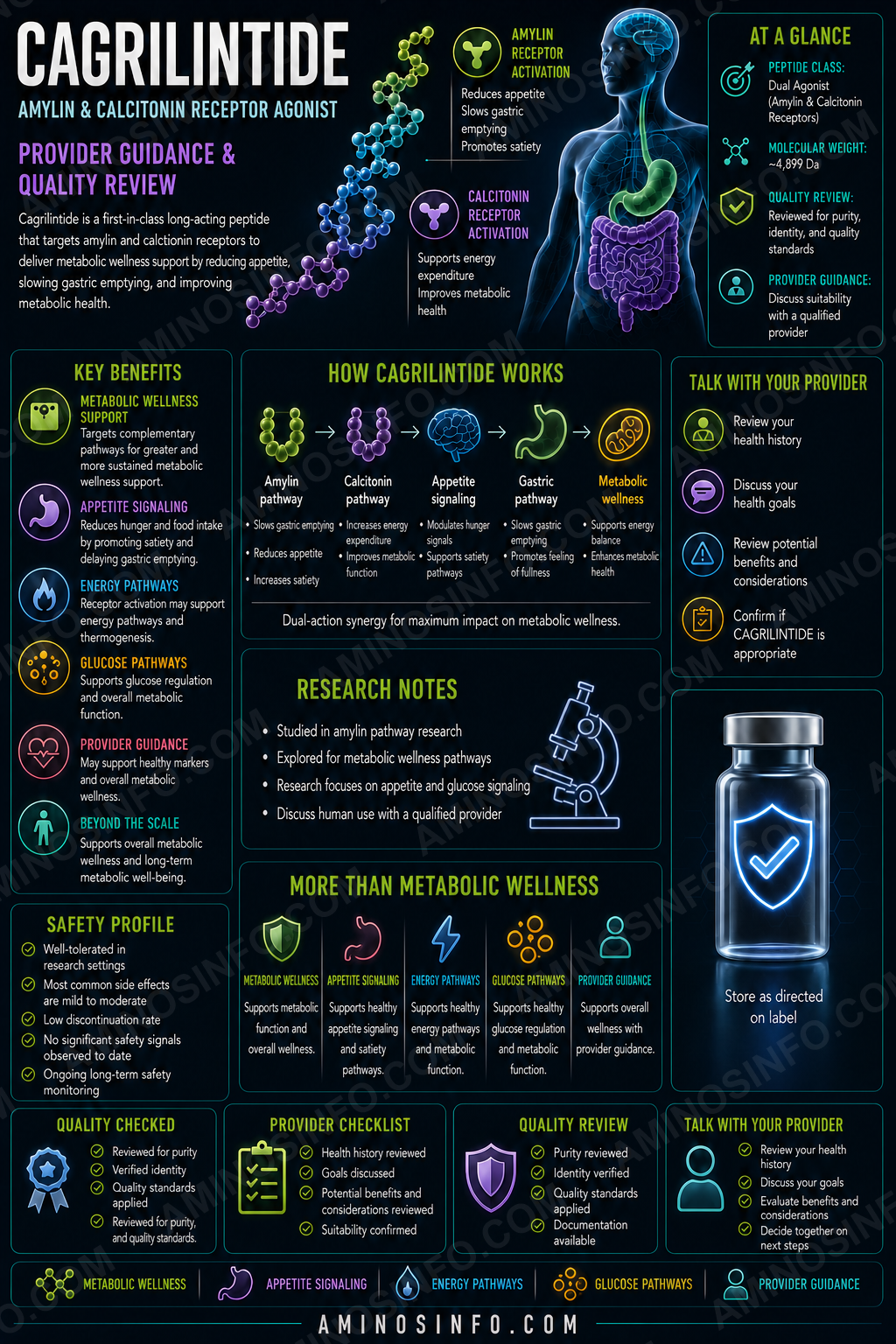
Cagrilintide is a synthetic, long-acting analogue of the pancreatic hormone amylin. Native amylin is co-secreted with insulin and contributes to satiety, meal termination, gastric regulation, and postprandial glucose control.
Cagrilintide was engineered to overcome two major limitations of native human amylin:
- Rapid clearance and short duration
- Strong tendency to form amyloid fibrils and aggregates
Its sequence, disulfide loop, C-terminal amidation, and N-terminal lipid side chain were optimized to improve physical stability, receptor activity, and once-weekly exposure.
Long-acting amylin analogue
39 amino acids
C₁₉₄H₃₁₂N₅₄O₅₉S₂
Approximately 4409.0 g/mol
Cys3–Cys8
Once-weekly subcutaneous injection
🧬 Structure, Sequence, and Molecular Properties
🧪 Complete public reference sequence
{Eicosanedioic acid-γ-Glu}-Lys-Cys-Asn-Thr-Ala-Thr-Cys-Ala-Thr-Gln-Arg-Leu-Ala-Glu-Phe-Leu-Arg-His-Ser-Ser-Asn-Asn-Phe-Gly-Pro-Ile-Leu-Pro-Pro-Thr-Asn-Val-Gly-Ser-Asn-Thr-Pro-NH₂
{C20-diacid-γ-Glu}-KCNTATCATQRLAEFLRHSSNNFGPILPPTNVGSNTP-NH₂
Structural characteristics
- 39-amino-acid peptide
- Disulfide bridge between Cys3 and Cys8
- C-terminal amide
- N-terminal lysine carrying a γ-glutamyl-linked eicosanedioic-acid side chain
- Multiple proline substitutions that reduce fibrillation
- Designed for albumin association and once-weekly pharmacokinetics
⚛️ Molecular properties
| Molecular formula | C194H312N54O59S2 |
|---|---|
| Average molecular weight | Approximately 4409.01 g/mol |
| CAS number | 1415456-99-3 |
| UNII | AO43BIF1U8 |
| PubChem CID | 167312356 / related database records |
| C-terminal chemistry | Amidated |
| Lipid modification | γ-Glu-linked C20 diacid |
Why the disulfide bridge matters
Native amylin-family peptides use a short N-terminal disulfide loop that is important for receptor activation. Incorrect pairing, incomplete oxidation, or disulfide scrambling can reduce potency even when intact mass appears correct.
Why the lipid side chain matters
The C20 diacid promotes reversible albumin association, slowing renal clearance and protecting the peptide from rapid degradation.
📅 Discovery Timeline and Development History
1980s: Amylin physiology established
Amylin was identified as an islet hormone co-secreted with insulin and involved in appetite, gastric emptying, and glucose control.
2005: Pramlintide approval
Pramlintide became the first approved amylin analogue, but its short duration requires frequent dosing with meals.
2010s: Long-acting amylin design
Novo Nordisk researchers optimized amylin analogues for reduced fibrillation, receptor potency, and albumin binding.
2021: Development chemistry published
The medicinal-chemistry program describing cagrilintide’s design and selection was published.
2021: Phase 2 obesity trial
A 26-week dose-finding trial showed dose-dependent weight loss and supported once-weekly development.
2023: CagriSema phase 2 diabetes trial
Cagrilintide plus semaglutide produced greater weight and glycemic effects than either component alone.
2024–2025: REDEFINE phase 3 program
Cagrilintide monotherapy and the CagriSema combination were tested in large phase 3 obesity studies.
September 2025: Monotherapy phase 3 analysis
Cagrilintide 2.4 mg produced an average 11.8% weight reduction at 68 weeks in the trial-product estimand and 11.5% in the treatment-policy estimand.
December 2025: CagriSema NDA submitted
Novo Nordisk filed CagriSema for FDA review as a fixed-dose 2.4 mg/2.4 mg combination.
2025–2026: Dedicated RENEW program
Based on monotherapy results, Novo Nordisk advanced cagrilintide into a dedicated phase 3 obesity program.
Current status
Cagrilintide monotherapy remains investigational. CagriSema also remains unapproved while FDA review continues.
🧠 How Does Cagrilintide Work?
1. Satiation
Cagrilintide helps terminate an ongoing meal earlier, reducing meal size.
2. Satiety
It can prolong fullness between meals and reduce the frequency or intensity of eating.
3. Food reward
Amylin pathways communicate with mesolimbic reward circuits and may reduce the motivational value of highly palatable foods.
4. Gastric regulation
Amylin slows gastric emptying, particularly around meals, contributing to postprandial fullness.
5. Glucagon suppression
Amylin reduces inappropriate postprandial glucagon secretion and helps coordinate glucose handling.
🎯 Amylin Receptor Profile
Receptor architecture
Amylin receptors are heteromeric complexes formed by the calcitonin receptor combined with receptor activity-modifying proteins:
| Receptor | Components | Role |
|---|---|---|
| AMY1 | CTR + RAMP1 | Amylin signaling in appetite and sensory pathways |
| AMY2 | CTR + RAMP2 | Amylin-family signaling |
| AMY3 | CTR + RAMP3 | Prominent metabolic and brain amylin signaling |
| Calcitonin receptor | CTR without RAMP | May also respond depending on ligand and assay |
Structural research
Cryo-electron microscopy studies published in 2025 characterized cagrilintide-bound active amylin-receptor and calcitonin-receptor complexes, helping define how the analogue engages receptor extracellular domains and transmembrane pockets.
No GLP-1 receptor activity
Cagrilintide itself is not a GLP-1 receptor agonist. GLP-1 activity in CagriSema comes from semaglutide.
Brain Pathways and Appetite Regulation
Area postrema
The area postrema is a hindbrain structure with access to circulating signals and is a major amylin-responsive site.
Nucleus of the solitary tract
Amylin signaling influences brainstem networks coordinating satiation, gastric function, and autonomic responses.
Hypothalamic pathways
Secondary communication with hypothalamic feeding systems contributes to longer-term satiety and energy balance.
Reward pathways
Amylin signaling can affect mesolimbic dopamine circuits and may reduce food-seeking behavior.
2025 mechanistic evidence
Experimental work showed that cagrilintide lowers body weight through brain amylin receptors and identified neural circuits important for its feeding effects.
Phase 2 Obesity Evidence
Trial design
The 26-week randomized trial studied once-weekly cagrilintide doses ranging from 0.3 mg to 4.5 mg in adults with overweight or obesity, with liraglutide as an active comparator.
Weight reduction
Weight loss was dose dependent, with the highest doses producing double-digit mean percentage reductions over 26 weeks.
Comparison with liraglutide
Several cagrilintide dose groups produced greater average weight reduction than daily liraglutide 3.0 mg.
Waist circumference
Reductions in waist circumference supported meaningful central-fat loss.
Tolerability
Gastrointestinal events were common but generally transient and mild to moderate.
REDEFINE 1 Phase 3 Monotherapy Data
Trial setting
REDEFINE 1 evaluated 3,417 adults with obesity or overweight plus a weight-related complication and without type 2 diabetes. It compared CagriSema, semaglutide, cagrilintide, and placebo over 68 weeks.
| Cagrilintide 2.4 mg outcome | Result |
|---|---|
| Average weight reduction if all participants adhered | 11.8% |
| Placebo comparison | 2.3% |
| Average reduction regardless of adherence | 11.5% |
| Placebo comparison | 3.0% |
| Participants achieving ≥15% loss with adherence | 31.6% |
| Placebo achieving ≥15% | 4.7% |
| Nausea-related permanent discontinuation | 1.0% |
Interpretation
The monotherapy data establish clinically meaningful phase 3 efficacy through a mechanism distinct from GLP-1 therapy, although average weight loss was lower than that reported for the CagriSema combination and some approved high-efficacy incretin therapies.
RENEW program
The dedicated RENEW phase 3 program is evaluating cagrilintide as a standalone obesity treatment in broader populations.
CagriSema Combination Research
What is CagriSema?
CagriSema is a fixed-dose once-weekly combination of cagrilintide 2.4 mg and semaglutide 2.4 mg.
Complementary biology
- Cagrilintide: Amylin receptor agonism, satiation, fullness, gastric and reward effects
- Semaglutide: GLP-1 receptor agonism, appetite reduction, glucose regulation, gastric effects
REDEFINE 1
CagriSema produced 20.4% mean weight loss in the treatment-policy estimand and 22.7% in the trial-product estimand over 68 weeks.
REDEFINE 2
In adults with obesity or overweight and type 2 diabetes, the combination produced significantly greater weight loss than placebo.
FDA submission
Novo Nordisk submitted a New Drug Application in December 2025. The application remained under review as of July 14, 2026.
Not FDA approved
CagriSema is not approved in the United States or European Union.
Glucose and Metabolic Effects
Postprandial glucagon
Amylin analogues reduce inappropriate glucagon secretion after meals.
Gastric nutrient delivery
Slower gastric emptying moderates the rate at which glucose enters the circulation.
Combination with GLP-1 therapy
Adding semaglutide produces stronger A1C and glucose effects than cagrilintide alone.
Hypoglycemia
Amylin analogues can increase hypoglycemia risk when used with insulin, as established with pramlintide. Cagrilintide’s eventual risk framework will depend on indication and concomitant therapies.
Gastric Emptying and Satiety
Meal-related slowing
Amylin is a physiological brake on gastric emptying, helping coordinate nutrient delivery with insulin availability.
Satiety contribution
Gastric effects work together with central nervous system signaling to reduce eating.
Nausea versus satiety
Therapeutic appetite reduction should not be confused with weight loss caused solely by nausea. Trials separately evaluate tolerability, food intake, and weight trajectories.
Combination overlap
Because semaglutide also affects gastric emptying and appetite, the combination requires gradual titration to manage overlapping gastrointestinal effects.
Side Effects and Safety Considerations
Most common effects
- Nausea
- Vomiting
- Diarrhea
- Constipation
- Abdominal discomfort
- Reduced appetite
- Injection-site reactions
Potential amylin-class concerns
- Delayed gastric emptying
- Hypoglycemia when combined with insulin
- Severe gastrointestinal intolerance
- Dehydration
- Reduced oral medication absorption
Potential combination-class concerns
CagriSema may also carry GLP-1-related risks involving pancreatitis, gallbladder disease, kidney injury from dehydration, diabetic retinopathy, and aspiration during anesthesia, depending on final regulatory labeling.
Long-term uncertainty
Cardiovascular outcomes, rare pancreatic or gallbladder effects, lean-mass preservation, weight regain after stopping, and long-term adherence remain under study.
Pharmacokinetics and Weekly Dosing
Albumin association
The γ-Glu-C20 diacid side chain promotes reversible albumin binding.
Proteolytic stability
Sequence substitutions and proline-rich regions improve resistance to enzymatic degradation and fibrillation.
Once-weekly exposure
The molecule was selected to maintain pharmacologically active concentrations across a weekly interval.
Dose escalation
Clinical studies use gradual escalation to reduce gastrointestinal effects. No FDA-approved cagrilintide titration schedule exists.
Regulatory and Compounding Status
Standalone cagrilintide
Cagrilintide is not FDA approved and is being studied in the RENEW phase 3 program.
CagriSema
The combination’s FDA application was submitted in December 2025 and remained under review as of July 14, 2026.
FDA compounding statement
FDA states that cagrilintide cannot be used in compounding under federal law because it is not a component of an FDA-approved drug and has not been found safe and effective for any condition.
Research products
A vendor certificate or “research use only” label does not establish legal human use, pharmaceutical equivalence, or safety.
🧪 Laboratory Testing Methods
| Method | Purpose | Important limitation |
|---|---|---|
| RP-HPLC / UPLC | Separates intact cagrilintide from deletion peptides, deacylated material, oxidized forms, and aggregates. | Area purity does not prove complete identity or net content. |
| LC-HRMS | Confirms intact molecular mass and formula. | Does not alone prove sequence, disulfide pairing, or modification site. |
| MS/MS peptide mapping | Confirms the 39-residue sequence and modification architecture. | Disulfide-linked and lipidated fragments require specialized methods. |
| Reduced/nonreduced peptide mapping | Confirms Cys3–Cys8 disulfide pairing. | Incorrect disulfides may require orthogonal mapping. |
| Edman degradation | Supports N-terminal sequence identity. | N-terminal lipidation can block routine Edman analysis. |
| Amino-acid analysis | Confirms composition and supports net-content measurement. | Does not establish residue order or disulfide connectivity. |
| Chiral amino-acid analysis | Detects epimerization. | Hydrolysis can introduce artifacts. |
| C-terminal amidation assay | Confirms Pro-NH₂ rather than free acid. | Requires targeted MS or enzymatic methods. |
| Lipid-chain characterization | Confirms eicosanedioic acid, γ-Glu linker, and N-terminal lysine attachment. | Incorrect lipidation may preserve approximate mass. |
| Disulfide scrambling assay | Measures incorrect cysteine pairing and reduced peptide. | Requires nonreducing separation. |
| Amyloid/fibrillation assay | Measures aggregation propensity using ThT, microscopy, or orthogonal techniques. | Accelerated conditions may not predict all storage behavior. |
| SEC-HPLC | Measures soluble aggregates and high-molecular-weight species. | Small or reversible oligomers may be missed. |
| DLS or analytical ultracentrifugation | Assesses particle size and self-association. | Formulation conditions strongly influence results. |
| Net peptide-content assay | Measures actual active peptide mass. | Must correct for water, salts, counterions, and excipients. |
| AMY1/AMY2/AMY3 cAMP assays | Measure functional agonist activity across amylin-receptor subtypes. | Receptor expression level affects potency. |
| Calcitonin-receptor assay | Measures activity at CTR without a RAMP. | Needed to understand receptor selectivity. |
| Albumin-binding assay | Confirms long-acting design. | In-vitro affinity does not fully predict human half-life. |
| Plasma/protease stability | Measures degradation and deacylation. | Species differences matter. |
| Residual-solvent and counterion testing | Quantifies TFA, acetate, acetonitrile, and synthesis residues. | Does not establish receptor activity. |
| Sterility and endotoxin | Required for finished injectable products. | Raw-peptide purity cannot establish injectable safety. |
| Particulate matter | Measures visible and subvisible particles. | Requires finished-product testing. |
| Stability-indicating assay | Tracks oxidation, deamidation, disulfide scrambling, deacylation, fibrillation, and potency loss. | Requires validated forced-degradation studies. |
📄 How to Interpret a Cagrilintide COA
- Verify the complete 39-residue sequence.
- Confirm the Cys3–Cys8 disulfide bridge: Intact mass cannot prove correct pairing.
- Confirm C-terminal amidation: The reference ends in Pro-NH₂.
- Verify the N-terminal lipid architecture: C20 diacid, γ-Glu linker, and lysine attachment.
- Confirm intact mass and formula: Approximately 4409.01 g/mol and C₁₉₄H₃₁₂N₅₄O₅₉S₂.
- Use reduced and nonreduced peptide mapping.
- Confirm stereochemistry: Epimers retain the same nominal mass.
- Measure deacylated peptide, deletion sequences, reduced peptide, disulfide isomers, oxidation, deamidation, and aggregates.
- Evaluate fibrillation: This is especially important for amylin analogues.
- Report net peptide content: “99% HPLC purity” is not the actual number of milligrams.
- Test multiple amylin-receptor subtypes and CTR potency.
- Confirm albumin binding and plasma stability.
- For injectable products, require sterility, endotoxin, particles, fill accuracy, container closure, and stability.
- Do not infer clinical equivalence: A COA cannot prove equivalence to Novo Nordisk’s clinical material or CagriSema.
📊 Cagrilintide vs Amylin vs Pramlintide vs Semaglutide
| Feature | Cagrilintide | Native amylin | Pramlintide | Semaglutide |
|---|---|---|---|---|
| Type | Long-acting amylin analogue | Natural pancreatic hormone | Short-acting amylin analogue | Long-acting GLP-1 analogue |
| Main receptor | Amylin receptors | Amylin receptors | Amylin receptors | GLP-1 receptor |
| Dosing concept | Weekly | Endogenous secretion | With meals | Weekly |
| FDA approved? | No | N/A | Yes, diabetes adjunct | Yes, specific indications |
Cagrilintide vs CagriSema vs Tirzepatide vs Retatrutide
| Compound | Targets | Status |
|---|---|---|
| Cagrilintide | Amylin receptors | Investigational |
| CagriSema | Amylin receptors + GLP-1R | NDA under FDA review |
| Tirzepatide | GIPR + GLP-1R | FDA approved for specific indications |
| Retatrutide | GIPR + GLP-1R + GCGR | Investigational |
Cagrilintide vs GLP-1 Therapy
| Feature | Cagrilintide | GLP-1 agonist |
|---|---|---|
| Primary appetite signal | Amylin-mediated satiation and satiety | GLP-1-mediated appetite and reward signaling |
| Gastric effects | Strong physiological amylin brake | Delayed gastric emptying, especially early |
| Insulin secretion | Indirect and contextual | Direct glucose-dependent stimulation |
| Combination potential | Complementary | Complementary with amylin |
Cagrilintide Raw Peptide vs Clinical Drug Product
| Quality attribute | Raw peptide | Clinical drug product |
|---|---|---|
| Identity | Sequence, disulfide, lipidation | Identity plus formulation confirmation |
| Potency | Amylin receptor assays | Release specifications and dose accuracy |
| Aggregation | Fibrillation and oligomer testing | Long-term formulation and device stability |
| Microbiology | Bioburden as applicable | Sterility, endotoxin, particles |
| Clinical equivalence | Not established by COA | Requires sponsor manufacturing and clinical data |
🖼️ Original Diagram Specifications
Diagram 1: Cagrilintide peptide architecture
Show the 39-residue chain, Cys3–Cys8 loop, C-terminal amide, N-terminal lysine, γ-Glu linker, and C20 diacid.
Diagram 2: Amylin receptor structure
Show CTR combined with RAMP1, RAMP2, or RAMP3 to form AMY1, AMY2, and AMY3 receptors.
Diagram 3: Appetite pathway
Show area postrema, nucleus tractus solitarius, hypothalamus, reward circuitry, smaller meals, and prolonged satiety.
Diagram 4: REDEFINE 1 monotherapy result
Show 11.8% average weight loss versus 2.3% placebo and the proportion achieving at least 15% loss.
Diagram 5: CagriSema complementary mechanism
Show cagrilintide activating amylin receptors and semaglutide activating GLP-1 receptors, converging on appetite and metabolic pathways.
Diagram 6: Fibrillation-control design
Compare native human amylin aggregation with cagrilintide’s proline-rich, lipidated, stabilized structure.
Diagram 7: COA workflow
Show exact sequence, disulfide mapping, amidation, lipid-chain confirmation, HRMS, peptide mapping, fibrillation, receptor potency, albumin binding, sterility, and stability.
❓ Frequently Asked Questions
Is cagrilintide a peptide?
Yes. It is a 39-amino-acid long-acting amylin analogue.
What is its molecular formula?
C₁₉₄H₃₁₂N₅₄O₅₉S₂.
What is its molecular weight?
Approximately 4409.01 g/mol.
What is its CAS number?
1415456-99-3.
Does it contain a disulfide bond?
Yes. The reference structure has a Cys3–Cys8 disulfide bridge.
Is cagrilintide FDA approved?
No.
What is CagriSema?
A once-weekly fixed-dose combination of cagrilintide and semaglutide.
Is CagriSema FDA approved?
No. Its NDA was under FDA review as of July 14, 2026.
How much weight loss did cagrilintide produce in phase 3?
REDEFINE 1 reported 11.8% average weight loss at 68 weeks if participants adhered to treatment.
How is cagrilintide different from semaglutide?
Cagrilintide activates amylin receptors; semaglutide activates GLP-1 receptors.
How is it different from pramlintide?
Cagrilintide is engineered for once-weekly exposure, while pramlintide is short acting and administered around meals.
What are the most common side effects?
Nausea, vomiting, diarrhea, constipation, reduced appetite, and other gastrointestinal effects.
Can cagrilintide be compounded legally?
FDA states that it cannot be used in human compounding under federal law.
Does 99% HPLC purity prove authentic cagrilintide?
No. Sequence, disulfide pairing, amidation, lipidation, stereochemistry, net content, fibrillation, and receptor potency must also be confirmed.
Final Thoughts
Cagrilintide is an investigational long-acting amylin analogue designed to produce sustained satiation and weight reduction through a mechanism distinct from GLP-1 receptor agonism. Phase 3 monotherapy data demonstrated approximately 11.8% average weight loss at 68 weeks, supporting a dedicated standalone development program.
Its complementary mechanism is also central to CagriSema, which combines cagrilintide with semaglutide and produced substantially greater average weight loss than either component alone. However, neither cagrilintide nor CagriSema was FDA approved as of July 14, 2026.
Proper analytical authentication requires much more than HPLC purity because biological activity and safety depend on the exact 39-residue sequence, Cys3–Cys8 disulfide bridge, C-terminal amidation, N-terminal C20-diacid lipidation, stereochemical integrity, low aggregation and fibrillation, net peptide content, albumin binding, and functional potency at amylin-receptor complexes.
📚 References
- Kruse T, et al. Development of Cagrilintide, a Long-Acting Amylin Analogue. Journal of Medicinal Chemistry. 2021.
- Lau DCW, et al. Once-weekly cagrilintide for weight management in people with overweight and obesity. Lancet. 2021.
- Garvey WT, et al. Coadministered Cagrilintide and Semaglutide in Adults with Overweight or Obesity. New England Journal of Medicine. 2025.
- Davies MJ, et al. Cagrilintide–Semaglutide in Adults with Overweight or Obesity and Type 2 Diabetes. New England Journal of Medicine. 2025.
- Frias JP, et al. Once-weekly cagrilintide with semaglutide in type 2 diabetes. Lancet. 2023.
- Novo Nordisk. Phase 3 cagrilintide monotherapy data from REDEFINE 1. September 2025.
- Novo Nordisk. CagriSema FDA NDA submission. December 2025.
- ClinicalTrials.gov. REDEFINE 1, NCT05567796.
- ClinicalTrials.gov. REDEFINE 2, NCT05394519.
- ClinicalTrials.gov. REDEFINE 3, NCT05669755.
- ClinicalTrials.gov. RENEW 1, NCT07220642.
- PubChem. Cagrilintide compound record.
- FDA Global Substance Registration System. Cagrilintide substance record.
- FDA. Concerns with Unapproved GLP-1 Drugs Used for Weight Loss. June 2026.
- Cao J, et al. Structural and dynamic features of cagrilintide binding to amylin receptors and calcitonin receptor. Nature Communications. 2025.
- Carvas AO, et al. Cagrilintide lowers body weight through brain amylin receptors. 2025.
- Gabery S, et al. Characterization of an amylin tool compound related to cagrilintide. Life Sciences. 2025.
- Hay DL, et al. Amylin receptors: molecular composition and pharmacology. Pharmacological Reviews.
- Christopoulos G, et al. Calcitonin receptor-like receptor and RAMP biology. Molecular Pharmacology.
- Poyner DR, et al. International Union of Pharmacology recommendations for calcitonin-family receptors. Pharmacological Reviews.
- Lutz TA. The role of amylin in the control of energy homeostasis. American Journal of Physiology.
- Lutz TA, Meyer U. Amylin at the interface between metabolism and brain function. Frontiers in Neuroscience.
- Roth JD, et al. Amylin receptor agonism and body-weight regulation. Endocrinology.
- Mietlicki-Baase EG. Amylin-mediated control of energy balance. Physiology & Behavior.
- Hayes MR, et al. Amylin and energy balance: from brainstem to reward circuitry. Endocrinology.
- Boyle CN, et al. Amylin action in the area postrema and nucleus of the solitary tract. Neuroendocrinology.
- Coester B, et al. Amylin signaling and mesolimbic food reward. Neuropharmacology.
- Roth JD, et al. Effects of amylin receptor agonists on food intake and body weight. Diabetes.
- Young AA. Amylin’s physiology and its role in diabetes. Current Opinion in Endocrinology.
- Weyer C, et al. Pramlintide in diabetes and weight management. Diabetes Care.
- Ryan GJ, Jobe LJ, Martin R. Pramlintide in type 1 and type 2 diabetes. Clinical Therapeutics.
- Ratner RE, et al. Adjunctive pramlintide therapy in insulin-treated diabetes. Diabetes Care.
- Drucker DJ. Mechanisms of action and therapeutic application of GLP-1. Cell Metabolism.
- Müller TD, et al. Glucagon-like peptide 1 molecular physiology and therapeutic applications. Nature Reviews Drug Discovery.
- Holst JJ. The physiology of glucagon-like peptide 1. Physiological Reviews.
- Wilding JPH, et al. Once-weekly semaglutide in adults with overweight or obesity. New England Journal of Medicine.
- Jastreboff AM, et al. Tirzepatide once weekly for the treatment of obesity. New England Journal of Medicine.
- Jastreboff AM, et al. Retatrutide for obesity. New England Journal of Medicine.
- Lincoff AM, et al. Semaglutide and cardiovascular outcomes in obesity. New England Journal of Medicine.
- Heymsfield SB, Wadden TA. Mechanisms, pathophysiology, and management of obesity. New England Journal of Medicine.
- Morton GJ, et al. Neurobiology of food intake. Nature Reviews Neuroscience.
- Kenny PJ. Reward mechanisms in obesity. Neuron.
- Volkow ND, et al. Reward, dopamine, and food intake. Trends in Cognitive Sciences.
- Westermark P, et al. Islet amyloid polypeptide and amyloid formation. Proceedings of the National Academy of Sciences.
- Akter R, et al. Islet amyloid polypeptide: structure and aggregation. Journal of Diabetes Research.
- Abedini A, Schmidt AM. Mechanisms of islet amyloidosis toxicity. FEBS Letters.
- International Council for Harmonisation. ICH Q1A(R2): Stability Testing.
- International Council for Harmonisation. ICH Q2(R2): Validation of Analytical Procedures.
- International Council for Harmonisation. ICH Q3A and Q3B: Impurities.
- International Council for Harmonisation. ICH Q3C: Residual Solvents.
- International Council for Harmonisation. ICH Q6B: Specifications for Biotechnological Products.
- International Council for Harmonisation. ICH M10: Bioanalytical Method Validation.
- United States Pharmacopeia General Chapter <621>: Chromatography.
- United States Pharmacopeia General Chapter <71>: Sterility Tests.
- United States Pharmacopeia General Chapter <85>: Bacterial Endotoxins Test.
- United States Pharmacopeia General Chapter <788>: Particulate Matter in Injections.
- United States Pharmacopeia General Chapters <232> and <233>: Elemental Impurities.
Chemistry, amylin-receptor pharmacology, phase 2 and phase 3 monotherapy data, CagriSema findings, safety, regulatory status, and analytical recommendations were reviewed in July 2026.