Survodutide (BI 456906): What It Is, How It Works, Benefits, and Research Overview
A comprehensive, evidence-graded review of survodutide, a once-weekly investigational peptide that activates both the glucagon and GLP-1 receptors and is being developed for obesity, metabolic dysfunction-associated steatohepatitis, and related cardiometabolic disease.
What Is Survodutide?
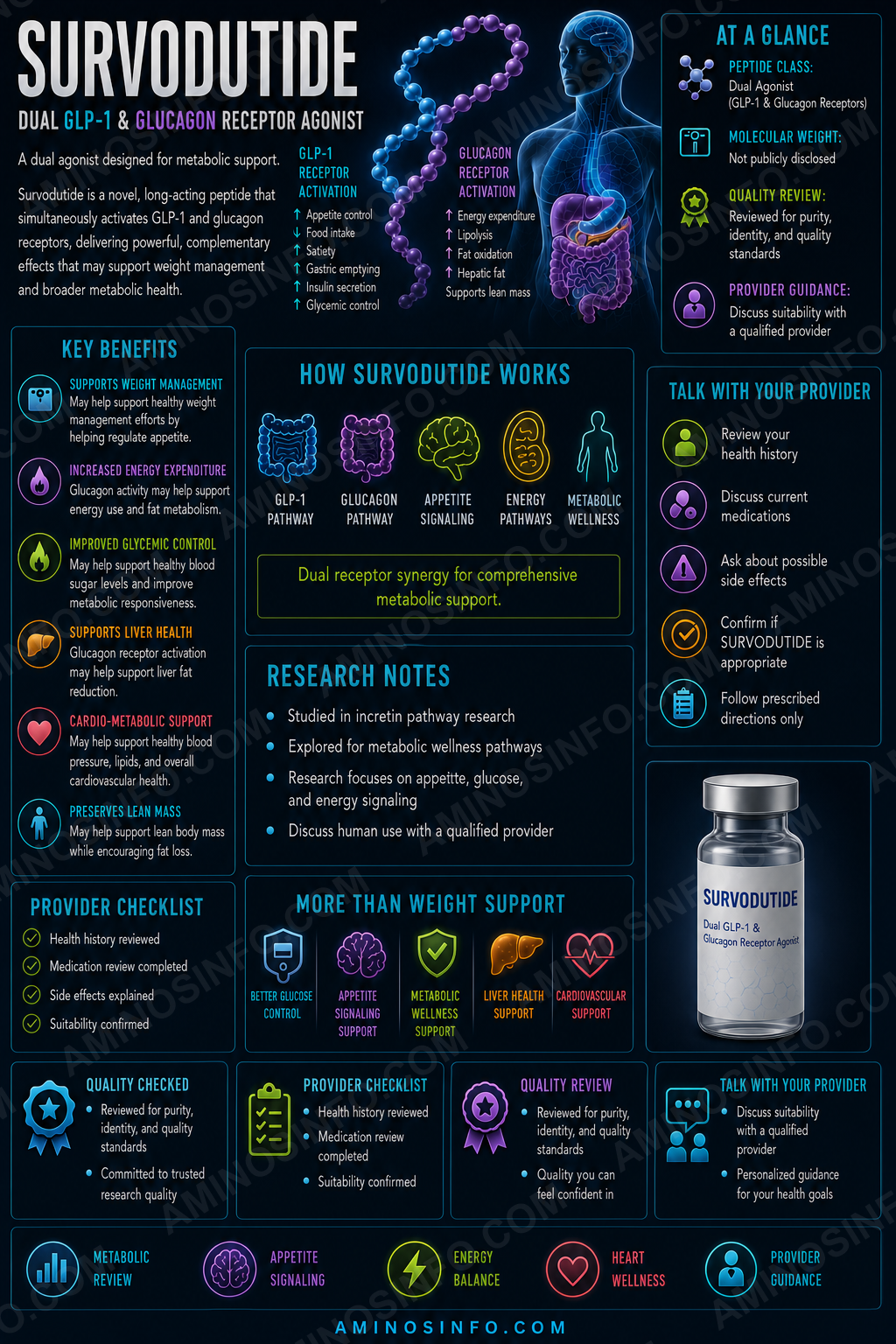
Survodutide, previously known as BI 456906, is a long-acting synthetic peptide agonist of the glucagon receptor and glucagon-like peptide-1 receptor. It was discovered by Zealand Pharma and is being developed by Boehringer Ingelheim.
The dual-receptor concept is designed to combine:
- GLP-1 receptor activity to reduce appetite, lower food intake, and improve glucose-dependent metabolic regulation.
- Glucagon receptor activity to increase energy expenditure, mobilize stored energy, and potentially exert direct effects on liver fat and hepatic metabolism.
BI 456906
Long-acting modified peptide
GCGR + GLP-1R
Once-weekly subcutaneous injection
C₁₉₂H₂₈₉N₄₇O₆₁
Approximately 4232 g/mol
🧬 Structure, Sequence, and Molecular Properties
🧪 Peptide sequence
Public chemical databases describe survodutide as a modified peptide with a 29-residue primary peptide chain and an attached seven-residue linker/lipidation element.
HXQGTFTSDYSKYLDERAAKDFIKWLESA
KEGG represents the attached modification segment as:
EGSGSGG
The modification is attached through an amide linkage involving the lysine at position 24 of the primary chain and the terminal residue of the modification segment.
⚛️ Molecular properties
| Molecular formula | C192H289N47O61 |
|---|---|
| Average molecular weight | Approximately 4232 g/mol |
| Exact mass | Approximately 4229.10 Da |
| PubChem CID | 168429725 |
| Peptide type | Modified glucagon analogue |
| Disulfide bonds | None reported in the reference structure |
| Long-acting feature | Fatty-acid acylation supporting albumin association |
Glucagon-derived design
Unlike some dual agonists designed from oxyntomodulin, survodutide is described as a glucagon analogue engineered to retain glucagon-receptor activity while adding meaningful GLP-1 receptor activity.
Fatty-acid modification
The acyl side chain increases albumin binding and reduces rapid renal clearance and proteolysis, supporting once-weekly dosing.
📅 Discovery Timeline and Development History
2011: Licensing partnership
Boehringer Ingelheim obtained exclusive development and commercialization rights from Zealand Pharma.
Early clinical development
Phase 1 studies evaluated safety, receptor activity, pharmacokinetics, glucose effects, and early body-weight changes.
2023–2024: Phase 2 obesity findings
A dose-finding obesity study reported dose-related weight reduction over 46 weeks, with the highest tested dose producing approximately 15% mean weight reduction in the treatment-policy estimand and greater loss in participants who remained on therapy.
2024: Phase 2 MASH publication
A 48-week biopsy-based trial found significantly higher rates of MASH improvement without worsening fibrosis than placebo.
2024–2025: Phase 3 SYNCHRONIZE program
Multiple phase 3 trials began in obesity populations with and without type 2 diabetes and with selected obesity-related complications.
April 2026: Top-line phase 3 result
Boehringer Ingelheim announced that SYNCHRONIZE-1 achieved its primary endpoint, with up to 16.6% average weight loss at 76 weeks.
June 2026: Full phase 3 publication
The SYNCHRONIZE-1 results were published in the New England Journal of Medicine, together with detailed body-composition and metabolic findings.
Current status
Survodutide remains under clinical development. No FDA approval or approved brand name has been established as of July 14, 2026.
🧠 How Does Survodutide Work?
1. GLP-1 receptor signaling
GLP-1 receptor activation increases intracellular cAMP, reduces appetite, increases glucose-dependent insulin secretion, suppresses inappropriate glucagon release during hyperglycemia, and delays gastric emptying.
2. Glucagon receptor signaling
Glucagon receptor activation promotes hepatic energy mobilization, lipid oxidation, and energy expenditure. In a dual agonist, the aim is to preserve beneficial energy-expenditure effects while using GLP-1 activity to control appetite and glycemia.
3. Liver-directed biology
The glucagon component may be particularly relevant to hepatic lipid handling, fatty-acid oxidation, liver-fat reduction, and MASH biology.
4. Coordinated dual agonism
The clinical effect depends on the relative potency and exposure at each receptor. Too much glucagon activity could worsen hyperglycemia, while too much GLP-1 activity may reduce differentiation from mono-agonist therapies.
🎯 Receptor Profile and Signaling Balance
| Target | Role | Clinical relevance |
|---|---|---|
| Glucagon receptor | Direct agonist | Energy expenditure, hepatic lipid metabolism, liver-fat reduction |
| GLP-1 receptor | Direct agonist | Appetite suppression, satiety, glucose-dependent insulin secretion |
| GIP receptor | No intended direct agonism | Distinguishes it from tirzepatide and retatrutide |
| cAMP pathway | Primary GPCR signaling pathway | Common downstream signal at both receptors |
| Albumin | Reversible association through lipidation | Extends systemic exposure |
Receptor-balance testing
A legitimate potency program should separately quantify glucagon-receptor and GLP-1-receptor activity. A product can have correct mass and sequence yet possess the wrong receptor balance because of modification errors, oxidation, aggregation, or conformational changes.
Obesity and Weight-Loss Research
Phase 2 dose-finding study
The phase 2 obesity trial enrolled adults with overweight or obesity without diabetes and tested several once-weekly doses for 46 weeks. Weight loss was dose dependent and clinically meaningful.
High-dose findings
At the highest dose, mean weight loss reached approximately 15% under the treatment-policy estimand and approached 19% in the hypothetical estimand among participants who remained on treatment.
Responder thresholds
A substantial proportion of participants achieved at least 10%, 15%, or 20% weight loss, although gastrointestinal intolerance and treatment discontinuation affected results.
Plateau timing
Weight loss had not fully plateaued in some dose groups by the end of phase 2, supporting continued phase 3 evaluation.
Phase 3 SYNCHRONIZE Results
SYNCHRONIZE-1
This 76-week randomized trial evaluated adults with obesity or overweight and at least one weight-related complication, without type 2 diabetes.
| Outcome | Reported result |
|---|---|
| Maximum mean body-weight reduction | 16.6% |
| Placebo mean reduction | Approximately 3.2% |
| Visceral-fat reduction | Approximately 34% |
| Liver-fat reduction | Approximately 63% |
| Treatment duration | 76 weeks |
Clinical interpretation
The result confirms meaningful phase 3 weight-loss efficacy but falls within a competitive field containing semaglutide, tirzepatide, retatrutide, and other next-generation agents.
Tolerability limitation
Gastrointestinal adverse effects remained common, and approximately one fifth of participants in some high-dose analyses discontinued because of adverse effects. This is an important part of the benefit–risk interpretation.
Body Composition, Visceral Fat, and Liver Fat
Visceral adipose tissue
Phase 3 analyses reported a roughly 34% reduction in visceral fat, the metabolically active fat surrounding abdominal organs.
Liver fat
Liver fat was reduced by approximately 63%, supporting the biological rationale for MASH development.
Lean mass
The sponsor reported that lean-mass loss was limited relative to total weight loss, although full interpretation requires comparison with baseline body composition, sex, age, protein intake, exercise, and comparator therapies.
Why glucagon may matter
Glucagon-receptor activity may contribute to preferential hepatic and visceral fat mobilization, but definitive superiority over approved incretin therapies requires direct comparative trials.
MASH and Liver-Fibrosis Research
Phase 2 design
A 48-week trial enrolled adults with biopsy-confirmed metabolic dysfunction-associated steatohepatitis and fibrosis stages F1 through F3.
Primary endpoint
Improvement in MASH without worsening fibrosis occurred significantly more often with survodutide than placebo.
Fibrosis endpoint
Fibrosis improvement without worsening MASH was also observed in a substantial proportion of participants, particularly in the higher-dose groups.
Mechanistic rationale
- Weight reduction
- Reduced liver fat
- Improved insulin sensitivity
- Glucagon-mediated lipid oxidation
- Potential direct hepatic metabolic effects
Phase 3 liver program
LIVERAGE and related phase 3 studies are evaluating histologic and clinical outcomes in MASH and cirrhosis populations.
No approved MASH indication
Survodutide has not yet been approved to treat MASH, fibrosis, or cirrhosis.
Glucose and Metabolic Effects
Glucose-dependent insulin secretion
GLP-1 receptor activation can improve postprandial and fasting glucose regulation.
Glucagon-related glucose pressure
Glucagon receptor activation can increase hepatic glucose output. The molecule is designed so GLP-1 effects offset this tendency while preserving energy-expenditure and liver benefits.
Type 2 diabetes trials
SYNCHRONIZE-2 and related studies are evaluating efficacy in adults with obesity and type 2 diabetes.
Hypoglycemia
Hypoglycemia risk is expected to be lower without insulin or sulfonylureas because GLP-1-mediated insulin release is glucose dependent, but formal risk depends on concomitant therapy.
Energy Expenditure and Glucagon Biology
Thermogenesis
Glucagon can increase energy expenditure through hepatic substrate cycling, lipid oxidation, and sympathetic or endocrine signaling.
Fat oxidation
Dual agonism is intended to promote greater use of stored fat while GLP-1 reduces calorie intake.
Muscle preservation hypothesis
Improved fat oxidation may help preserve a larger proportion of lean tissue, but this remains a comparative clinical question rather than a proven universal property.
Potential heart-rate effect
Glucagon and GLP-1 signaling can both influence pulse, requiring cardiovascular monitoring in clinical development.
Side Effects and Safety Considerations
Common adverse effects
- Nausea
- Vomiting
- Diarrhea
- Constipation
- Abdominal discomfort
- Reduced appetite
- Injection-site reactions
Discontinuation due to adverse effects
Phase 3 reporting indicated that gastrointestinal intolerance led to treatment discontinuation in a meaningful minority of participants, especially at higher doses.
Potential class risks
- Pancreatitis
- Gallbladder disease
- Dehydration and acute kidney injury
- Severe gastrointestinal intolerance
- Delayed gastric emptying
- Hypoglycemia with insulin or insulin secretagogues
- Heart-rate increase
- Loss of lean mass during rapid weight reduction
Glucagon-specific considerations
Potential concerns include increased hepatic glucose output, altered amino-acid metabolism, heart-rate effects, and changes in liver enzymes or lipid metabolism.
Long-term uncertainty
Cardiovascular outcomes, gallbladder risk, pancreatic safety, long-term liver outcomes, weight regain after discontinuation, and rare adverse effects require continued study.
Pharmacokinetics and Weekly Dosing
Albumin binding
The fatty-acid side chain supports reversible albumin association, extending circulation time.
Protease resistance
Noncanonical residues and sequence engineering reduce rapid enzymatic cleavage.
Once-weekly exposure
The combination of albumin association and structural stabilization supports weekly subcutaneous dosing.
Dose escalation
Clinical trials use gradual dose escalation to reduce gastrointestinal adverse effects. No approved commercial titration schedule exists.
Regulatory Status and Ongoing Development
United States
Survodutide is not FDA approved.
European Union
It is not approved by the European Medicines Agency.
Phase 3 obesity program
The SYNCHRONIZE program includes adults with and without type 2 diabetes and selected obesity-related complications.
Phase 3 liver program
LIVERAGE studies are evaluating MASH, fibrosis, and cirrhosis outcomes.
No legal equivalence from a COA
A vendor COA cannot establish that a research product is equivalent to the clinical-trial drug substance or future approved medicine.
🧪 Laboratory Testing Methods
| Method | Purpose | Important limitation |
|---|---|---|
| RP-HPLC / UPLC | Separates intact survodutide from deletion peptides, oxidized forms, deacylated material, and aggregates. | Area purity does not prove complete identity or net peptide content. |
| LC-HRMS | Confirms intact molecular mass and elemental composition. | Cannot alone prove modification location or stereochemistry. |
| MS/MS peptide mapping | Confirms sequence, noncanonical residues, linker, and acylation site. | Requires validated fragmentation and reference standards. |
| Edman degradation | Supports N-terminal sequence identity. | Does not fully characterize the lipidated side chain. |
| Amino-acid analysis | Confirms overall composition and supports net-content assignment. | Does not prove residue order or modification site. |
| Chiral amino-acid analysis | Confirms stereochemistry and detects epimers. | Hydrolysis can create artifacts. |
| Acyl-chain characterization | Confirms fatty-acid identity, linker composition, and attachment. | Requires targeted LC-MS and often NMR. |
| Deacylated-peptide assay | Measures loss or absence of the long-acting lipid modification. | Deacylated material can retain partial receptor activity. |
| Oxidation assay | Measures oxidation of methionine, tryptophan, histidine, or other vulnerable residues. | Must be stability indicating. |
| Deamidation and isomerization assay | Measures Asn/Gln deamidation and Asp isomerization. | Some variants may coelute without high-resolution methods. |
| SEC-HPLC | Measures aggregates and high-molecular-weight species. | Small reversible oligomers may require orthogonal analysis. |
| Net peptide-content assay | Measures actual active peptide mass. | Must correct for water, counterions, and excipients. |
| GLP-1R cAMP assay | Measures GLP-1 receptor potency. | Does not measure glucagon-receptor balance. |
| GCGR cAMP assay | Measures glucagon receptor potency. | Must use comparable receptor-expression systems. |
| Dual-receptor potency ratio | Confirms intended balance between GLP-1R and GCGR activity. | No single universal assay ratio applies across laboratories. |
| Albumin-binding assay | Confirms long-acting pharmacokinetic design. | In-vitro binding does not fully predict human half-life. |
| Plasma stability | Measures proteolysis and deacylation. | Species differences are important. |
| Residual-solvent and counterion testing | Quantifies TFA, acetate, acetonitrile, and synthesis residues. | Does not establish receptor potency. |
| Sterility and endotoxin | Required for parenteral finished products. | Raw peptide purity cannot establish injectable safety. |
| Particulate matter and subvisible particles | Assesses injectable-product quality. | Requires finished-product testing. |
| Stability-indicating assay | Tracks oxidation, deamidation, aggregation, deacylation, hydrolysis, and potency loss. | Requires qualified forced-degradation studies. |
📄 How to Interpret a Survodutide COA
- Verify the exact primary sequence: The reference peptide is not simply “glucagon plus GLP-1.”
- Confirm every nonstandard residue: Public sequence notation includes a noncanonical position.
- Confirm the linker and lipid side chain: Long-acting activity depends on correct acylation.
- Verify the exact attachment site: Incorrect lysine acylation can alter receptor potency and pharmacokinetics.
- Confirm intact mass: Approximately 4232 g/mol for the reference structure.
- Use peptide mapping and MS/MS: HPLC and intact mass alone are inadequate.
- Confirm stereochemistry: Epimers can retain the same mass but change biological activity.
- Measure deacylated material, deletion peptides, oxidation, deamidation, isomerization, and aggregates.
- Report net peptide content: “99% purity” is not equivalent to the labeled milligram amount.
- Test both receptors separately: GLP-1R and GCGR potency must both be established.
- Evaluate the receptor-potency ratio: Correct dual balance is a critical quality attribute.
- For injectable products, require sterility, endotoxin, particles, fill accuracy, container closure, and stability.
- Do not infer clinical equivalence: A COA cannot prove equivalence to Boehringer Ingelheim’s clinical material.
📊 Survodutide vs Semaglutide vs Tirzepatide vs Retatrutide
| Feature | Survodutide | Semaglutide | Tirzepatide | Retatrutide |
|---|---|---|---|---|
| Receptors | GCGR + GLP-1R | GLP-1R | GIPR + GLP-1R | GIPR + GLP-1R + GCGR |
| Type | Modified peptide | Modified peptide | Modified peptide | Modified peptide |
| Route studied | Weekly injection | Weekly injection | Weekly injection | Weekly injection |
| Main differentiation | Liver and visceral-fat emphasis | Established GLP-1 therapy | Strong approved weight-loss efficacy | Triple-receptor investigational approach |
| FDA approved? | No | Yes, specific products | Yes, specific products | No |
Survodutide vs Mazdutide vs Pemvidutide
| Compound | Receptors | Development focus |
|---|---|---|
| Survodutide | GCGR + GLP-1R | Obesity and MASH |
| Mazdutide | GCGR + GLP-1R | Obesity and diabetes, especially China |
| Pemvidutide | GCGR + GLP-1R | Obesity and MASH |
Survodutide vs Approved MASH Therapies
| Approach | Main action | Status |
|---|---|---|
| Survodutide | Weight loss, glucagon/GLP-1 dual agonism, liver-fat reduction | Investigational |
| Resmetirom | Thyroid hormone receptor-beta agonist | FDA approved for selected MASH with fibrosis |
| Semaglutide-based approaches | GLP-1-mediated weight and metabolic effects | Indication depends on jurisdiction and product |
| Lifestyle and weight reduction | Reduces metabolic and hepatic stress | Core standard of care |
Survodutide Raw Peptide vs Clinical-Trial Drug Product
| Quality attribute | Raw peptide | Clinical drug product |
|---|---|---|
| Identity | Sequence, mass, lipidation | Identity plus formulation confirmation |
| Potency | Dual receptor assays | Release specifications and dose accuracy |
| Microbiology | Bioburden as applicable | Sterility, endotoxin, particles |
| Performance | Albumin binding and stability | Delivery, exposure, container closure |
| Clinical equivalence | Not established by COA | Requires sponsor-controlled manufacturing and trials |
🖼️ Original Diagram Specifications
Diagram 1: Survodutide peptide architecture
Show the glucagon-derived peptide chain, noncanonical residue, lysine attachment site, linker, and fatty-acid side chain.
Diagram 2: Dual-receptor mechanism
Show survodutide activating GLP-1R in appetite and pancreatic pathways and GCGR in hepatic and energy-expenditure pathways.
Diagram 3: Weight-loss pathway
Show reduced calorie intake plus increased energy expenditure converging on total, visceral, and liver-fat reduction.
Diagram 4: SYNCHRONIZE-1 results
Show 16.6% body-weight loss, 34% visceral-fat reduction, and 63% liver-fat reduction over 76 weeks.
Diagram 5: MASH pathway
Show liver fat, inflammation, hepatocyte injury, fibrosis, and the proposed effects of dual agonism.
Diagram 6: Benefit–risk balance
Show weight and liver benefits opposite nausea, vomiting, diarrhea, gallbladder risk, dehydration, and discontinuation.
Diagram 7: COA workflow
Show sequence, modification site, HRMS, peptide mapping, chiral purity, acyl chain, aggregates, dual-receptor assays, albumin binding, sterility, and stability.
❓ Frequently Asked Questions
Is survodutide a peptide?
Yes. It is a long-acting chemically modified peptide.
What is its development code?
BI 456906.
What receptors does it activate?
The glucagon receptor and GLP-1 receptor.
Does it activate GIP receptors?
No intended direct GIP receptor agonism is part of its mechanism.
What is its molecular formula?
C₁₉₂H₂₈₉N₄₇O₆₁.
What is its molecular weight?
Approximately 4232 g/mol.
Is survodutide FDA approved?
No. It remains investigational as of July 14, 2026.
How much weight loss did phase 3 report?
SYNCHRONIZE-1 reported up to 16.6% mean weight loss over 76 weeks.
Does it reduce liver fat?
Phase 3 analyses reported approximately 63% liver-fat reduction.
Is it being studied for MASH?
Yes. Phase 2 results were positive, and phase 3 liver studies are ongoing.
How is it administered in trials?
Once-weekly subcutaneous injection.
What are the most common side effects?
Gastrointestinal effects including nausea, vomiting, diarrhea, constipation, and abdominal symptoms.
Why is glucagon included?
Glucagon-receptor activity may increase energy expenditure and improve liver-fat metabolism.
How is it different from tirzepatide?
Tirzepatide activates GIP and GLP-1 receptors; survodutide activates glucagon and GLP-1 receptors.
How is it different from retatrutide?
Retatrutide activates three receptors—GIP, GLP-1, and glucagon—while survodutide activates two.
Does 99% HPLC purity prove authentic survodutide?
No. Exact sequence, modification site, lipid chain, stereochemistry, net content, aggregates, and both receptor potencies must be confirmed.
Final Thoughts
Survodutide is an investigational, once-weekly glucagon/GLP-1 dual-receptor peptide designed to reduce appetite while increasing energy mobilization and targeting liver and visceral fat. Phase 3 evidence confirms substantial weight-loss efficacy, with SYNCHRONIZE-1 reporting up to 16.6% mean weight loss at 76 weeks.
Its strongest potential differentiator may be body-composition and liver biology: approximately 34% visceral-fat reduction and 63% liver-fat reduction were reported in phase 3 analyses, while phase 2 biopsy data demonstrated meaningful MASH improvement.
However, survodutide remains unapproved, gastrointestinal tolerability and discontinuation are important limitations, and long-term cardiovascular, pancreatic, gallbladder, hepatic, and weight-maintenance outcomes require continued evaluation. Proper analytical authentication requires far more than HPLC purity because the peptide’s biological profile depends on exact sequence, lipidation, attachment site, stereochemistry, albumin binding, and the balance of glucagon and GLP-1 receptor potency.
📚 References
- le Roux CW, et al. Survodutide Once Weekly for the Treatment of Adults with Obesity. New England Journal of Medicine. 2026.
- le Roux CW, et al. Glucagon and GLP-1 receptor dual agonist survodutide for obesity: a randomized phase 2 trial. Lancet Diabetes & Endocrinology. 2024.
- Sanyal AJ, et al. A Phase 2 Randomized Trial of Survodutide in MASH and Fibrosis. New England Journal of Medicine. 2024.
- Boehringer Ingelheim. Results from Phase III SYNCHRONIZE-1 obesity trial. April 2026.
- Boehringer Ingelheim. Survodutide phase 3 body-composition and liver-fat data. June 2026.
- Zealand Pharma. Survodutide development pipeline.
- ClinicalTrials.gov. SYNCHRONIZE-1, NCT06077864.
- ClinicalTrials.gov. SYNCHRONIZE-2, NCT06066528.
- ClinicalTrials.gov. SYNCHRONIZE-MASLD, NCT06214741.
- ClinicalTrials.gov. LIVERAGE, NCT06632444.
- Wharton S, et al. Design and rationale of the SYNCHRONIZE phase 3 program. Diabetes, Obesity and Metabolism. 2024.
- Kaplan LM, et al. SYNCHRONIZE-MASLD phase 3 trial. Nature Medicine. 2026.
- PubChem. Survodutide compound record, CID 168429725.
- KEGG Drug. Survodutide, D12898.
- Henderson SJ, et al. Robust anti-obesity and metabolic effects of a dual GLP-1/glucagon receptor peptide agonist. Diabetes, Obesity and Metabolism.
- Finan B, et al. Unimolecular dual and triple incretin receptor agonists. Science Translational Medicine.
- Day JW, et al. A new glucagon and GLP-1 co-agonist eliminates obesity in rodents. Nature Chemical Biology.
- Pocai A, et al. Glucagon-like peptide-1/glucagon receptor dual agonism reverses obesity in mice. Diabetes.
- Müller TD, et al. Glucagon-like peptide 1 molecular physiology and therapeutic applications. Nature Reviews Drug Discovery.
- Holst JJ. The physiology of glucagon-like peptide 1. Physiological Reviews.
- Habegger KM, et al. The metabolic actions of glucagon revisited. Nature Reviews Endocrinology.
- Campbell JE, Drucker DJ. Islet alpha cells and glucagon. Cell Metabolism.
- Longuet C, et al. The glucagon receptor is required for control of energy expenditure. Cell Metabolism.
- Kleinert M, et al. Glucagon regulation of energy expenditure. Diabetes.
- Secher A, et al. The arcuate nucleus mediates GLP-1 receptor agonist weight loss. Journal of Clinical Investigation.
- Gabery S, et al. Semaglutide lowers body weight through distributed neural pathways. JCI Insight.
- Wilding JPH, et al. Once-weekly semaglutide in adults with overweight or obesity. New England Journal of Medicine.
- Jastreboff AM, et al. Tirzepatide once weekly for the treatment of obesity. New England Journal of Medicine.
- Jastreboff AM, et al. Triple-hormone-receptor agonist retatrutide for obesity. New England Journal of Medicine.
- Ji L, et al. Once-weekly mazdutide in adults with obesity or overweight. New England Journal of Medicine. 2025.
- Loomba R, et al. Tirzepatide for MASH with liver fibrosis. New England Journal of Medicine. 2024.
- Harrison SA, et al. Resmetirom for MASH with liver fibrosis. New England Journal of Medicine.
- Newsome PN, et al. A placebo-controlled trial of semaglutide in NASH. New England Journal of Medicine.
- Younossi ZM, et al. Global burden and clinical landscape of MASLD and MASH. Hepatology.
- Rinella ME, et al. AASLD practice guidance on NAFLD/MASLD. Hepatology.
- European Association for the Study of the Liver. Clinical practice guidelines for MASLD.
- Drucker DJ. Mechanisms of action and therapeutic application of GLP-1. Cell Metabolism.
- Baggio LL, Drucker DJ. Biology of incretins. Gastroenterology.
- Nauck MA, Meier JJ. Incretin hormones and GLP-1 receptor agonists. Lancet Diabetes & Endocrinology.
- Knop FK, et al. Glucagon physiology and pathophysiology. Diabetes, Obesity and Metabolism.
- Frías JP, et al. Efficacy and safety of dual-receptor agonists in metabolic disease. Lancet.
- Heymsfield SB, Wadden TA. Mechanisms, pathophysiology, and management of obesity. New England Journal of Medicine.
- Morton GJ, et al. Neurobiology of food intake in health and disease. Nature Reviews Neuroscience.
- Hall KD, et al. Energy balance and body-weight regulation. American Journal of Clinical Nutrition.
- Prado CMM, et al. Muscle mass and weight-loss pharmacotherapy. Lancet Diabetes & Endocrinology.
- Rubino D, et al. Weight regain after withdrawal of semaglutide. Diabetes, Obesity and Metabolism.
- Lincoff AM, et al. Semaglutide and cardiovascular outcomes in obesity. New England Journal of Medicine.
- International Council for Harmonisation. ICH Q1A(R2): Stability Testing.
- International Council for Harmonisation. ICH Q2(R2): Validation of Analytical Procedures.
- International Council for Harmonisation. ICH Q3A and Q3B: Impurities.
- International Council for Harmonisation. ICH Q3C: Residual Solvents.
- International Council for Harmonisation. ICH Q6B: Specifications for Biotechnological Products.
- International Council for Harmonisation. ICH M10: Bioanalytical Method Validation.
- United States Pharmacopeia General Chapter <621>: Chromatography.
- United States Pharmacopeia General Chapter <71>: Sterility Tests.
- United States Pharmacopeia General Chapter <85>: Bacterial Endotoxins Test.
- United States Pharmacopeia General Chapter <788>: Particulate Matter in Injections.
- United States Pharmacopeia General Chapters <232> and <233>: Elemental Impurities.
Chemistry, phase 2 and phase 3 obesity findings, MASH evidence, body-composition findings, safety, regulatory status, and analytical recommendations were reviewed in July 2026.