
:root{--ink:#16202a;--muted:#5c6975;--line:#dce3e8;--panel:#f6f8fa;--accent:#174f69;--accent2:#6d4c7b;--warning-bg:#fff8e8} *{box-sizing:border
Argireline Scientific Overview: Structure, Mechanism, Evidence, and Testing
For example, Argireline scientific overview content should distinguish acetyl hexapeptide-8 from botulinum toxin and from unrelated cosmetic peptides. This topical SNAP-25-inspired peptide with modest cosmetic evidence and important delivery limitations.
What Is Argireline?
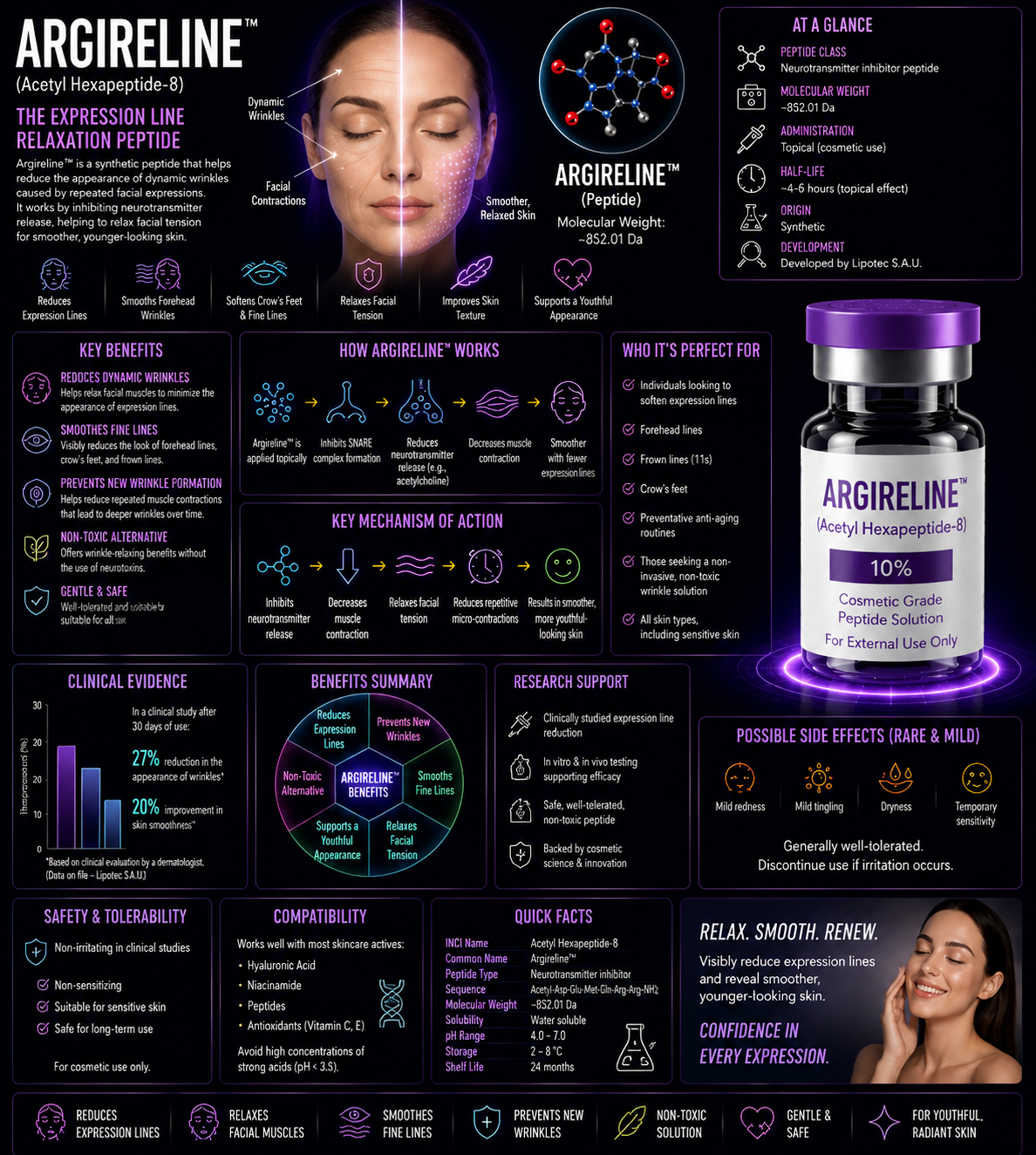
First, Argireline® is a trade name commonly used for acetyl hexapeptide-8 amide, a synthetic six-amino-acid cosmetic peptide modeled on a region of SNAP-25, a protein involved in synaptic vesicle fusion and neurotransmitter release.
Next, formulators use it in topical creams, serums, gels, masks, and eye-area products intended to reduce the visible appearance of dynamic expression lines. For example, these include forehead lines, glabellar lines, and crow’s feet.
However, the ingredient is sometimes marketed as “Botox in a bottle.” That phrase is an oversimplification. Meanwhile, botulinum toxin is injected directly into target muscle and enzymatically cleaves SNARE proteins. Argireline is applied to the skin surface, has much lower potency, and must cross substantial skin barriers before it could reach relevant deeper targets.
Acetyl Hexapeptide-8
Argireline®
Synthetic acetylated hexapeptide amide
SNAP-25-inspired peptide
Topical cosmetic wrinkle reduction
No
🧬 Molecular Structure
First, Argireline is an N-terminally acetylated, C-terminally amidated hexapeptide. Moreover, the terminal modifications protect the peptide ends and are part of the recognized cosmetic active.
🧪 Amino-Acid Sequence
Ac-Glu-Glu-Met-Gln-Arg-Arg-NH₂
| Component | Meaning | Relevance |
|---|---|---|
| Ac | N-terminal acetyl group | Meanwhile, this modification protects the N-terminus and forms part of the ingredient identity. |
| Glu-Glu | Two glutamate residues | Likewise, Contribute acidic character and water solubility. |
| Met | Methionine | In addition, Can be susceptible to oxidation during storage. |
| Gln | Glutamine | Moreover, Contributes polar hydrogen-bonding capacity. |
| Arg-Arg | Two arginine residues | By contrast, Contribute positive charge and target interactions. |
| NH₂ | C-terminal amide | Also, Distinguishes the amide form from a free-acid peptide. |
⚛️ Molecular Weight and 🧫 Formula
| Common amide-form formula | Consequently, C36H64N14O14S |
|---|---|
| Average molecular weight | Approximately 888.0 g/mol |
| Alternative database record | However, Some records list a closely related free-acid or historical form near 887.0 g/mol |
| Peptide length | 6 amino acids |
| Common CAS number | 616204-22-9 |
Therefore, molecular formula and mass depend on whether the peptide is the amide, free acid, acetate salt, hydrate, or supplied in a diluted commercial solution. Likewise, the COA must specify the exact form.
📅 Development Timeline
1980s–1990s: Researchers establish SNARE biology
First, researchers identified SNAP-25, syntaxin, and synaptobrevin as core proteins required for synaptic vesicle fusion and neurotransmitter release.
1990s: Botulinum-toxin targets clarified
Next, researchers showed to cleave specific SNARE proteins. In addition, botulinum toxin type A cleaves SNAP-25.
Early 2000s: Argireline introduced
Then, developers created as a topical cosmetic active intended to compete with or modulate SNARE-complex assembly.
2002: Early supplier-associated study published
Afterward, in vitro and topical-use work reported reduced neurotransmitter release in model systems and reductions in wrinkle depth after repeated application.
2010s: Clinical and delivery research expands
Meanwhile, small trials and formulation studies evaluated wrinkle appearance, skin penetration, emulsions, and delivery vehicles.
2020s: Researchers reassess the evidence
Finally, recent reviews conclude that acetyl hexapeptide-8 may improve wrinkle depth, elasticity, or hydration in some formulations, while emphasizing that penetration to neuromuscular junctions remains uncertain.
📖 Research History
Importantly, the rationale for Argireline is based on the role of SNAP-25 in vesicle fusion. Moreover, a synthetic peptide resembling one SNAP-25 region was proposed to compete with the native protein and destabilize efficient SNARE-complex formation.
However, this mechanism is plausible in cell-free or simplified biological systems. By contrast, the unanswered question is whether enough intact peptide can move from a topical formulation through the stratum corneum and viable skin to affect neurotransmission at a meaningful level in vivo.
Moreover, some topical studies report reduced wrinkle scores or depth. However, formulations often contain moisturizers, film-forming agents, humectants, and other peptides, so the benefit cannot always be attributed to Argireline alone.
🧠 Proposed Mechanism of Action
First, researchers propose that Argireline modulates SNARE-complex assembly, which acetylcholine-containing vesicles require for fusion with the motor-neuron membrane.
1. Acetylcholine vesicles approach the nerve terminal
Next, at a neuromuscular junction, nerve terminals prepare acetylcholine-containing vesicles for membrane fusion.
2. SNARE proteins assemble
Then, SNAP-25 and syntaxin on the nerve membrane interact with synaptobrevin on the vesicle to form the SNARE complex.
3. Calcium triggers vesicle fusion
Moreover, calcium entry activates the fusion machinery, releasing acetylcholine into the synaptic cleft.
4. Acetylcholine activates muscle receptors
In addition, acetylcholine binds muscle nicotinic receptors and initiates contraction.
5. Argireline may reduce release efficiency
Finally, in model systems, the peptide is proposed to interfere with productive SNARE assembly. Also, any effect in topical cosmetics depends on stability and delivery to the relevant site.
🎯 Target Profile
| Target or pathway | Role | Argireline relevance |
|---|---|---|
| SNAP-25 | Plasma-membrane SNARE protein | Therefore, Primary biomimetic design inspiration. |
| Syntaxin | Plasma-membrane SNARE partner | For example, Part of the fusion complex potentially affected indirectly. |
| Synaptobrevin/VAMP | Vesicle SNARE | Meanwhile, Completes the core fusion complex. |
| Acetylcholine release | Likewise, Neurotransmitter output from motor neurons | In addition, Proposed downstream outcome in model systems. |
| Muscle nicotinic receptor | Moreover, Postsynaptic receptor triggering contraction | By contrast, Not the proposed direct target of Argireline. |
Potential Cosmetic Benefits
Dynamic expression lines
First, Argireline is most relevant to lines partly caused by repeated facial movement. Consequently, it is less likely to meaningfully correct deep static wrinkles, tissue laxity, sun damage, or volume loss on its own.
Wrinkle-depth reduction
Next, small controlled and uncontrolled studies have reported reductions in periorbital wrinkle depth or scores after repeated use. However, reported effect sizes vary substantially.
Skin hydration and elasticity
Moreover, recent reviews report possible improvements in hydration and elasticity. Therefore, these effects may reflect the total formulation rather than a direct neuromuscular mechanism.
Noninvasive use
In addition, formulators can include in topical products without injections, procedure downtime, or the risks associated with botulinum-toxin administration.
Combination skincare
Finally, formulators commonly combine with hyaluronic acid, niacinamide, retinoids, antioxidants, barrier-support ingredients, or matrix-signaling peptides.
Evidence Limitations
- First, Many studies are small or supplier associated.
- Next, Finished formulations differ widely.
- Also, Some trials lack a peptide-free vehicle control.
- Moreover, Hydration can temporarily reduce the measured appearance of wrinkles.
- In addition, Skin penetration to neuromuscular targets remains uncertain.
- Likewise, There is no evidence that topical Argireline produces botulinum-toxin-equivalent chemodenervation.
Topical Delivery and Formulation Considerations
Skin-barrier limitation
First, Argireline is large, highly polar, and charged. For example, these features make passive penetration through intact stratum corneum difficult.
Vehicle matters
Next, researchers have investigated oil-in-water emulsions, multiple emulsions, liposomes, nanoparticles, penetration enhancers, microneedle systems, and other technologies to improve delivery.
Commercial solution vs pure peptide
Moreover, a finished product labeled “10% Argireline solution” may contain 10% of a supplier blend, not 10% pure acetyl hexapeptide-8. Meanwhile, the actual active concentration may be much lower.
Stability
In addition, methionine oxidation, hydrolysis, deamidation, adsorption to packaging, and microbial degradation can reduce quality. Likewise, extreme pH and prolonged heat may accelerate instability.
Application instructions
Finally, use frequency should follow the validated finished-product directions. In addition, a universal twice-daily or fixed concentration recommendation is not supported for every formulation.
Safety and Regulatory Considerations
Cosmetic status
First, Argireline is a cosmetic ingredient, not an FDA-approved drug. Moreover, cosmetic products cannot lawfully claim to treat neuromuscular disease or replicate approved botulinum-toxin treatment.
Local irritation
Next, potential adverse effects include redness, stinging, dryness, itching, contact dermatitis, or irritation from the peptide, preservative system, solvent, or other ingredients.
Eye-area use
Moreover, users should keep products out of the eyes and applied only according to finished-product labeling.
Pregnancy and neuromuscular conditions
However, human safety evidence is limited in pregnancy, breastfeeding, infants, and people with neuromuscular disorders. By contrast, medical advice is appropriate when uncertainty exists.
CIR safety conclusion
Finally, the Cosmetic Ingredient Review panel concluded that acetyl hexapeptide-8 amide was safe in cosmetics at concentrations up to 0.005% under the evaluated conditions, while available data were insufficient for unrestricted higher concentrations. Also, this refers to active concentration, not necessarily the percentage of a diluted supplier solution.
🧪 Laboratory Testing Methods
| Method | Purpose | Important limitation |
|---|---|---|
| RP-HPLC or UPLC | Also, Measures chromatographic purity and related peptide impurities. | Consequently, Does not establish active concentration in a diluted commercial solution unless quantitatively validated. |
| LC-MS / HRMS | However, Confirms intact molecular mass and supports identity. | Therefore, Does not establish topical penetration or cosmetic efficacy. |
| MS/MS peptide mapping | For example, Confirms amino-acid order and terminal modifications. | Meanwhile, Requires validated interpretation for short, highly charged peptides. |
| Amino-acid analysis | Likewise, Supports composition and quantitative content. | In addition, Does not independently prove sequence order. |
| N-terminal acetylation analysis | Moreover, Confirms the acetyl modification. | By contrast, May require MS/MS or NMR confirmation. |
| C-terminal amidation analysis | Also, Distinguishes the amide from the free-acid form. | Consequently, Intact-mass interpretation must account for the correct terminal form. |
| Oxidized methionine testing | However, Measures a key degradation impurity. | Therefore, Requires a stability-indicating chromatographic method. |
| For example, Assay / active content | Meanwhile, Measures actual Argireline concentration. | Likewise, Must distinguish pure peptide from supplier blend percentage. |
| In addition, Residual-solvent and counterion testing | Moreover, Characterizes synthesis-related residues and salt form. | By contrast, Does not establish microbiological quality. |
| Microbial limits | Also, Evaluates bacteria, yeast, and mold in cosmetic raw materials. | Consequently, Not equivalent to pharmaceutical sterility. |
| Preservative challenge testing | However, Assesses finished-product protection against microbial contamination. | Therefore, laboratories must perform the test on the finished formula and packaging. |
| Stability testing | For example, Monitors assay, impurities, appearance, pH, and microbiology over time. | Meanwhile, Supplier raw-material stability does not prove finished-product stability. |
📄 How to Interpret an Argireline COA
1. Confirm the exact identity
First, the report should identify acetyl hexapeptide-8 and specify whether it is the C-terminal amide form.
2. Verify the sequence
Next, the expected sequence is Ac-Glu-Glu-Met-Gln-Arg-Arg-NH₂.
3. Determine whether the material is pure or diluted
Moreover, many commercial raw materials are aqueous supplier solutions. Consequently, the COA should state the active assay and carrier composition.
4. Separate purity from active content
- Identity First, confirms the expected peptide.
- Purity Next, estimates relative chromatographic composition.
- Assay Also, measures actual active concentration.
5. Review methionine oxidation
In addition, methionine sulfoxide may form during storage, so laboratories should control it as a related substance.
6. Check microbiological data
Likewise, a water-based cosmetic raw material should have microbial specifications and an appropriate preservative system.
7. Match the batch
Finally, the lot number, production date, test date, methods, specifications, numerical results, and authorized review should be present.
📊 Argireline vs Botulinum Toxin vs SYN-AKE vs Matrixyl
Mechanisms, Routes, and Evidence Differences
| Feature | Argireline | Botulinum toxin type A | SYN-AKE | Matrixyl-type peptides |
|---|---|---|---|---|
| Compound type | Acetylated hexapeptide | Likewise, Large bacterial neurotoxin protein | In addition, Small waglerin-inspired cosmetic active | Palmitoylated signal peptides |
| Proposed target | Moreover, SNARE-complex assembly / SNAP-25-inspired modulation | Enzymatic SNAP-25 cleavage | By contrast, Muscle nicotinic receptor antagonism | Extracellular-matrix signaling |
| Route | Topical | Injection | Topical | Topical |
| Muscle effect | Also, Mild and uncertain in intact skin | Clinically significant chemodenervation | Mild and proposed | Consequently, No primary muscle effect |
| Evidence level | However, Small clinical studies and reviews | Therefore, Extensive controlled clinical evidence | For example, Limited and largely supplier associated | Meanwhile, Varies by specific peptide and formulation |
| FDA drug approval | No | Likewise, Yes, specific products and indications | No | No |
Argireline vs SNAP-25
Peptide Versus Native Protein
| Property | Argireline | Native SNAP-25 |
|---|---|---|
| Size | 6 amino acids | 206-amino-acid protein |
| Role | In addition, Synthetic biomimetic cosmetic peptide | Moreover, Essential neuronal membrane-fusion protein |
| Same molecule? | No | No |
| Location | By contrast, Applied to skin surface in cosmetics | Also, Inside presynaptic nerve terminals |
🔗 Related Cosmetic Peptides
- SYN-AKE: First, A waglerin-inspired ingredient proposed to antagonize muscle nicotinic receptors.
- Pentapeptide-18: Next, A cosmetic peptide marketed around enkephalin-related neuromodulation.
- Palmitoyl Pentapeptide-4: Also, A Matrixyl-family signal peptide associated with matrix support.
- Palmitoyl Tripeptide-1 and Palmitoyl Tetrapeptide-7: Moreover, Peptides commonly paired in Matrixyl 3000-type systems.
- Copper Tripeptide-1: In addition, A copper-binding peptide studied in skin remodeling and wound biology.
🖼️ Original Diagram Specifications
Diagram 1: Argireline sequence map
Consequently, Show Ac-Glu-Glu-Met-Gln-Arg-Arg-NH₂ with labels for N-terminal acetylation, methionine oxidation sensitivity, and C-terminal amidation.
Diagram 2: SNARE-complex pathway
However, Illustrate SNAP-25, syntaxin, and synaptobrevin assembling to fuse an acetylcholine vesicle with the nerve membrane.
Diagram 3: Proposed Argireline mechanism
Therefore, Show Argireline as a competing SNAP-25-inspired peptide that may reduce efficient SNARE assembly. Label this as proposed and formulation dependent.
Diagram 4: Argireline vs botulinum toxin
Show botulinum toxin entering the nerve terminal and cleaving SNAP-25, while topical Argireline remains outside and must first cross the skin barrier.
Diagram 5: Skin-delivery challenge
For example, Illustrate the stratum corneum, epidermis, dermis, nerve terminal, and muscle, emphasizing the distance and barriers between topical application and the proposed target.
Diagram 6: COA workflow
Meanwhile, Show sequence identity, intact mass, acetylation, amidation, methionine oxidation, active assay, microbial limits, stability, and final batch review.
❓ Frequently Asked Questions
Is Argireline a peptide?
Likewise, Yes. It is a synthetic acetylated hexapeptide used in cosmetic formulations.
What is its sequence?
Ac-Glu-Glu-Met-Gln-Arg-Arg-NH₂.
Does Argireline work like Botox?
In addition, Only in a broad marketing sense. Both relate to neurotransmitter-release biology, but botulinum toxin enzymatically cleaves SNAP-25 after injection. Argireline is topical, milder, reversible, and limited by skin penetration.
Does Argireline paralyze muscles?
Moreover, There is no evidence that normal topical use produces botulinum-like paralysis. Any effect is expected to be mild and cosmetic.
How long does it take to work?
By contrast, Small studies commonly evaluate results after four to eight weeks. The effect depends on formulation, concentration, adherence, and baseline wrinkle type.
Is 10% Argireline the same as 10% pure peptide?
Also, Not necessarily. It often refers to 10% of a commercial supplier solution containing a much lower percentage of active peptide.
Can it be combined with retinoids or hyaluronic acid?
Consequently, Many finished products combine these ingredients. Compatibility and irritation depend on the complete formulation rather than a universal layering rule.
Is Argireline FDA approved?
However, It is not an FDA-approved wrinkle-treatment drug. It is used as a cosmetic ingredient.
Is it safe?
Therefore, Topical products are generally well tolerated, but irritation or allergy can occur. Safety depends on the active concentration and the complete formulation.
Does 99% HPLC purity prove a serum will work?
For example, No. Raw-material purity does not prove skin penetration, active concentration in the finished serum, stability, preservation, or clinical wrinkle reduction.
Argireline Scientific Overview: Final Thoughts
In conclusion, Argireline is a synthetic SNAP-25-inspired hexapeptide used in topical anti-aging cosmetics. Its sequence and terminal modifications are well defined, and small studies suggest it may modestly reduce the appearance of expression wrinkles in some formulations.
However, its “Botox-like” reputation should be interpreted cautiously. Botulinum toxin and Argireline differ dramatically in molecular size, route, access to nerve terminals, mechanism, potency, duration, evidence quality, and regulatory status.
Therefore, the most important unanswered issue is delivery. A topical peptide cannot influence a deep neuromuscular process unless sufficient intact material reaches the relevant target. Product quality therefore depends not only on peptide purity but also on active concentration, vehicle, stability, preservation, packaging, and finished-formula performance.
📚 References
- For example, Blanes-Mira C, et al. A synthetic hexapeptide (Argireline) with antiwrinkle activity. International Journal of Cosmetic Science. 2002.
- Moreover, Wang Y, et al. The anti-wrinkle efficacy of Argireline, a synthetic peptide patterned from SNAP-25. Journal of Cosmetic and Laser Therapy. 2013.
- In addition, Wang Y, et al. Anti-wrinkle efficacy and histological effects of Argireline. 2013.
- However, Zdrada-Nowak J, et al. Acetyl Hexapeptide-8 in Cosmeceuticals—A Review of Skin Permeability and Efficacy. 2025.
- Therefore, Zdrada-Nowak J, et al. Acetyl Hexapeptide-8 in Cosmeceuticals. PubMed record. 2025.
- Likewise, Hoppel M, et al. Topical delivery of acetyl hexapeptide-8 from different emulsions. 2015.
- For example, Henseler H, et al. Investigating the effects of Argireline in a skin serum. 2023.
- Moreover, Aruan RR, et al. Double-blind randomized trial of peptide-containing antiaging formulations. 2023.
- In addition, Olsson SE, et al. Public interest in acetyl hexapeptide-8 and review of the literature. 2024.
- However, Journal of Drugs in Dermatology. Acetyl Hexapeptide-8 as a topical alternative to botulinum toxin: review of literature. 2025.
- Therefore, Cosmetic Ingredient Review. Safety Assessment of Acetyl Hexapeptide-8 Amide as Used in Cosmetics. 2021.
- Likewise, National Center for Biotechnology Information. PubChem Compound Summary: Acetyl Hexapeptide-8.
- For example, National Center for Biotechnology Information. PubChem Compound Summary: Argireline.
- Moreover, Schiavo G, Matteoli M, Montecucco C. Neurotoxins affecting neuroexocytosis. Physiological Reviews.
- In addition, Söllner T, et al. SNAP receptors implicated in vesicle targeting and fusion. Nature. 1993.
- However, Sutton RB, Fasshauer D, Jahn R, Brunger AT. Crystal structure of a SNARE complex. Nature. 1998.
- Therefore, Jahn R, Scheller RH. SNAREs—engines for membrane fusion. Nature Reviews Molecular Cell Biology. 2006.
- Likewise, Montecucco C, Molgó J. Botulinal neurotoxins: revival of an old killer. Current Opinion in Pharmacology.
- For example, Rossetto O, Pirazzini M, Montecucco C. Botulinum neurotoxins: genetic, structural and mechanistic insights. Nature Reviews Microbiology.
- Moreover, Schagen SK. Topical peptide treatments with effective anti-aging results. Cosmetics. 2017.
- In addition, Gorouhi F, Maibach HI. Role of topical peptides in preventing or treating aged skin. International Journal of Cosmetic Science.
- However, Bos JD, Meinardi MMHM. The 500 Dalton rule for skin penetration. Experimental Dermatology. 2000.
- Therefore, Prausnitz MR, Langer R. Transdermal drug delivery. Nature Biotechnology. 2008.
- Likewise, International Organization for Standardization. ISO 11930: Cosmetics—Microbiology—Evaluation of antimicrobial protection.
- For example, International Organization for Standardization. ISO 17516: Cosmetics—Microbiology—Microbiological limits.
- International Council for Harmonisation. ICH Q2(R2): Validation of Analytical Procedures.
- United States Pharmacopeia. General Chapter <621>, Chromatography.
- International Council for Harmonisation. ICH Q3C: Impurities—Guideline for Residual Solvents.
- International Council for Harmonisation. ICH Q1A(R2): Stability Testing of New Drug Substances and Products.
Argireline Evidence and SNARE-Biology Sources
Delivery, Safety, and Analytical Sources
Meanwhile, this article review checked ingredient identity, molecular properties, safety assessment, delivery limitations, and clinical evidence in July 2026.