
:root{--ink:#16202a;--muted:#5c6975;--line:#dce3e8;--panel:#f6f8fa;--accent:#174f69;--accent2:#73582b;--warning-bg:#fff8e8} *{box-sizing:border
NAD+ Scientific Overview: Structure, Metabolism, Research, and Testing
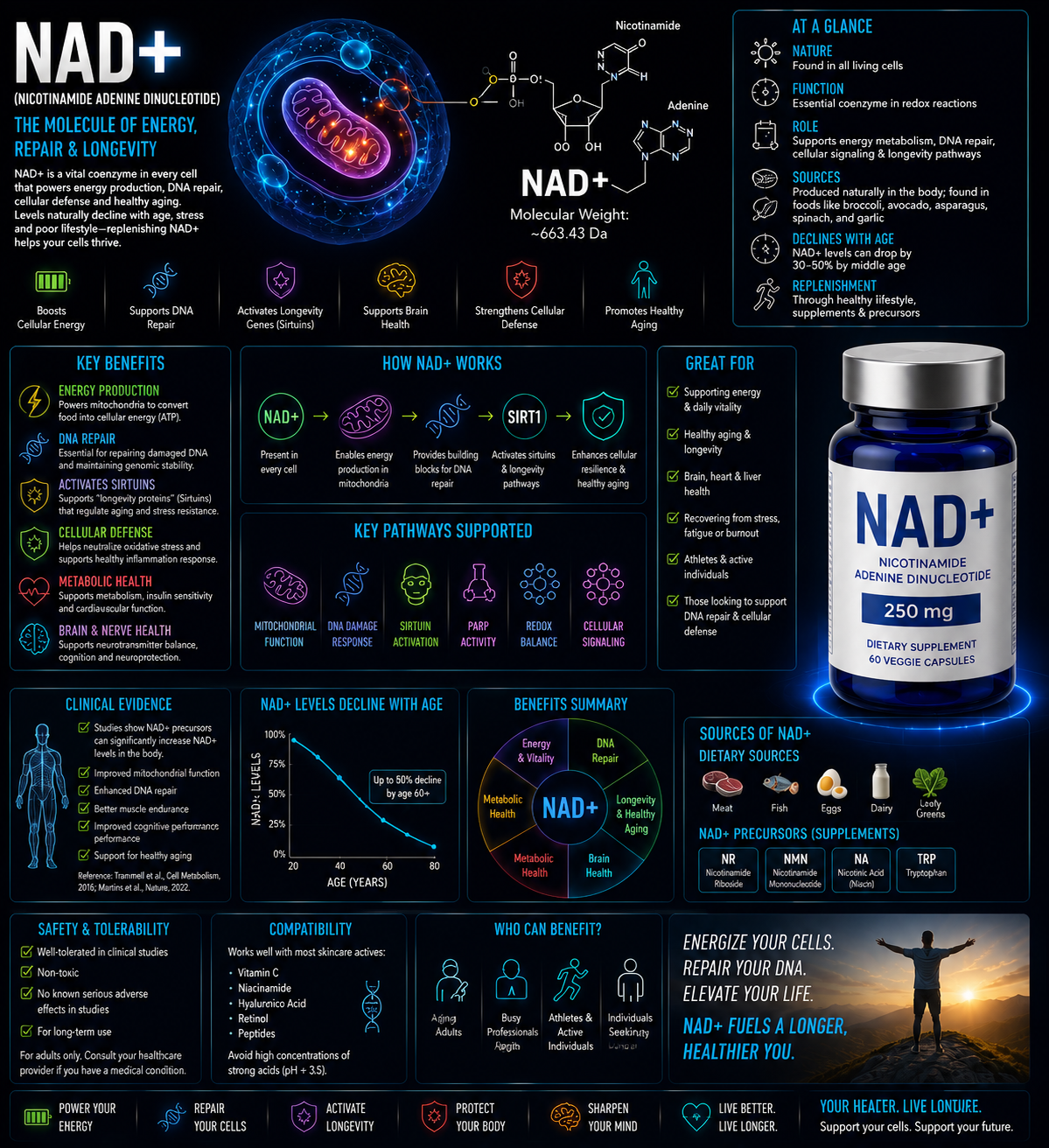
NAD+ scientific overview content should distinguish established redox biology from broader claims about anti-aging, energy, cognition, IV infusions, NR, and NMN. This dinucleotide coenzyme transfers electrons and also serves as a substrate for several signaling enzymes.
What Is NAD⁺?
First, nicotinamide adenine dinucleotide is a dinucleotide coenzyme found in all living cells. Its oxidized form is written NAD⁺, while its reduced electron-carrying form is NADH.
Next, NAD⁺ serves two broad biological roles:
- Redox coenzyme: NAD⁺ accepts a hydride equivalent during metabolic reactions and becomes NADH. NADH then transfers electrons into pathways such as mitochondrial oxidative phosphorylation.
- Consumed signaling substrate: Next, Enzymes including sirtuins, PARPs, CD38, and SARM1 cleave NAD⁺ to regulate protein modification, DNA repair, calcium signaling, immune activity, and axonal degeneration.
However, NAD⁺ does not simply “create energy.” It enables metabolic enzymes to transfer electrons. For example, aTP production depends on the complete metabolic and mitochondrial system, including oxygen availability, substrate supply, electron transport, membrane potential, and ATP synthase.
Dinucleotide coenzyme
NAD⁺
NADH
Electron transfer
Sirtuins, PARPs, CD38, SARM1
Vitamin B3 family
🧬 Molecular Structure
First, NAD⁺ consists of two ribonucleotides joined through their phosphate groups. Meanwhile, one contains adenine; the other contains nicotinamide. The nicotinamide ring is the redox-active portion that accepts a hydride ion.
🧪 Structural Components
| Component | Role |
|---|---|
| Nicotinamide ribose nucleotide | For example, Contains the redox-active nicotinamide ring. |
| Adenosine monophosphate unit | Meanwhile, Contributes recognition and enzyme binding. |
| Pyrophosphate linkage | Likewise, Joins the two nucleotide units. |
| Nicotinamide C4 position | In addition, Accepts a hydride during reduction to NADH. |
⚛️ Molecular Formula and Weight
| β-NAD⁺ formula | Moreover, C21H27N7O14P2 |
|---|---|
| β-NAD⁺ molecular weight | Approximately 663.4 g/mol |
| NADH formula | By contrast, C21H29N7O14P2 |
| NADH molecular weight | Approximately 665.4 g/mol |
| Common salt forms | Also, Disodium salts, hydrates, and other counterion forms |
| PubChem CID, β-NAD⁺ | 925 |
Therefore, published molecular weights vary because databases and suppliers may describe different protonation states, zwitterions, salts, or hydrates. Likewise, a COA should state the exact chemical form.
NAD⁺ vs NADH
Importantly, NAD⁺ is electron deficient and accepts reducing equivalents. In addition, nADH contains two additional hydrogen equivalents and can donate electrons. The NAD⁺/NADH relationship is compartment specific; cytosol and mitochondria maintain different redox states.
📅 Discovery Timeline
1906: A heat-stable fermentation cofactor identified
First, Arthur Harden and William Young found that yeast fermentation required a dialyzable cofactor later recognized as containing NAD-related activity.
1930s: Warburg identifies the hydrogen-transfer role
Next, Otto Warburg and colleagues established that nicotinamide-containing coenzymes participate in biological oxidation and reduction.
1936: Chemical structure clarified
Then, researchers recognized NAD as a dinucleotide containing nicotinamide and adenine nucleotides.
1950s–1960s: Metabolic pathways mapped
Afterward, NAD-dependent dehydrogenases became central to glycolysis, the TCA cycle, alcohol metabolism, fatty-acid oxidation, and mitochondrial respiration.
1960s: NAD⁺ identified as a substrate for ADP-ribosylation
Meanwhile, researchers discovered that NAD⁺ is consumed during poly(ADP-ribose) synthesis, expanding its role beyond redox metabolism.
1990s–2000s: Sirtuins connect NAD⁺ to regulation
Moreover, researchers identified sirtuins as NAD⁺-dependent deacylases involved in chromatin, metabolism, stress responses, and mitochondrial biology.
2000s–2010s: NAD⁺ salvage and aging research accelerates
Consequently, NR, NMN, NAMPT, CD38, PARPs, and tissue NAD⁺ decline became major research targets.
2020s: Researchers test human translation more rigorously
Finally, trials generally show that NR and NMN can alter blood NAD-related metabolites, but clinical outcomes for aging, cognition, metabolic disease, or physical performance are inconsistent.
📖 Research History
Importantly, NAD⁺ research moved from classical metabolism into signaling biology. Moreover, enzymes that consume NAD⁺ link energy state to chromatin, DNA repair, inflammation, calcium signaling, and cell survival.
However, preclinical experiments often produce striking results from restoring NAD⁺ in aged or diseased animals. By contrast, human trials have been more modest. Increasing a biomarker does not necessarily improve symptoms, function, or long-term health outcomes.
NAD⁺ Biosynthesis and Salvage Pathways
De novo pathway
First, tryptophan can be converted through the kynurenine pathway into quinolinic acid and ultimately NAD⁺. This pathway also intersects with immune and neuroactive metabolites.
Preiss–Handler pathway
Next, the Preiss–Handler pathway converts nicotinic acid to nicotinic acid mononucleotide, then nicotinic acid adenine dinucleotide, and finally NAD⁺.
Nicotinamide salvage pathway
Moreover, nicotinamide released by NAD-consuming enzymes is converted by NAMPT into NMN. NMNAT enzymes then convert NMN into NAD⁺.
Nicotinamide riboside pathway
In addition, nicotinamide riboside kinases phosphorylate NR to form NMN, and NMNAT enzymes convert NMN into NAD⁺.
Compartmentalization
Finally, NAD⁺ metabolism differs among the nucleus, cytosol, mitochondria, and extracellular space. Also, whole-blood measurements do not necessarily represent brain, muscle, liver, or mitochondrial NAD⁺.
🧠 How NAD⁺ Works
1. Glycolysis
First, NAD⁺ accepts electrons during glyceraldehyde-3-phosphate oxidation, allowing glycolysis to continue. Consequently, nADH must be reoxidized through mitochondrial shuttles or fermentation pathways.
2. TCA cycle and fatty-acid oxidation
Next, multiple dehydrogenases reduce NAD⁺ to NADH while oxidizing acetyl-CoA-derived intermediates and fatty acids.
3. Electron transport and ATP production
Then, mitochondrial NADH donates electrons to Complex I. However, electron flow supports proton pumping and ATP synthesis. NADH is therefore an electron donor, while NAD⁺ is regenerated for continued metabolism.
4. Sirtuins
Moreover, sirtuins use NAD⁺ to remove acyl groups from proteins, producing nicotinamide and ADP-ribose-related products. Therefore, they regulate metabolism, mitochondrial proteins, chromatin, stress responses, and circadian biology.
5. PARPs and DNA damage responses
In addition, PARP enzymes consume NAD⁺ to build ADP-ribose chains at sites of DNA damage. For example, excessive PARP activation can substantially deplete cellular NAD⁺ and ATP.
6. CD38 and calcium signaling
Likewise, CD38 consumes NAD⁺ to generate ADP-ribose, cyclic ADP-ribose, and related calcium-mobilizing metabolites. Meanwhile, cD38 activity increases in some inflammatory and aging contexts.
7. SARM1 and axonal degeneration
Finally, activated SARM1 rapidly destroys NAD⁺ in injured axons and initiates a degenerative program. Likewise, sARM1 inhibition is being investigated for neurodegenerative and neuropathy applications.
🎯 Major NAD⁺-Dependent Enzyme Systems
| System | Consumes or uses NAD⁺ for |
|---|---|
| Dehydrogenases | However, Reversible electron transfer in metabolism. |
| Sirtuins | Therefore, Protein deacetylation and deacylation. |
| PARPs | For example, ADP-ribosylation and DNA-damage signaling. |
| CD38/CD157 | Meanwhile, Calcium-mobilizing metabolite production and immune signaling. |
| SARM1 | Likewise, NADase activity driving programmed axon degeneration. |
| NAD kinases | In addition, Conversion of NAD⁺ to NADP⁺ for anabolic and antioxidant pathways. |
Potential Benefits and Research Areas
Mitochondrial and metabolic research
For example, increasing NAD-related metabolites can alter mitochondrial and metabolic biomarkers. In addition, human trials have not consistently demonstrated broad improvements in insulin sensitivity, exercise capacity, weight, or energy.
Aging biology
However, NAD⁺ restoration extends healthspan or reverses selected dysfunctions in multiple animal models. Moreover, human anti-aging effectiveness remains unproven, and recent reviews describe clinical outcomes as inconclusive.
Cardiovascular research
Moreover, researchers have studied NR for blood pressure, arterial stiffness, heart failure, and vascular function. By contrast, some biomarker changes are promising, but findings are not uniformly positive.
Neurological research
In addition, NAD⁺ pathways are relevant to axonal degeneration, Parkinson disease, Alzheimer disease, neuropathy, and mitochondrial disorders. Also, most disease-modifying claims remain investigational.
Muscle and physical performance
Likewise, systematic reviews of NR and NMN have found inconsistent or nonsignificant effects on strength, gait speed, body composition, and sarcopenia-related outcomes.
Rare diseases and mitochondrial disorders
Finally, selected studies suggest NAD-boosting strategies may benefit specific genetic or mitochondrial conditions. Consequently, these disease-focused findings should not be generalized to healthy anti-aging use.
NAD⁺ Supplementation and Precursor Forms
Direct oral NAD⁺
First, NAD⁺ is large, charged, and susceptible to extracellular metabolism. However, oral products may be degraded into smaller precursors before absorption. Evidence that intact oral NAD⁺ reaches tissues in meaningful amounts is limited.
Intravenous NAD⁺
However, IV delivery creates direct systemic exposure, but published clinical evidence for anti-aging, addiction recovery, energy, cognition, or general wellness is sparse. Therefore, a recent systematic review found clinical effectiveness inconclusive and identified direct IV NAD⁺ evidence mainly as pharmacokinetic context.
Nicotinamide riboside
Moreover, NR is an NAD⁺ precursor and vitamin B3 derivative. For example, repeated oral dosing can increase circulating NAD-related metabolites. Clinical benefits vary by outcome and population.
Nicotinamide mononucleotide
In addition, NMN is converted to NAD⁺ through NMNAT enzymes, although extracellular conversion and transport biology remain active research areas. Meanwhile, human trials suggest short-term tolerability and biomarker effects, but broad clinical benefits remain uncertain.
Nicotinamide
Likewise, nicotinamide is an inexpensive vitamin B3 form and direct salvage substrate. High exposure can inhibit sirtuins and PARPs through product feedback and may cause liver or metabolic adverse effects.
Nicotinic acid
Meanwhile, nicotinic acid supports NAD⁺ synthesis through the Preiss–Handler pathway but also has pharmacological lipid effects and commonly causes flushing.
NADH supplements
Finally, NADH is the reduced coenzyme. Oral stability and absorption depend on formulation. Evidence for fatigue, Parkinson disease, or cognitive claims is limited.
Safety and Regulatory Considerations
NR and NMN tolerability
First, short human trials generally report acceptable tolerability, with possible nausea, abdominal symptoms, headache, fatigue, or laboratory changes. Long-term safety across diverse populations remains less certain.
Methyl-donor metabolism
Moreover, nicotinamide generated from NAD⁺ turnover can be methylated and excreted. High precursor exposure may influence methyl-group demand and homocysteine-related metabolism, although clinical significance varies.
Cancer biology
However, NAD⁺ supports DNA repair and healthy-cell metabolism, but it can also support survival and metabolism of established tumor cells. People with cancer should not assume NAD-boosting therapy is universally beneficial.
IV infusion reactions
In addition, wellness clinics report nausea, chest or abdominal discomfort, flushing, headache, lightheadedness, and infusion-rate intolerance. Robust controlled safety data for long-term repeated IV NAD⁺ are limited.
Injectable product quality
Consequently, unapproved injectables introduce risks involving sterility, endotoxin, particulates, incorrect concentration, degradation, pH, osmolality, and compounding quality.
Regulatory status
Finally, there is no FDA-approved NAD⁺ drug for anti-aging or wellness. FDA does not approve dietary supplements for safety or effectiveness. The U.S. regulatory status of NMN as a dietary-supplement ingredient has been disputed and has changed through agency interpretations, notifications, and industry challenges; current FDA source documents should be checked before making marketing claims.
🧪 Laboratory Testing Methods
| Method | Purpose | Important limitation |
|---|---|---|
| HPLC-UV / UPLC | Moreover, Assays NAD⁺ and separates NADH, NMN, nicotinamide, ADP-ribose, and degradants. | By contrast, NAD⁺ can degrade during storage and handling. |
| Also, Ion-pair or anion-exchange chromatography | Consequently, Improves separation of highly polar nucleotide species. | However, Method conditions and ion-pair reagents affect MS compatibility. |
| LC-MS/MS | Therefore, Confirms identity and quantifies NAD metabolites. | For example, Requires isotope standards and careful matrix validation for biological samples. |
| NMR spectroscopy | Meanwhile, Supports structural and purity characterization. | Likewise, Less sensitive than MS for trace impurities. |
| Enzymatic cycling assay | In addition, Measures NAD⁺, NADH, or total NAD pools. | Moreover, Extraction and differential destruction steps can introduce bias. |
| UV absorbance ratios | By contrast, Provides rapid identity or purity screening. | Also, Not specific enough for a complete COA. |
| Consequently, Assay / net content | However, Measures actual NAD⁺ quantity. | Therefore, Must account for salt, hydrate, and water basis. |
| For example, pH, osmolality, and particulates | Meanwhile, Evaluates finished injectable formulation quality. | Likewise, Does not prove molecular identity. |
| Endotoxin and sterility | In addition, Evaluates pyrogenic endotoxin and viable microbes. | Moreover, Both are necessary for injectables and answer different questions. |
| By contrast, Elemental impurities and residual solvents | Evaluates process contaminants. | Also, Does not establish biological potency. |
| Stability-indicating testing | Consequently, Tracks hydrolysis, nicotinamide formation, adenine-nucleotide impurities, pH, and assay. | However, Must reflect the actual container and storage conditions. |
📄 How to Interpret an NAD⁺ COA
1. Confirm the exact analyte
First, the COA should distinguish NAD⁺ from NADH, NADP⁺, NMN, NR, nicotinamide, and related adenine nucleotides.
2. Identify stereochemical and chemical form
Next, β-NAD⁺ is the biologically standard coenzyme form. The report should state whether the material is β-NAD⁺, α-NAD, disodium salt, hydrate, or another form.
3. Separate purity and assay
- Identity First, confirms the correct nucleotide.
- Purity Next, estimates chromatographic composition.
- Assay Also, measures actual NAD⁺ content.
4. Review NADH and degradation impurities
Moreover, NAD⁺ preparations may contain NADH, nicotinamide, AMP, ADP-ribose, NMN, or hydrolysis products. A stability-indicating chromatogram should resolve relevant species.
5. Account for salts and hydration
In addition, gross powder weight can include sodium ions, water, and counterions. Label claims should specify whether content is calculated as anhydrous NAD⁺ or the supplied salt.
6. Examine pH and buffer claims
Likewise, “buffered NAD⁺” describes a formulation characteristic, not a different NAD⁺ molecule. The COA should identify buffer components, pH, concentration, and compatibility.
7. Do not confuse raw purity with injectable suitability
However, a 99% HPLC result does not prove sterility, endotoxin safety, correct osmolality, low particulates, container compatibility, or dose accuracy.
📊 NAD⁺ vs NADH vs NMN vs NR
Forms, Precursors, and Evidence Differences
| Feature | NAD⁺ | NADH | NMN | NR |
|---|---|---|---|---|
| Compound type | Oxidized dinucleotide coenzyme | Reduced dinucleotide coenzyme | Mononucleotide precursor | Nucleoside precursor |
| Primary role | Therefore, Electron acceptor and enzyme substrate | Electron donor | For example, Converted to NAD⁺ by NMNAT | Meanwhile, Converted to NMN by NR kinases |
| Oral evidence | Likewise, Limited for intact absorption | In addition, Formulation dependent and limited | Moreover, Raises NAD-related biomarkers in several trials | By contrast, Raises NAD-related biomarkers in multiple trials |
| Clinical anti-aging proof | Clinical anti-aging proof remains unestablished. | Human outcome evidence remains unestablished. | Researchers have not established clinical anti-aging efficacy. | No conclusive anti-aging outcome evidence exists. |
| FDA-approved anti-aging drug? | For example, No approved anti-aging indication. | Moreover, No approved anti-aging indication. | In addition, No approved anti-aging indication. | However, No approved anti-aging indication. |
NAD⁺ vs NADP⁺
Redox-Pair and Metabolic Differences
| Property | NAD⁺ / NADH | NADP⁺ / NADPH |
|---|---|---|
| Main metabolic emphasis | Also, Catabolic oxidation and ATP-related electron transfer | Consequently, Reductive biosynthesis and antioxidant defense |
| Structural difference | However, No extra 2′ phosphate | Therefore, Additional phosphate on adenosine ribose |
| Key examples | For example, Glycolysis, TCA cycle, Complex I | Meanwhile, Fatty-acid synthesis, glutathione reduction, cytochrome P450 |
NR vs NMN vs Nicotinamide
| Precursor | Conversion route | Important consideration |
|---|---|---|
| NR | Likewise, NR → NMN → NAD⁺ | In addition, Human biomarker evidence is relatively extensive; outcome evidence varies. |
| NMN | NMN → NAD⁺ | Moreover, Transport and extracellular metabolism remain active research topics. |
| Nicotinamide | By contrast, NAM → NMN → NAD⁺ | Also, High exposure can inhibit NAD-consuming enzymes and cause adverse effects. |
| Nicotinic acid | Preiss–Handler pathway | Consequently, Can cause flushing and has distinct lipid pharmacology. |
🔗 Related Molecules
- NADH: First, Reduced electron-carrying form.
- NADP⁺/NADPH: Next, Phosphorylated redox pair central to biosynthesis and antioxidant defense.
- NMN: Also, Immediate NAD⁺ precursor in salvage pathways.
- NR: Moreover, Vitamin B3-related nucleoside precursor.
- Nicotinamide: In addition, Salvage substrate and product of NAD-consuming reactions.
- Nicotinic acid: Likewise, Precursor entering the Preiss–Handler pathway.
- ADP-ribose and cADPR: Finally, NAD-derived signaling molecules.
🖼️ Original Diagram Specifications
Diagram 1: NAD⁺ molecular anatomy
However, Show nicotinamide ribose, adenine ribose, pyrophosphate linkage, and the redox-active nicotinamide carbon.
Diagram 2: NAD⁺/NADH metabolic cycle
Therefore, Illustrate NAD⁺ reduction during glycolysis, TCA cycle, and fatty-acid oxidation, followed by NADH electron donation to mitochondrial Complex I.
Diagram 3: NAD⁺ biosynthesis pathways
For example, Show tryptophan de novo synthesis, nicotinic-acid Preiss–Handler pathway, nicotinamide salvage, NR conversion, and NMN conversion.
Diagram 4: NAD⁺ consumers
Meanwhile, Place NAD⁺ at the center with branches to sirtuins, PARPs, CD38, and SARM1, showing nicotinamide release and distinct biological outcomes.
Diagram 5: Human evidence ladder
Likewise, Separate biochemical plausibility, animal results, blood biomarker increases, small clinical trials, and proven patient outcomes to show where evidence is strong or limited.
Diagram 6: NAD⁺ COA workflow
In addition, Show chemical form, HPLC assay, LC-MS identity, NADH/degradants, water and salt basis, pH, endotoxin, sterility, particulates, and final batch review.
❓ Frequently Asked Questions
Is NAD⁺ a peptide?
Moreover, No. NAD⁺ is a dinucleotide coenzyme, not a peptide.
What does NAD⁺ do?
By contrast, It transfers electrons in metabolism and serves as a substrate for enzymes involved in protein regulation, DNA repair, calcium signaling, immunity, and axonal degeneration.
Does NAD⁺ produce ATP?
Also, Indirectly. NADH donates electrons to the mitochondrial electron-transport chain, which supports ATP synthesis. NAD⁺ itself is not ATP.
Do NAD⁺ levels decline with age?
Consequently, Many animal studies show age-related decline. Human evidence is less consistent and varies by tissue and measurement method.
Does raising NAD⁺ slow human aging?
However, That has not been established. Biomarker changes do not yet prove longer life, delayed aging, or broad wellness benefits.
Can oral NAD⁺ be absorbed?
Intact absorption appears limited because First, NAD⁺ is large and charged. It may be broken down into smaller precursors before uptake.
Does IV NAD⁺ work better than NR or NMN?
Therefore, There is not enough comparative clinical evidence to conclude that IV NAD⁺ provides superior health outcomes.
Are NR and NMN safe?
For example, Short-term trials generally report acceptable tolerability. Long-term safety and effectiveness across different populations remain under study.
Is NAD⁺ FDA approved for anti-aging?
Meanwhile, No. There is no FDA-approved NAD⁺ anti-aging or wellness drug.
Is buffered NAD⁺ a different molecule?
Likewise, No. “Buffered” refers to formulation pH and excipients. The active NAD⁺ molecule remains NAD⁺.
Does 99% HPLC purity prove injectable NAD⁺ is safe?
In addition, No. It does not prove sterility, endotoxin safety, correct content, low particulates, suitable pH, osmolality, or stability.
NAD+ Scientific Overview: Final Thoughts
In conclusion, NAD⁺ is an essential dinucleotide coenzyme at the intersection of metabolism, redox balance, DNA-damage responses, protein regulation, immune signaling, calcium signaling, and neuronal survival.
Moreover, NR and NMN can increase NAD-related metabolites in humans, but clinical benefits for healthy aging, cognition, energy, metabolic health, or physical function remain inconsistent. Direct IV NAD⁺ has even less rigorous outcome evidence despite widespread wellness marketing.
Therefore, the most accurate conclusion is that NAD⁺ augmentation has clear biological activity but unproven broad anti-aging effectiveness. Product evaluation should distinguish NAD⁺ from NADH and its precursors and should separately assess identity, chemical form, assay, degradation, stability, and—when injectable—sterility, endotoxin, particulate, pH, and osmolality controls.
📚 References
- Therefore, National Center for Biotechnology Information. PubChem Compound Summary: β-Nicotinamide Adenine Dinucleotide.
- Likewise, National Center for Biotechnology Information. PubChem Compound Summary: NADH.
- For example, Verdin E. NAD⁺ in aging, metabolism, and neurodegeneration. Science. 2015.
- Moreover, Yoshino J, Baur JA, Imai SI. NAD⁺ intermediates: biology and therapeutic potential. Cell Metabolism. 2018.
- In addition, Covarrubias AJ, Perrone R, Grozio A, Verdin E. NAD⁺ metabolism and its roles in cellular processes during ageing. Nature Reviews Molecular Cell Biology. 2021.
- However, Rajman L, Chwalek K, Sinclair DA. Therapeutic potential of NAD-boosting molecules. Cell Metabolism. 2018.
- Therefore, Garten A, et al. Physiological and pathophysiological roles of NAMPT and NAD metabolism. Nature Reviews Endocrinology. 2015.
- Likewise, Camacho-Pereira J, et al. CD38 dictates age-related NAD decline and mitochondrial dysfunction. Cell Metabolism. 2016.
- For example, Chini CCS, et al. CD38 ectoenzyme in immune cells and age-associated NAD decline. Nature Metabolism.
- Moreover, Lautrup S, Sinclair DA, Mattson MP, Fang EF. NAD⁺ in brain aging and neurodegenerative disorders. Cell Metabolism. 2019.
- In addition, Essuman K, et al. The SARM1 Toll/Interleukin-1 receptor domain possesses NADase activity that promotes pathological axonal degeneration. Neuron. 2017.
- However, Gerdts J, Summers DW, Milbrandt J, DiAntonio A. Axon self-destruction: new links among SARM1, MAPKs, and NAD metabolism. Neuron.
- Therefore, Belenky P, Bogan KL, Brenner C. NAD⁺ metabolism in health and disease. Trends in Biochemical Sciences. 2007.
- Likewise, Canto C, Menzies KJ, Auwerx J. NAD⁺ metabolism and the control of energy homeostasis. Cell Metabolism. 2015.
- For example, Katsyuba E, Auwerx J. Modulating NAD⁺ metabolism, from bench to bedside. EMBO Journal. 2017.
- Moreover, Mehmel M, Jovanović N, Spitz U. Nicotinamide riboside—the current state of research and therapeutic uses. Nutrients. 2020.
- In addition, Freeberg KA, et al. Dietary supplementation with NAD⁺-boosting compounds in humans. 2023.
- However, Yi L, et al. Efficacy and safety of β-nicotinamide mononucleotide supplementation. GeroScience. 2023.
- Therefore, Wen J, et al. Systematic review of randomized NMN trials. 2024.
- Likewise, Prokopidis K, et al. Effects of NMN and NR on sarcopenia-related outcomes. 2025.
- For example, Vinten KT, et al. NAD⁺ precursor supplementation in human ageing: clinical evidence and challenges. 2025.
- Moreover, Gallagher C, et al. NAD⁺ supplementation for anti-aging and wellness: systematic review. 2026.
- In addition, Bohr VA, et al. NAD supplementation in rare diseases and human clinical research. 2025.
- However, Elhassan YS, et al. Nicotinamide riboside augments the aged human skeletal muscle NAD metabolome. Cell Reports. 2019.
- Therefore, Martens CR, et al. Chronic nicotinamide riboside supplementation is well tolerated and elevates NAD⁺ in healthy adults. Nature Communications. 2018.
- Likewise, Dollerup OL, et al. Nicotinamide riboside supplementation in obesity and insulin sensitivity. American Journal of Clinical Nutrition.
- For example, Yoshino M, et al. Nicotinamide mononucleotide increases muscle insulin sensitivity in prediabetic women. Science. 2021.
- Moreover, Iriondo A, et al. Human NAD precursor trials: pharmacokinetics, safety, and clinical endpoints. Reviews in Endocrine and Metabolic Disorders.
- In addition, ClinicalTrials.gov. Absorption and tolerability study comparing injected NR and NAD⁺.
- However, ClinicalTrials.gov. Nicotinamide riboside for elevated systolic blood pressure and arterial stiffness.
- Therefore, ClinicalTrials.gov. Mechanistic study of nicotinamide riboside in heart failure.
- U.S. Food and Drug Administration. Select dietary supplement ingredients and other substances. Updated 2026.
- U.S. Food and Drug Administration. Submitted new dietary ingredient notifications.
- International Council for Harmonisation. ICH Q2(R2): Validation of Analytical Procedures.
- United States Pharmacopeia. General Chapter <621>, Chromatography.
- United States Pharmacopeia. General Chapter <71>, Sterility Tests.
- United States Pharmacopeia. General Chapter <85>, Bacterial Endotoxins Test.
- United States Pharmacopeia. General Chapters <788> and <790>, Particulate Matter and Visible Particulates in Injections.
- United States Pharmacopeia. General Chapters <232> and <233>, Elemental Impurities.
- International Council for Harmonisation. ICH Q3C: Impurities—Guideline for Residual Solvents.
- International Council for Harmonisation. ICH Q1A(R2): Stability Testing of New Drug Substances and Products.
Foundational NAD+ Biology and Human-Research Sources
Clinical, Regulatory, and Analytical Sources
Moreover, Molecular data, human precursor research, direct NAD⁺ evidence, and regulatory context were reviewed in July 2026. Consult current FDA documents and primary studies before making time-sensitive product or health claims.