
:root{--ink:#16202a;--muted:#5c6975;--line:#dce3e8;--panel:#f6f8fa;--accent:#174f69;--accent2:#6c4d28;--warning-bg:#fff8e8} *{box-sizing:border
Teriparatide Scientific Overview: Structure, Mechanism, Evidence, and Testing
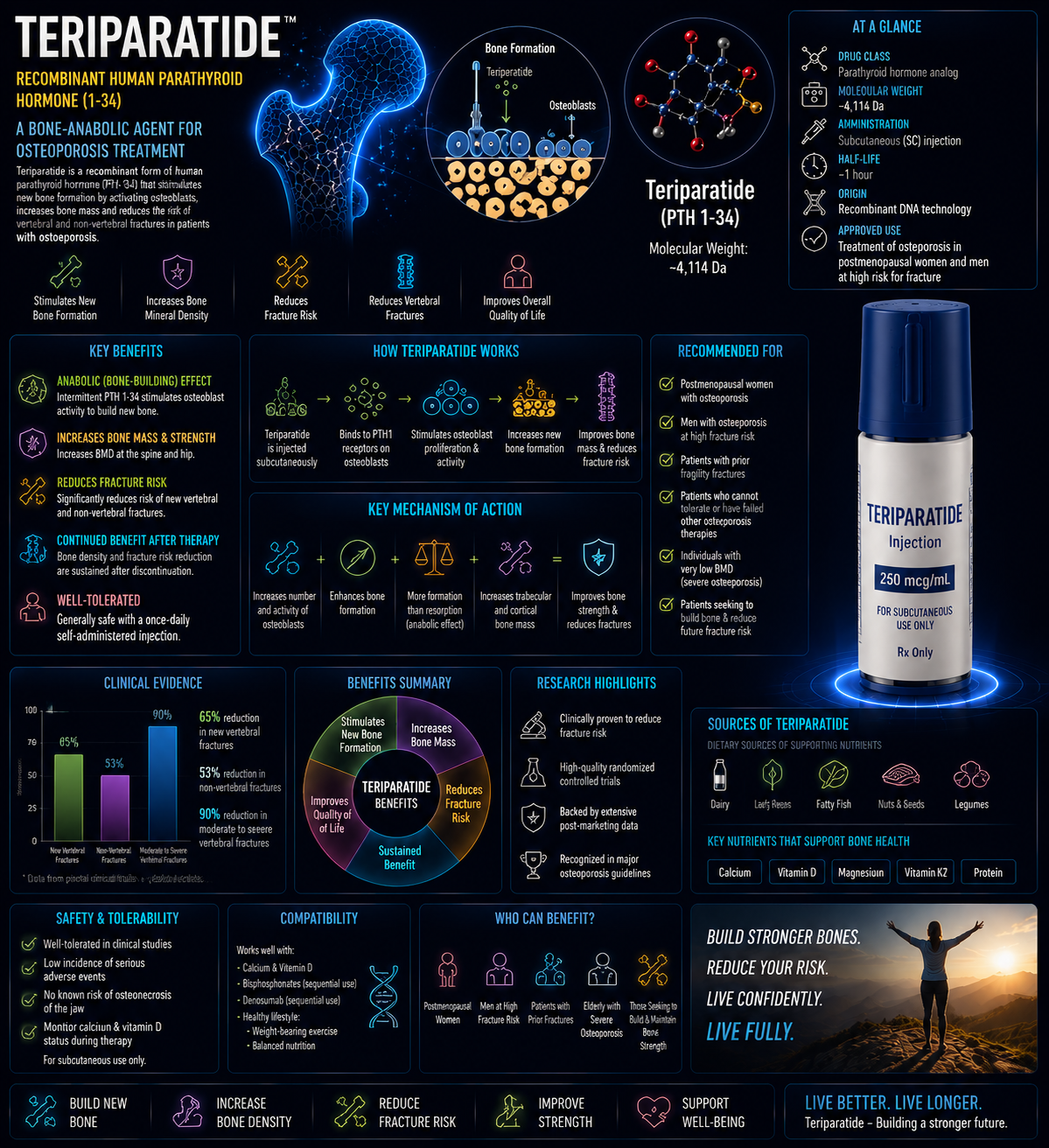
For example, Teriparatide scientific overview content should distinguish current FDA labeling from outdated duration and osteosarcoma statements. This recombinant human PTH 1–34, a prescription anabolic therapy that activates PTH1R and increases bone formation when used intermittently.
What Is Teriparatide?
First, teriparatide is a recombinant human parathyroid hormone analog consisting of the first 34 amino acids of endogenous PTH. This N-terminal region contains the receptor-binding and signaling activity of the full 84-amino-acid hormone.
Next, teriparatide is a bone-anabolic medicine. For example, unlike antiresorptive therapies that primarily slow bone breakdown, it initially increases osteoblast-mediated bone formation and can improve bone mass and microarchitecture when administered intermittently.
Current U.S. indications
- First, Treatment of postmenopausal women with osteoporosis at high risk for fracture, or who have failed or cannot tolerate other therapy
- Next, Increase of bone mass in men with primary or hypogonadal osteoporosis at high risk for fracture, or who have failed or cannot tolerate other therapy
- Also, Treatment of men and women with glucocorticoid-induced osteoporosis at high risk for fracture, or who have failed or cannot tolerate other therapy
Parathyroid hormone analog
Human PTH 1–34
PTH1R
Bone anabolism with intermittent exposure
Subcutaneous injection
20 micrograms in current labeling
🧬 Molecular Structure
First, teriparatide is a linear 34-amino-acid recombinant peptide identical to residues 1–34 of human parathyroid hormone. Meanwhile, it contains no disulfide bridges and no lipid or carbohydrate modification.
🧪 Amino-Acid Sequence
Ser-Val-Ser-Glu-Ile-Gln-Leu-Met-His-Asn-Leu-Gly-Lys-His-Leu-Asn-Ser-Met-Glu-Arg-Val-Glu-Trp-Leu-Arg-Lys-Lys-Leu-Gln-Asp-Val-His-Asn-Phe
One-letter notation:
SVSEIQLMHNLGKHLNSMERVEWLRKKLQDVHNF
⚛️ Molecular Weight and 🧫 Formula
| Molecular formula | Meanwhile, C181H291N55O51S2 |
|---|---|
| Average molecular weight | Approximately 4,117.8 Da |
| Peptide length | 34 amino acids |
| Natural reference | Likewise, N-terminal active region of human PTH 1–84 |
| Production | Recombinant DNA technology |
Structure-function regions
| Region | Functional importance |
|---|---|
| Residues 1–14 | In addition, Strongly involved in receptor activation and signaling. |
| Residues 15–34 | Moreover, Contribute high-affinity receptor binding and peptide conformation. |
| N-terminal residues | By contrast, Required for full agonist activity at PTH1R. |
📅 Development Timeline
1920s–1960s: Parathyroid hormone physiology established
First, researchers identified PTH as a central regulator of serum calcium, phosphate, kidney function, vitamin D activation, and skeletal remodeling.
1970s–1980s: Intermittent PTH shows anabolic effects
Next, preclinical studies revealed that intermittent exposure could produce net bone formation, while sustained excess PTH favored cortical resorption and hypercalcemia.
1987: Initial U.S. approval history begins
Also, Human PTH-related therapeutic development entered U.S. Likewise, regulatory history, followed by modern recombinant teriparatide development.
2002: Forteo approved for osteoporosis
Then, teriparatide became the first widely used FDA-approved anabolic osteoporosis therapy.
2009: Glucocorticoid-induced osteoporosis indication
Moreover, clinical evidence supported use in adults at high fracture risk receiving sustained systemic glucocorticoids.
2020: FDA revises the boxed warning and lifetime-limit language
Importantly, FDA-approved labeling removed the boxed warning and changed the strict lifetime duration language after long-term surveillance did not demonstrate an increased human osteosarcoma signal above background expectations.
2020s: Biosimilars and additional teriparatide products
Finally, multiple teriparatide injection products entered the U.S. In addition, market, while research continued into sequencing, re-treatment, fracture healing, dental applications, and perioperative bone health.
📖 Research History
Importantly, the key discovery behind teriparatide was the “anabolic window.” Bone-formation markers rise rapidly after intermittent treatment, while resorption markers increase later. Moreover, during the early portion of therapy, formation exceeds resorption, producing net skeletal gain.
Moreover, the pivotal fracture-prevention trial in postmenopausal osteoporosis demonstrated substantial reductions in new vertebral fractures and reductions in nonvertebral fragility fractures. By contrast, later trials established benefits in men and glucocorticoid-treated patients.
🧠 Mechanism of Action
First, teriparatide binds to parathyroid hormone receptor type 1 (PTH1R), a class B G-protein-coupled receptor expressed in osteoblast-lineage cells, kidney, and other tissues.
1. PTH1R binding
Next, the peptide’s C-terminal region supports receptor binding, while the N-terminal region activates the receptor.
2. cAMP and PKA signaling
Then, PTH1R couples strongly to Gs, activating adenylyl cyclase, increasing cAMP, and stimulating protein kinase A.
3. PLC and calcium signaling
Moreover, PTH1R can also activate Gq/11, phospholipase C, intracellular calcium, and protein kinase C pathways.
4. Osteoblast-lineage effects
In addition, intermittent signaling increases osteoblast differentiation, activity, and survival and recruits bone-lining cells into active matrix-producing cells.
5. Wnt pathway interaction
Likewise, teriparatide reduces sclerostin expression and supports Wnt/β-catenin signaling, an important pathway in bone formation.
6. Coupled osteoclast activation
Finally, it also increases RANKL and remodeling signals. Also, osteoclast activity rises later, but intermittent dosing creates an early period in which formation predominates.
🎯 Receptor and Pathway Profile
| Target or pathway | Effect |
|---|---|
| PTH1R | Consequently, Primary receptor mediating skeletal, renal, and calcium-regulatory effects. |
| Gs/cAMP/PKA | However, Major signal supporting osteoblast activity and gene transcription. |
| Gq/PLC/PKC | Additional calcium-dependent signaling. |
| Wnt/β-catenin | Therefore, Enhanced indirectly through reduced sclerostin and osteoblast signaling. |
| RANKL/OPG | For example, Controls delayed coupling to osteoclast-mediated remodeling. |
Bone and Mineral Physiology
Trabecular bone
First, teriparatide increases trabecular number, thickness, connectivity, and bone-formation surfaces, especially in the spine.
Cortical bone
Next, it stimulates periosteal and endosteal remodeling. Consequently, cortical porosity may transiently increase, but bone size, geometry, and material distribution can improve. The oversimplified statement that it always “strengthens cortical bone” requires this nuance.
Bone mineral density
Moreover, lumbar-spine BMD usually rises substantially. However, hip gains are typically smaller and slower. Distal-radius BMD can remain stable or decline because of cortical remodeling, even while overall fracture protection improves.
Calcium and phosphate
In addition, teriparatide transiently raises serum calcium, increases renal calcium reabsorption, increases phosphate excretion, and stimulates renal production of calcitriol, which can increase intestinal calcium absorption.
Bone-turnover markers
Finally, formation markers such as P1NP often rise within weeks, followed later by resorption markers such as CTX. Therefore, marker testing may help assess biological response and adherence but is not required in every patient.
Clinical Benefits and Evidence
Vertebral-fracture reduction
Likewise, teriparatide reduces the risk of new vertebral fractures in postmenopausal women with osteoporosis at high fracture risk.
Nonvertebral-fracture reduction
Next, clinical trials also demonstrate reduced nonvertebral fragility fractures. For example, evidence for hip-fracture reduction specifically is less direct because pivotal trials were not powered for that endpoint.
Men with osteoporosis
Moreover, teriparatide increases spine and hip BMD in men with primary or hypogonadal osteoporosis at high fracture risk.
Glucocorticoid-induced osteoporosis
In addition, in adults using systemic glucocorticoids, teriparatide produced larger spine-BMD gains and fewer new vertebral fractures than alendronate in a major comparative trial.
Patients after antiresorptive therapy
However, response can vary after bisphosphonates or denosumab. Meanwhile, transition directly from denosumab to teriparatide alone can cause rapid bone loss at some skeletal sites and requires careful specialist planning.
Fracture healing and nonunion
Finally, researchers frequently study teriparatide off-label for delayed union, nonunion, atypical femoral fractures, and postoperative fusion. Likewise, results are promising in some studies and case series, but systematic reviews conflict, and it is not FDA approved as a general fracture-healing drug.
Treatment Duration and Sequential Therapy
Current duration language
Importantly, current U.S. In addition, prescribing information states that treatment for more than two years during a patient’s lifetime should be considered only if the patient remains at, or has returned to, high fracture risk.
Why duration was historically limited
Next, early rodent toxicology studies showed dose- and duration-dependent osteosarcoma. Moreover, human postmarketing surveillance over many years did not identify an increased incidence above expected background rates.
After teriparatide
Moreover, bone gained during therapy can be lost after stopping. An antiresorptive medicine—often a bisphosphonate or denosumab—is commonly used afterward to preserve BMD gains, depending on the patient’s risk and treatment history.
Retreatment
Finally, clinicians may consider repeat or extended treatment for selected patients who remain at very high fracture risk, although response may be smaller and specialist oversight remains appropriate.
Safety, Contraindications, and Monitoring
Common adverse reactions
- First, Nausea
- Next, Joint pain or generalized pain
- Also, Leg cramps
- Moreover, Dizziness
- In addition, Headache
- Likewise, Injection-site reactions
Orthostatic hypotension
First, transient symptomatic orthostatic hypotension can occur after initial doses. By contrast, current labels advise initial administration under circumstances in which the patient can sit or lie down if symptoms occur.
Hypercalcemia
Next, teriparatide can transiently raise serum calcium. Also, it should be avoided in patients with pre-existing hypercalcemia or disorders such as primary hyperparathyroidism.
Urolithiasis and hypercalciuria
Moreover, use requires caution in active or recent kidney stones. Consequently, urinary calcium testing may be considered when hypercalciuria or stones are suspected.
Digoxin interaction
In addition, hypercalcemia can increase susceptibility to digitalis toxicity. However, caution is advised in patients receiving digoxin.
Osteosarcoma-risk populations
Likewise, avoid use in patients with increased baseline osteosarcoma risk, including Paget disease of bone, unexplained elevations of alkaline phosphatase, open epiphyses, prior skeletal radiation, or hereditary disorders predisposing to osteosarcoma.
Skeletal malignancy
However, clinicians should not use teriparatide in patients with bone metastases or a history of skeletal malignancy.
Renal impairment
Finally, severe kidney disease, CKD-related mineral and bone disorder, and altered calcium physiology require specialist evaluation. Therefore, osteoporosis and renal osteodystrophy are not interchangeable diagnoses.
Monitoring
Meanwhile, Clinicians may assess calcium, vitamin D status, renal function, alkaline phosphatase, urinary calcium, bone-turnover markers, and interval BMD based on individual circumstances.
🧪 Laboratory Testing Methods
| Method | Purpose | Important limitation |
|---|---|---|
| RP-HPLC or UPLC | Likewise, Assay and separation of peptide-related impurities. | In addition, Does not prove biological potency or sterility alone. |
| LC-MS / HRMS | Moreover, Confirms intact molecular mass and major variants. | By contrast, Does not fully establish higher-order structure or potency. |
| Also, Peptide mapping by LC-MS/MS | Consequently, Confirms sequence and detects substitutions or truncations. | However, Requires validated digestion and coverage. |
| Amino-acid analysis | Therefore, Supports composition and quantitative content. | For example, Does not independently prove sequence order. |
| Capillary electrophoresis | Meanwhile, Assesses charge variants and purity. | Likewise, laboratories must correlate the result with orthogonal methods. |
| In addition, Cell-based PTH1R potency assay | Moreover, Measures cAMP or another functional response. | By contrast, Assay system and reference standard affect results. |
| Binding assay | Measures PTH1R affinity. | Also, Binding does not equal full signaling potency. |
| Consequently, Aggregation and particle testing | However, Detects soluble aggregates and subvisible particles. | Therefore, One method cannot cover all particle sizes. |
| For example, Protein concentration / assay | Meanwhile, Measures actual teriparatide content. | Likewise, Must distinguish intact active peptide from related material. |
| Endotoxin and sterility | In addition, Evaluates pyrogenic endotoxin and viable microbes. | Moreover, Each answers a different safety question. |
| By contrast, pH, osmolality, and preservative assay | Also, Evaluates finished injection formulation. | Consequently, Does not prove molecular identity. |
| Stability-indicating analysis | However, Tracks oxidation, deamidation, hydrolysis, aggregation, and loss of potency. | Therefore, Must reflect actual storage and device conditions. |
📄 How to Interpret a Teriparatide COA
1. Verify the exact peptide
First, the report should state human PTH 1–34 or teriparatide and provide sequence-level identity.
2. Confirm recombinant source and reference standard
Next, manufacturing organism, purification, reference standards, and comparability are important for a recombinant peptide drug.
3. Separate identity, purity, content, and potency
- Identity First, confirms the correct sequence.
- Purity Next, measures peptide-related impurities.
- Content Also, measures the amount of teriparatide.
- Potency Moreover, measures PTH1R-mediated biological activity.
4. Review oxidation and deamidation
Moreover, methionine oxidation, asparagine or glutamine deamidation, truncation, and aggregation can reduce quality or potency.
5. Evaluate finished-product controls
In addition, a sterile multidose pen requires sterility, endotoxin, particulates, preservative content, extractables/leachables, dose-delivery accuracy, device performance, and in-use stability.
6. Do not equate research-grade powder with an approved medicine
However, a research COA cannot establish bioequivalence, device accuracy, sterility assurance, clinical safety, or interchangeability with an FDA-approved teriparatide product.
📊 Teriparatide vs Abaloparatide vs Romosozumab
Anabolic-Therapy Differences
| Feature | Teriparatide | Abaloparatide | Romosozumab |
|---|---|---|---|
| Compound type | PTH 1–34 peptide | PTH-related peptide analog | For example, Monoclonal antibody to sclerostin |
| Primary receptor/target | PTH1R | PTH1R | Sclerostin |
| Main action | Meanwhile, Stimulates formation with later coupled resorption | Likewise, Stimulates formation with a somewhat different receptor-signaling profile | In addition, Increases formation and decreases resorption early in treatment |
| Administration | Daily subcutaneous injection | Daily subcutaneous injection | Moreover, Monthly subcutaneous injections by a healthcare professional |
| Current duration guidance | By contrast, >2 years only for patients who remain or return to high risk | Also, Lifetime use beyond 2 years not recommended in current labeling | 12 monthly doses |
| Major special warning | Consequently, Osteosarcoma-risk precautions and calcium effects | However, Osteosarcoma-risk precautions and calcium effects | Therefore, Boxed warning for myocardial infarction, stroke, and cardiovascular death risk |
Teriparatide vs Bisphosphonates vs Denosumab
Anabolic Versus Antiresorptive Strategies
| Feature | Teriparatide | Bisphosphonates | Denosumab |
|---|---|---|---|
| Primary category | Anabolic | Antiresorptive | Antiresorptive monoclonal antibody |
| Target | PTH1R | For example, Osteoclast mevalonate pathway / bone mineral binding | RANKL |
| Stopping therapy | Meanwhile, Follow-on antiresorptive commonly needed | Likewise, Residual skeletal effect persists | In addition, Stopping without another therapy can cause rebound bone loss and vertebral fractures |
| Best suited for | High or very high fracture risk and anabolic-first strategies | Many first-line osteoporosis settings | Moreover, High fracture risk or intolerance/contraindications to alternatives |
🔗 Related Hormones and Therapies
- Parathyroid hormone 1–84: First, Full-length endogenous hormone and a therapeutic product in some regions.
- Abaloparatide: Next, PTHrP analog activating PTH1R.
- Palopegteriparatide: Also, A prodrug of PTH 1–34 approved for adults with hypoparathyroidism, not osteoporosis.
- Romosozumab: Moreover, Sclerostin antibody with dual formation and antiresorptive effects.
- Denosumab: In addition, RANKL antibody that strongly suppresses bone resorption.
- Bisphosphonates: Likewise, Bone-binding antiresorptive drugs.
🖼️ Original Diagram Specifications
Diagram 1: PTH 1–34 sequence map
By contrast, Show all 34 residues, highlighting the N-terminal activation region and C-terminal high-affinity binding region.
Diagram 2: Intermittent vs continuous PTH signaling
Also, Compare brief daily PTH1R activation favoring osteoblast formation with sustained hyperparathyroid exposure favoring resorption and hypercalcemia.
Diagram 3: Anabolic window
Graph formation markers rising first and resorption markers rising later, with the area between them labeled the anabolic window.
Diagram 4: PTH1R pathway
Consequently, Show Gs/cAMP/PKA, Gq/PLC/PKC, Wnt/sclerostin, osteoblast survival, RANKL, and delayed coupled remodeling.
Diagram 5: Sequential osteoporosis therapy
However, Show teriparatide building bone followed by antiresorptive therapy preserving gains. Include a warning against unsupervised denosumab-to-teriparatide transition.
Diagram 6: COA and finished-pen testing
Therefore, Show sequence identity, peptide mapping, potency, assay, impurities, aggregation, sterility, endotoxin, preservative, dose accuracy, and device testing.
❓ Frequently Asked Questions
Is teriparatide a peptide?
For example, Yes. It is a recombinant 34-amino-acid peptide identical to human PTH residues 1–34.
What is teriparatide used for?
Meanwhile, It treats selected women and men with osteoporosis at high fracture risk, including glucocorticoid-induced osteoporosis.
How does it build bone?
Likewise, Intermittent PTH1R activation increases osteoblast differentiation, activity, and survival before resorption rises, creating an anabolic window.
Does it reduce fractures?
In addition, Yes. It reduces vertebral and nonvertebral fracture risk in postmenopausal osteoporosis. Evidence for hip fracture specifically is less direct.
Is treatment strictly limited to 24 months?
Moreover, No. Current U.S. labeling allows consideration beyond two years when a patient remains at or returns to high fracture risk.
Does it cause osteosarcoma?
By contrast, High-dose lifetime exposure caused osteosarcoma in rats. Long-term human surveillance has not shown an increased incidence above background, but patients with elevated baseline risk should avoid it.
What happens after treatment?
An antiresorptive drug is commonly used afterward to preserve bone-density gains.
Can it heal fractures faster?
Also, Research is mixed. It is not FDA approved as a general fracture-healing or nonunion treatment.
Can teriparatide raise calcium?
Consequently, Yes. It can cause transient hypercalcemia and may increase urinary calcium.
Is research-grade teriparatide equivalent to Forteo or another approved product?
However, No. Approved products require validated potency, formulation, sterility, dose-delivery, device, stability, and clinical comparability controls.
Does a 99% HPLC result prove injectable safety?
Therefore, No. It does not establish potency, sterility, endotoxin safety, aggregation, particulates, preservative content, or pen-dose accuracy.
Teriparatide Scientific Overview: Final Thoughts
In conclusion, teriparatide is a clinically validated anabolic osteoporosis medicine that reproduces the biologically active N-terminal portion of human parathyroid hormone. Intermittent PTH1R activation stimulates osteoblast activity, increases spinal and hip BMD, and reduces vertebral and nonvertebral fractures in appropriately selected patients.
However, several statements commonly repeated online are outdated or oversimplified. Current U.S. labeling no longer imposes an absolute lifetime 24-month ceiling, cortical effects are more complex than simple uniform strengthening, and fracture-healing applications remain off-label with mixed evidence.
Therefore, because teriparatide is a potent prescription hormone analog, quality evaluation must include biological potency and finished-device performance—not merely peptide purity. Treatment selection, duration, sequencing, calcium management, and osteosarcoma-risk screening require clinician oversight.
📚 References
- For example, U.S. Food and Drug Administration. Teriparatide Injection Prescribing Information. 2025.
- Moreover, DailyMed. Teriparatide Injection label.
- In addition, DailyMed. Forteo prescribing information.
- However, DailyMed. Teriparatide molecular description and sequence.
- Therefore, Neer RM, et al. Effect of parathyroid hormone (1–34) on fractures and bone mineral density in postmenopausal women with osteoporosis. New England Journal of Medicine. 2001.
- Likewise, Orwoll ES, et al. The effect of teriparatide therapy in men with osteoporosis. Journal of Bone and Mineral Research. 2003.
- For example, Saag KG, et al. Teriparatide or alendronate in glucocorticoid-induced osteoporosis. New England Journal of Medicine. 2007.
- Moreover, Saag KG, et al. Effects of teriparatide versus alendronate for glucocorticoid-induced osteoporosis: 36-month results. Arthritis & Rheumatism.
- In addition, Krege JH, et al. Teriparatide and osteosarcoma risk: history, science, elimination of boxed warning, and label updates. JBMR Plus. 2022.
- However, Vall H, et al. Teriparatide. StatPearls. Updated 2024.
- Therefore, Compston J, et al. UK clinical guideline for the prevention and treatment of osteoporosis. Archives of Osteoporosis.
- Likewise, Eastell R, et al. Pharmacological management of osteoporosis in postmenopausal women: Endocrine Society guideline. Journal of Clinical Endocrinology & Metabolism.
- For example, LeBoff MS, et al. The clinician’s guide to prevention and treatment of osteoporosis. Osteoporosis International.
- Moreover, Cosman F, et al. Clinician’s guide to prevention and treatment of osteoporosis. Osteoporosis International.
- In addition, Langdahl BL, et al. Teriparatide and bone microarchitecture. Bone.
- However, Jiang Y, et al. Recombinant human parathyroid hormone (1–34) increases cancellous bone structure and connectivity in osteoporosis. Journal of Bone and Mineral Research.
- Therefore, Dempster DW, et al. Effects of daily teriparatide on bone formation and microarchitecture. Journal of Bone and Mineral Research.
- Likewise, Lindsay R, et al. Teriparatide for osteoporosis: importance of the full course. Osteoporosis International. 2016.
- For example, Leder BZ, et al. Denosumab and teriparatide transitions in postmenopausal osteoporosis: DATA-Switch study. Lancet. 2015.
- Moreover, Tsai JN, et al. Combination teriparatide and denosumab in postmenopausal osteoporosis. Lancet.
- In addition, Cosman F, et al. Romosozumab treatment in postmenopausal osteoporosis. New England Journal of Medicine.
- However, Miller PD, et al. Effect of abaloparatide versus placebo on new vertebral fractures. JAMA. 2016.
- Therefore, Jin H, et al. Comparative efficacy and safety of teriparatide versus bisphosphonates. 2025.
- Likewise, Kim SM, et al. Current role and application of teriparatide in fracture healing. 2017.
- For example, Han S, et al. Efficacy of teriparatide in improving hip-fracture healing: systematic review. 2020.
- Moreover, Yoon BH, et al. Does teriparatide improve fracture union? Systematic review. 2020.
- In addition, Lou S, et al. Effect of teriparatide on fracture healing in osteoporotic patients. 2016.
- However, Canalis E, Giustina A, Bilezikian JP. Mechanisms of anabolic therapies for osteoporosis. New England Journal of Medicine.
- Therefore, Jilka RL. Molecular and cellular mechanisms of the anabolic effect of intermittent PTH. Bone.
- Likewise, Silva BC, Bilezikian JP. Parathyroid hormone: anabolic and catabolic actions on the skeleton. Current Opinion in Pharmacology.
- Datta NS, Abou-Samra AB. PTH and PTHrP signaling in osteoblasts. Cellular Signalling.
- Wein MN, Kronenberg HM. Regulation of bone remodeling by parathyroid hormone. Cold Spring Harbor Perspectives in Medicine.
- International Council for Harmonisation. ICH Q2(R2): Validation of Analytical Procedures.
- International Council for Harmonisation. ICH Q5C: Stability Testing of Biotechnological/Biological Products.
- International Council for Harmonisation. ICH Q6B: Specifications for Biotechnological/Biological Products.
- United States Pharmacopeia. General Chapter <621>, Chromatography.
- United States Pharmacopeia. General Chapter <71>, Sterility Tests.
- United States Pharmacopeia. General Chapter <85>, Bacterial Endotoxins Test.
- United States Pharmacopeia. General Chapters <788> and <790>, Particulate Matter and Visible Particulates in Injections.
Regulatory, Clinical, and Mechanistic Sources
Comparative, Fracture-Healing, and Analytical Sources
For example, Current FDA labeling, treatment-duration language, molecular information, and safety details were reviewed in July 2026. Always consult the latest product-specific prescribing information.