Residual Moisture in freeze-dried Peptides Explained
In addition, Residual moisture in freeze-dried peptides does not mean a freeze-dried vial was made incorrectly. This guide explains why water remains, how primary and secondary drying differ, how Karl Fischer testing works, and why the lowest possible moisture level is not always best.
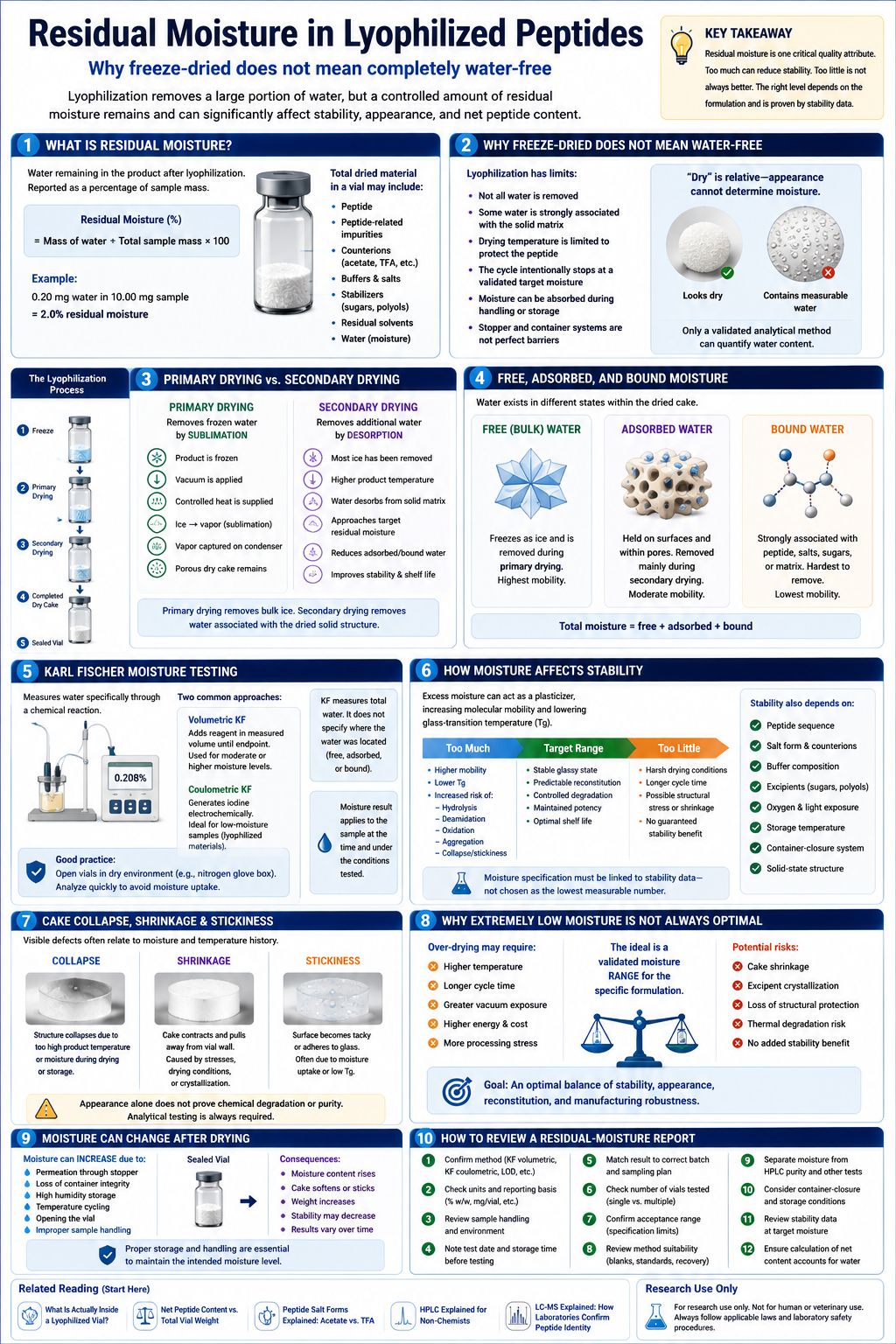
For example, Residual moisture in freeze-dried peptides is the small amount of water that remains after freeze-drying. First, frozen ice is removed during primary drying. Next, more closely held water is reduced during secondary drying. However, some water usually remains in the cake.
That remaining water can affect cake shape, storage behavior, and net vial weight. Therefore, moisture results should be read with the drying method, prepared mixture, stopper system, test date, and storage stability data.
Residual Moisture in freeze-dried Peptides: What Does It Mean?
Residual moisture is the water remaining in a material after the freeze-drying cycle has been completed.
Likewise, it is usually reported as a percentage of the sample’s mass:
For example, a dried cake containing 0.20 milligrams of measurable water in a 10.00-milligram sample would contain about 2.0% water by weight.
In addition, residual moisture is only one component of the total dried material. However, a freeze-dried vial may also contain:
- The target peptide
- Peptide-related impurities
- Counterions such as acetate or trifluoroacetate
- Buffers
- Bulking agents
- Stabilizing sugars or polyols
- Residual solvents
- Inorganic salts
Therefore, this is why gross dried weight should not automatically be interpreted as net peptide content. Moreover, water contributes measurable mass but is not part of the peptide’s amino-acid sequence.
See What Is Actually Inside a freeze-dried Vial? for a broader explanation of the materials that can contribute to vial weight.
Why Freeze-Dried Does Not Mean Completely Water-Free
freeze-drying is a controlled drying process. It greatly reduces water, but the term freeze-dried does not mean that every water molecule has been removed.
FDA describes freeze-drying as three linked stages: freezing, primary drying, and secondary drying. In addition, the agency explains that primary drying removes ice while secondary drying removes more closely held water. See the FDA freeze-drying Inspection Guide.
- Freezing
- Moreover, primary drying by direct ice-to-vapor drying
- As a result, secondary drying by release from the dried solid
During primary drying, frozen ice is removed. By contrast, during secondary drying, additional water held with the dried solid is removed. In addition, even after both stages, a controlled amount of residual moisture usually remains.
Complete water removal is difficult
Water can remain because:
- Some water is strongly held with the peptide or added ingredients.
- For example, water molecules may be trapped within an non-crystalline dried matrix.
- Therefore, the drying temperature may be limited to protect the peptide.
- The cycle may intentionally stop at a proven target moisture level.
- As a result, the vial may gain moisture during unloading, storage, or testing.
- Likewise, the stopper and container system may allow gradual moisture transfer.
“Dry” is a relative description
A powder may look dry, flow like a dry solid, and contain no visible liquid while still containing measurable residual water.
In addition, appearance cannot determine whether the material contains:
- 0.5% moisture
- 2% moisture
- 5% moisture
- Another prepared mixture-specific amount
However, a proven lab method is required to measure the water content.
Primary Drying vs. Secondary Drying
The two drying stages remove water by different physical ways.
Primary Drying
Removes frozen water primarily through direct ice-to-vapor drying.
- Moreover, the prepared mixture has already been frozen.
- Next, chamber pressure is reduced.
- Meanwhile, heat is supplied with care.
- As a result, ice changes directly into water vapor.
- Likewise, the vapor travels to the condenser.
Secondary Drying
Removes additional water primarily through release from the dried solid.
- By secondary drying, most visible ice has already been removed.
- However, shelf and product temperatures are usually increased.
- For example, water held with the dried matrix is released.
- Finally, the product approaches its target moisture level.
Moreover, fDA’s inspection guide identifies primary drying as the direct ice-to-vapor drying stage and secondary drying as the release from the dried solid stage. As a result, scientific reviews similarly describe secondary drying as the step used to remove water adsorbed to the dried product structure.
What happens during primary drying?
Once the product is frozen, the chamber pressure is lowered. By contrast, controlled heat is supplied so that the ice can sublime without melting the product.
In addition, water exists mainly as ice within the frozen matrix.
The chamber pressure is reduced below air pressure.
Ice changes directly into vapor.
For example, a dry-looking structure is left behind as ice channels empty.
Therefore, primary drying is often the longest portion of the cycle because vapor must travel through the progressively thicker dried layer. Heat and mass transfer through the vial, product, stopper opening, chamber, and condenser all affect the process.
What happens during secondary drying?
As a result, at the end of primary drying, visible or bulk ice may be gone, but the cake can still contain water held with the solid matrix.
Likewise, secondary drying typically uses a higher product temperature, under vacuum, to promote release from the dried solid of this remaining water.
The target is not necessarily the lowest moisture level the equipment can achieve. In addition, the target is a moisture range demonstrated to support the prepared mixture’s required quality and storage stability.
Ending primary drying does not mean the product has reached final moisture
However, primary drying primarily removes ice. Secondary drying is normally required to reduce adsorbed or more strongly held water to the prepared mixture’s target level.
Free Moisture vs. Bound Moisture
Therefore, water in a freeze-dried prepared mixture does not exist in only one physical state.
Moreover, Terms such as free water, adsorbed water, and bound water are used to describe water with different degrees of association with the product.
Free or bulk water
Water that freezes as ice and is primarily removed during primary drying.
Adsorbed water
Likewise, water held on surfaces or within the dried matrix and removed mainly during secondary drying.
Bound water
By contrast, water interacting closely with peptide groups, salts, sugars, or other prepared mixture components.
Free water
Free or bulk water usually has fairly high molecule movement. However, in a frozen product, much of this water forms ice that can be removed by direct ice-to-vapor drying.
Adsorbed water
For example, adsorbed water may remain on the surfaces of pores and solids after ice is removed. This water requires additional energy and time to desorb during secondary drying.
Bound water
Moreover, bound water interacts more strongly with water-attracting groups in the prepared mixture. As a result, it may participate in hydrogen bonding or remain trapped within an non-crystalline glassy matrix.
Removing strongly held water can require higher temperatures or longer secondary drying. By contrast, those conditions may not be suitable for every peptide or prepared mixture.
In addition, Primary drying removes most frozen water.
Secondary drying reduces water held with the dried solid.
For example, Some remaining water can be strongly held and prepared mixture-dependent.
Water content is not the same as water activity
Therefore, water content measures how much water is present. Water activity describes how available or mobile that water is in relation to the surrounding environment.
As a result, two prepared mixtures can contain the same total percentage of water while holding that water differently because of differences in peptide, salt, buffer, sugar, and solid-state structure.
Likewise, modern storage stability research increasingly evaluates residual water together with glass-transition behavior and water activity rather than relying only on a single moisture percentage.
What Is Karl Fischer Testing?
Karl Fischer water test is a widely used lab technique for measuring water content.
In addition, unlike a simple drying test that records total weight loss, Karl Fischer testing uses a chemical reaction that is designed to respond directly to water.
Karl Fischer water test
However, measures water through a defined chemical reaction using a calibrated water test system.
Loss on drying
Measures weight lost under defined heating or vacuum conditions, which may include water and other volatile substances.
USP describes Karl Fischer water test as a water-specific test and stresses that the test setup must suit the sample. For further background, see the USP Karl Fischer training overview.
volume-based versus electric-charge-based Karl Fischer
| Method | General principle | Typical application |
|---|---|---|
| volume-based Karl Fischer | A prepared reagent is added in measured volume until the water reaction reaches its endpoint. | Likewise, often used for samples containing moderate or fairly larger quantities of water. |
| electric-charge-based Karl Fischer | By contrast, iodine is generated electrochemically, and the electrical charge required to react with the water is measured. | Frequently used for low-moisture samples such as freeze-dried materials. |
USP has also described low-level moisture testing of synthetic peptide standards by electric-charge-based Karl Fischer water test. Moreover, those samples were opened under dry nitrogen to reduce moisture pickup from room air. See the USP synthetic peptide reference-standard report.
Why sample handling matters
Moreover, a dried cake can absorb moisture from the air. As a result, testing errors can occur if:
- For example, the vial may remain open before testing.
- By contrast, the sample is handled in humid laboratory air.
- In addition, wet tools or containers are used.
- In addition, the sample may not release its water fully.
- For example, side reactions interfere with the Karl Fischer chemistry.
- The blank correction is unsuitable.
- Therefore, the sample amount is too small for the method’s sensitivity.
Karl Fischer does not identify where the water was located
The result reports the total water detected by the method. As a result, it does not necessarily distinguish:
- Likewise, water weakly adsorbed to the cake
- Water strongly held with peptide or added ingredients
- Water gained after freeze-drying
- In addition, water present at the exact moment the cycle ended
However, reading therefore requires knowledge of sampling, storage, container closure, and lab timing.
How Residual Moisture Can Affect storage stability
One purpose of freeze-drying is to reduce molecule movement and slow breakdown reactions that occur more readily in solution.
Therefore, excess moisture can act as a softening agent within an non-crystalline dried matrix. Moreover, in practical terms, it can increase molecular movement and lower the glass-transition temperature of the prepared mixture.
Increased molecule movement may accelerate certain forms of:
- Hydrolysis
- a small chemical change
- oxygen-related change under suitable conditions
- clumping
- Excipent crystal formation
- Peptide–added ingredient reactions
- Physical collapse during storage
Likewise, studies of freeze-dried proteins report that elevated residual moisture can increase chemical breakdown by increasing mobility and allowing water to participate in reactions.
Moisture can lower the glass-transition temperature
By contrast, many freeze-dried prepared mixtures contain an non-crystalline glassy matrix. Below its glass-transition temperature, molecular movement is limited. However, as temperature or moisture increases, the matrix can become more mobile and rubber-like.
For example, this increased mobility can make the product more vulnerable to:
- Cake deformation
- Stickiness
- crystal formation
- Faster chemical breakdown
- Changes in mixing back into solution behavior
Moreover, research on freeze-dried sucrose systems shows that storage above the relevant glass-transition region can contribute to collapse or shrinkage and may be accompanied by crystal formation.
Moisture is not the only storage stability variable
storage stability also depends on:
- Peptide sequence and chemical liabilities
- Salt form and counterions
- Buffer composition
- As a result, presence of stabilizers or bulking agents
- Oxygen exposure
- Light exposure
- Storage temperature
- Container-closure integrity
- Solid-state structure
A moisture percentage is not a complete storage stability test
A low residual-moisture result does not by itself establish chemical identity, purity, potency, sterility, endotoxin status, or long-term storage stability.
Cake Collapse, Shrinkage, and Stickiness
The solid material remaining after freeze-drying is often called the cake.
In addition, an ideal cake is often described as:
- Uniform
- Porous
- physically intact
- Separated cleanly from the vial wall where suitable
- For example, capable of predictable mixing back into solution
Therefore, real freeze-dried cakes can display many visual forms. Appearance provides useful process information, but it does not independently establish peptide quality.
Collapse
As a result, the porous structure loses shape because the product becomes too mobile during drying or storage.
Shrinkage
Likewise, the cake contracts and may pull away from the vial wall or become noticeably smaller.
Stickiness
The material becomes tacky, adheres to glass, or loses its dry and porous appearance.
What causes collapse?
In addition, collapse can occur when the product temperature becomes too high relative to the prepared mixture’s collapse temperature during primary drying.
Potential contributing factors include:
- Excessive shelf temperature
- Insufficient chamber vacuum control
- prepared mixture composition
- High fill depth
- Inadequate freezing behavior
- Product-temperature variation across the dryer
- Moisture uptake during storage
However, prepared mixtures containing non-crystalline sugars are often characterized using collapse temperature and glass-transition measurements because these temperatures mark conditions where molecule movement rises sharply.
What causes shrinkage?
Shrinkage may occur during freezing, primary drying, secondary drying, or storage. Therefore, it can be influenced by:
- Shelf-temperature profile
- Product-temperature history
- Solid concentration
- Degree of crystal formation
- Surface tension and mechanical stresses
- Drying rate
Moreover, experimental work has directly examined how primary- and secondary-drying temperatures influence cake shrinkage.
What causes stickiness?
Stickiness often indicates increased mobility within the dried matrix. Likewise, possible causes include:
- High residual moisture
- By contrast, storage above the prepared mixture’s glass-transition temperature
- Moisture entering through the closure system
- moisture-absorbing added ingredients or salts
- However, partial melting or collapse during drying
Does a collapsed cake always mean the peptide is degraded?
For example, no. A collapsed or unattractive cake is a process and physical-quality concern, but appearance alone does not prove chemical breakdown.
Moreover, published studies have found cases in which collapsed cakes had comparable residual moisture, mixing back into solution, and protein storage stability to noncollapsed cakes. As a result, other studies show that collapse during later storage may be held with different risks. The effect is prepared mixture- and process-dependent.
By contrast, a visually imperfect cake is not automatically chemically defective.
In addition, a visually attractive cake is not automatically chemically pure, correctly filled, or stable.
Why Extremely Low Moisture Is Not Automatically Optimal
It is tempting to assume that less water is always better. For example, for freeze-dried prepared mixtures, that assumption can be too simplistic.
Therefore, the ideal moisture level is prepared mixture-specific. It should be established using storage stability data rather than selected only because it is the smallest measurable number.
Some residual water may support the desired solid structure
As a result, small amounts of water can influence:
- Hydrogen-bonding networks
- Protein or peptide conformation
- Interactions with stabilizing sugars
- Mechanical properties of the cake
- mixing back into solution behavior
- Resistance to processing stress
Likewise, the relationship between moisture and physical storage stability is not always linear. Scientific studies have reported prepared mixture-dependent and sometimes not simply higher or lower relationships between residual moisture and clumping or other storage stability outcomes.
Overdrying can require harsher processing
In addition, driving moisture to an very low level may require:
- Higher secondary-drying temperature
- Longer exposure to vacuum
- Longer manufacturing time
- Additional heat stress
- Higher process cost
However, those conditions may increase the risk of:
- Cake shrinkage
- Excipent crystal formation
- Loss of structural protection
- Chemical breakdown in heat-sensitive molecules
- Reduced process speed and cost
Secondary drying must therefore balance moisture removal against temperature exposure, cycle time, prepared mixture properties, and storage stability. Therefore, scientific process-development guidance describes secondary drying as a controlled step intended to reach a target residual-water level rather than an undefined absolute minimum.
The target is a proven moisture range
- Higher molecule movement
- Lower glass-transition temperature
- Greater risk of hydrolysis
- Potential stickiness or collapse
- Stable solid state
- Acceptable cake structure
- Predictable mixing back into solution
- Controlled breakdown rate
- Longer heat exposure
- Possible structural stress
- Unnecessary cycle time
- No guaranteed storage stability benefit
Residual Moisture Can Change After freeze-drying
Moreover, the moisture level measured after manufacturing may not remain constant throughout storage.
Water can enter or redistribute because of:
- Moisture movement through the stopper
- Loss of container-closure integrity
- Repeated temperature cycling
- Humid storage conditions
- Opening the vial
- Transfer to another container
- Improper laboratory sample handling
- Likewise, moisture exchange between components within the cake
The stopper matters
By contrast, vial stoppers and seals are designed to protect the vial, but container systems are not necessarily perfect barriers under every condition.
Moisture transmission can be influenced by:
- Stopper prepared mixture
- Stopper thickness
- Crimp quality
- Storage humidity
- Storage temperature
- Length of storage
- Vial shape
However, container and closure selection is therefore part of freeze-dried-product development, alongside heat transfer, mass transfer, and drying-cycle design.
Opening a vial changes the environment
For example, once a vial is opened, the cake can begin interacting with room-air humidity.
A moisture-absorbing material may absorb enough moisture to:
- Become softer
- Appear sticky
- Cling to the vial wall
- Change weight
- Moreover, produce a different moisture result than the sealed vial
A moisture result applies to the tested sample and condition
As a result, it should not automatically be assumed that every vial in a batch, every storage condition, or every later time point has exactly the same moisture level.
Residual Moisture vs. Other Common Test Results
| Test | What it measures | What it does not automatically prove |
|---|---|---|
| Residual moisture | Water detected in the sample by the stated method | By contrast, peptide identity, purity, or vial content |
| HPLC purity | In addition, relative area assigned to included chromatographic peaks | Water, total peptide quantity, sterility, or counterion content |
| LC-MS identity | For example, whether a detected component has the expected mass characteristics | Therefore, absolute vial content or residual moisture |
| Net peptide content | Peptide quantity after the report’s stated corrections | As a result, storage stability throughout the product’s entire storage period |
| Visual cake inspection | Likewise, physical appearance and obvious structural defects | Chemical purity, correct sequence, or exact moisture percentage |
| storage stability study | In addition, changes in selected quality quality features over time and conditions | However, every possible breakdown pathway unless directly tested |
Residual moisture should therefore be interpreted as one quality quality feature within a larger lab package.
How to Review a Residual-Moisture Report
Identify the method
Therefore, determine whether the result came from electric-charge-based Karl Fischer, volume-based Karl Fischer, loss on drying, or another method.
Check the reporting basis
Moreover, look for percent by weight, µg per vial, milligrams per vial, or another clearly stated unit.
Review sample handling
Determine how the vial was opened, transferred, and protected from air moisture.
Check the test date
Likewise, moisture measured immediately after production may differ from moisture measured after extended storage.
Match the batch
By contrast, confirm that the tested vial belongs to the batch being represented.
Review the sample count
A single vial may not describe the complete moisture spread across a batch.
Find the acceptance range
However, the report should state the prepared mixture-specific limit rather than merely calling the result low or acceptable.
Check method suitability
For example, the laboratory should show that the sample releases its water and does not interfere with the water test.
Separate moisture from purity
Residual water should not be treated as a peptide-related HPLC impurity unless the method was directly designed that way.
Check the container system
Moreover, stopper, seal, storage humidity, and closure integrity can influence moisture during storage.
Review storage stability data
As a result, a moisture limit should ideally be linked to demonstrated chemical and physical storage stability.
Avoid assuming lower is always better
The relevant question is whether the result falls within the proven target range for that prepared mixture.
Red Flags in Residual-Moisture Claims
Testing and Reporting Red Flags
- “Freeze-dried means no water.” freeze-drying reduces water but does not ordinarily produce absolute zero moisture.
- In addition, “The vial is dry because the cake looks dry.” Visual appearance cannot measure residual moisture.
- “The lowest moisture result is always the best result.” Optimal moisture is prepared mixture-specific and should be supported by storage stability data.
- For example, No moisture-testing method is listed. Karl Fischer and loss on drying do not necessarily measure exactly the same thing.
- Moreover, The sample was exposed to open air before testing. Moisture uptake can bias low-level measurements.
Cake and Storage Red Flags
- Likewise, One vial is presented as proof of an entire batch. Vial position, closure variation, and batch spread may matter.
- In addition, A collapsed cake is automatically declared degraded. Appearance alone does not establish chemical breakdown.
- For example, An attractive cake is automatically declared stable. Chemical changes can occur without obvious visual defects.
- Moreover, Residual moisture is treated as part of HPLC impurity percentage. Water usually requires a separate test.
- Likewise, No storage condition or test date is reported. Moisture may change after manufacturing.
Frequently Asked Questions About Residual Moisture
Drying and Water Basics
Does freeze-dried mean completely water-free?
No. However, freeze-drying removes most water through direct ice-to-vapor drying and release from the dried solid, but a controlled amount of residual moisture ordinarily remains.
What is the difference between primary and secondary drying?
For example, primary drying removes frozen ice through direct ice-to-vapor drying. Secondary drying removes additional water held with the dried solid through release from the dried solid.
What is bound moisture?
Moreover, bound moisture is water that interacts fairly strongly with the peptide, added ingredients, salts, or dried matrix. As a result, it is usually more difficult to remove than bulk ice.
How is residual moisture measured?
Karl Fischer water test is often used because it is designed to measure water directly. By contrast, other methods may include loss on drying or specialized moisture-analysis techniques.
Stability and Cake Appearance
Does HPLC purity measure water?
In addition, ordinary peptide HPLC purity usually does not measure residual water. Water normally requires a separate lab method.
Can residual moisture affect peptide storage stability?
For example, yes. Therefore, excess moisture can increase molecule movement, lower glass-transition temperature, and accelerate certain chemical or physical changes. The effect depends on the prepared mixture.
Does a collapsed cake mean the peptide is unusable?
As a result, not automatically. Likewise, collapse is an important physical and process observation, but chemical identity, purity, content, and storage stability require lab testing.
Why does a freeze-dried cake shrink?
Shrinkage can result from drying stresses, temperature history, prepared mixture composition, crystal formation, product concentration, or moisture-related changes.
Target Moisture and Vial Weight
Why does a dried cake become sticky?
In addition, stickiness can result from moisture uptake, elevated storage temperature, a low glass-transition temperature, moisture-absorbing ingredients, or partial structural collapse.
Is 0% moisture always the ideal limit?
However, no. The ideal moisture level should be established for the specific prepared mixture. Therefore, extremely aggressive drying may provide no additional storage stability benefit and may increase processing stress.
Can moisture increase after the vial is sealed?
Moreover, yes. Moisture can enter gradually through the closure system or increase after loss of container integrity, humid storage, temperature cycling, or opening.
Does residual moisture add to total vial weight?
Likewise, yes. By contrast, water contributes to gross dried-material weight and should be considered when calculating net peptide content or free-peptide equivalent.
Residual Moisture in freeze-dried Peptides: Water-Reduced, Not Water-Free
freeze-drying removes water in two major drying stages:
- However, primary drying removes frozen ice through direct ice-to-vapor drying.
- For example, secondary drying removes additional held water through release from the dried solid.
A controlled amount of residual moisture often remains because some water is adsorbed, trapped, or bound within the dried prepared mixture.
That moisture can influence:
- molecule movement
- Glass-transition temperature
- Chemical-breakdown rates
- Cake collapse and shrinkage
- Stickiness
- mixing back into solution behavior
- Net peptide content calculations
However, the correct target is not automatically the lowest number a laboratory can produce. As a result, the suitable residual-moisture range depends on the peptide, added ingredients, salt form, solid-state structure, drying cycle, container system, and demonstrated storage stability.
A trustworthy report should clearly identify:
- The testing method
- The units and reporting basis
- The sample-handling conditions
- By contrast, the batch and vial sampling plan
- The acceptance range
- In addition, the connection between moisture and storage stability data
Residual moisture is an important quality quality feature, but it must be interpreted together with identity, purity, quantity, counterion content, cake appearance, and storage stability.